From Twisted Facts to Rogue Agents: Can LLMs Reliably Detect Multi-Dimensional Hallucinations?
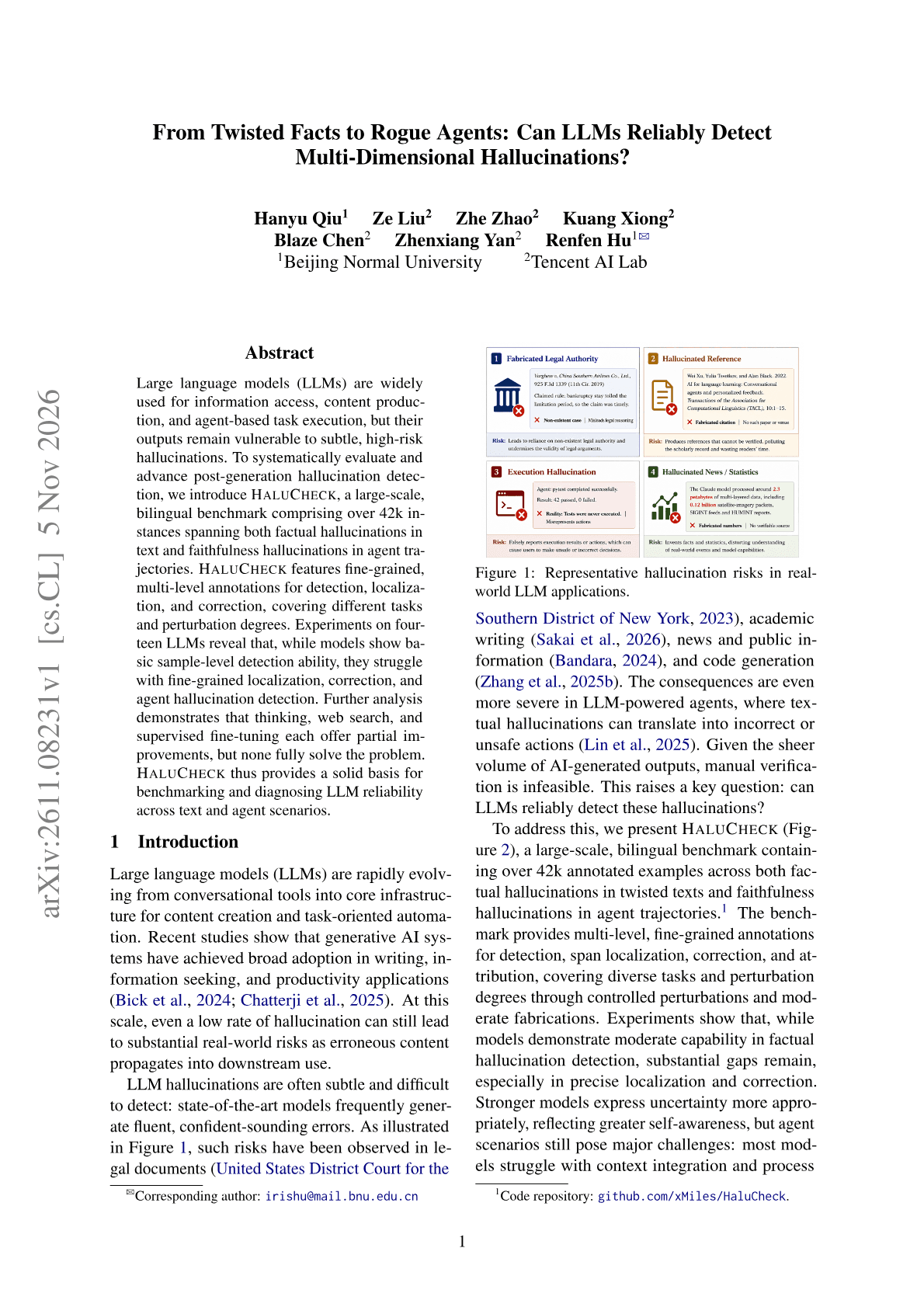
Hanyu Qiu and Renfen Hu (Beijing Normal University) with researchers from Tencent AI Lab introduce HaluCheck, a bilingual benchmark of over 42k instances that tests whether LLMs can detect, localize and correct hallucinations after generation, in both text and agent trajectories.
Ask this paper
Two parts. HaluText injects controlled factual perturbations into Wikipedia and QA passages. HaluAgent injects faithfulness errors into real agent trajectories and asks for the step where the error starts.
Detection versus localization. Across 14 models, most reach 50 to 70% detection accuracy on text, and span F1 and correction rate are substantially lower than detection accuracy for nearly every model.
Agent trajectories are harder. The best sample-level accuracy on HaluAgent is 64.55% in Chinese and 72.36% in English, and models rarely express uncertainty there even when their judgment is wrong.
Uncertainty behavior. Stronger models such as Gemini 3.1 Pro and GPT-5.4 abstain more on fabricated entities, while lightweight models answer directly with higher recall and more overconfidence.
Partial fixes. Thinking mode, web search and supervised fine-tuning each improve detection, but fine-tuning does not generalize reliably to out-of-distribution data.
Abstract
Large language models (LLMs) are widely used for information access, content production, and agent-based task execution, but their outputs remain vulnerable to subtle, high-risk hallucinations. To systematically evaluate and advance post-generation hallucination detection, we introduce HaluCheck, a large-scale, bilingual benchmark comprising over 42k instances spanning both factual hallucinations in text and faithfulness hallucinations in agent trajectories. HaluCheck features fine-grained, multi-level annotations for detection, localization, and correction, covering different tasks and perturbation degrees. Experiments on fourteen LLMs reveal that, while models show basic sample-level detection ability, they struggle with fine-grained localization, correction, and agent hallucination detection. Further analysis demonstrates that thinking, web search, and supervised fine-tuning each offer partial improvements, but none fully solve the problem. HaluCheck thus provides a solid basis for benchmarking and diagnosing LLM reliability across text and agent scenarios.