FrontierPhysics: Evaluating Agents for End-to-End Physics Research
Bingran You, Hartmut Haeffner and 70 co-authors from BenchFlow, UC Berkeley, Caltech, Harvard, Stanford and other institutions build FrontierPhysics, an end-to-end physics research benchmark written by working physicists from their own research.
Ask this paper
Tasks. 56 tasks from 42 physicists cover nine domains across theoretical, computational and experimental physics. Each requires a literature review, a research plan, the research itself and a manuscript.
Grading. Deterministic verifiers check correctness and expert-written rubrics judge whether the result is publishable.
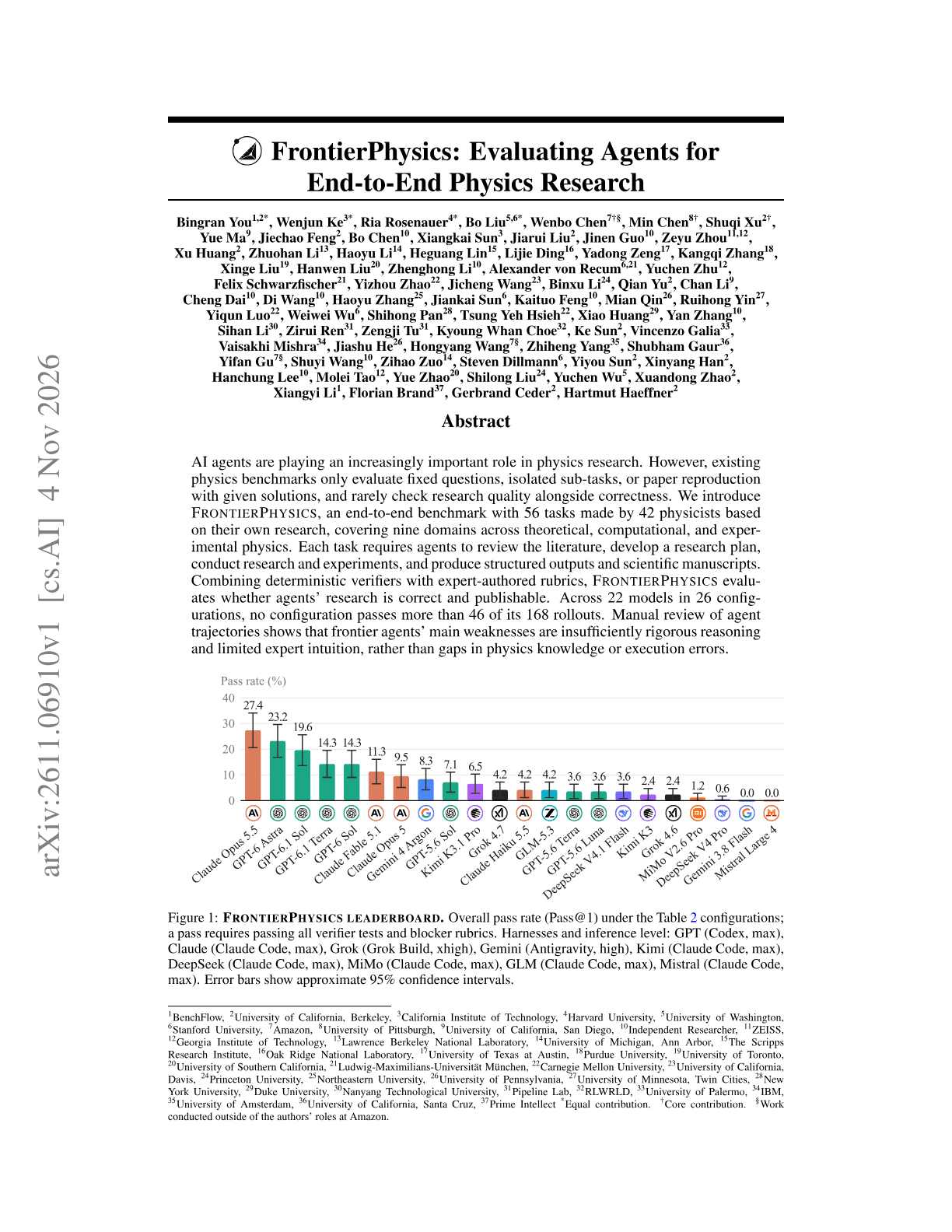
Results. Across 22 models in 26 configurations, the best (Opus 5.5 in Claude Code CLI) passes 46 of its 168 rollouts.
Failure analysis. Experts manually labeled 168 trajectories. The main weaknesses are lack of rigor, such as circular self-verification, and missing expert intuition, rather than missing physics knowledge or execution errors.
Direction. The authors argue for more open-ended tasks and evaluation that credits exploratory reasoning and partial progress.
Abstract
AI agents are playing an increasingly important role in physics research. However, existing physics benchmarks only evaluate fixed questions, isolated sub-tasks, or paper reproduction with given solutions, and rarely check research quality alongside correctness. We introduce FrontierPhysics, an end-to-end benchmark with 56 tasks made by 42 physicists based on their own research, covering nine domains across theoretical, computational, and experimental physics. Each task requires agents to review the literature, develop a research plan, conduct research and experiments, and produce structured outputs and scientific manuscripts. Combining deterministic verifiers with expert-authored rubrics, FrontierPhysics evaluates whether agents' research is correct and publishable. Across 22 models in 26 configurations, no configuration passes more than 46 of its 168 rollouts. Manual review of agent trajectories shows that frontier agents' main weaknesses are insufficiently rigorous reasoning and limited expert intuition, rather than gaps in physics knowledge or execution errors.