GAP
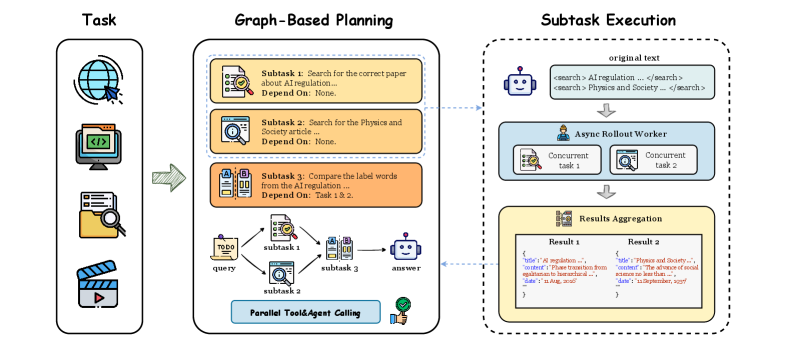
GAP introduces graph-based agent planning with parallel tool execution and reinforcement learning, enabling AI agents to coordinate multiple specialized capabilities simultaneously rather than sequentially. The framework significantly accelerates task completion and improves success rates on complex multi-step problems through optimized tool selection and execution ordering. - **Parallel tool execution breakthrough**: Unlike sequential approaches that execute one tool at a time, GAP enables simultaneous execution of independent tools. This fundamental shift dramatically accelerates task completion for complex problems requiring multiple information sources or capabilities, addressing a key bottleneck in current agent architectures. - **Graph-based task representation**: Models task structure and tool dependencies as a graph, enabling systematic optimization of execution paths. This representation explicitly captures which operations can run in parallel versus those requiring sequential ordering, allowing the system to maximize concurrency while respecting constraints. - **RL-driven planning optimization**: Integrates reinforcement learning to improve decision-making about which tools to invoke and their execution order over time. The system learns from experience to select optimal tool combinations and scheduling strategies, continuously refining its planning capabilities on specific task types. - **Efficiency gains in multi-step reasoning**: Demonstrates substantial improvements in both speed and success rates on complex reasoning tasks requiring multiple information sources. The parallel coordination of search, retrieval, and reasoning capabilities enables more efficient handling of intricate real-world problems. - **Practical applications for autonomous systems**: The framework directly benefits web-based agents, question-answering systems, and any domain requiring coordination of multiple specialized capabilities. By enabling efficient parallel tool use, GAP makes autonomous agents more capable at handling complex workflows that previously required extensive sequential processing.
Ask this paper
Parallel tool execution breakthrough: Unlike sequential approaches that execute one tool at a time, GAP enables simultaneous execution of independent tools. This fundamental shift dramatically accelerates task completion for complex problems requiring multiple information sources or capabilities, addressing a key bottleneck in current agent architectures.
Graph-based task representation: Models task structure and tool dependencies as a graph, enabling systematic optimization of execution paths. This representation explicitly captures which operations can run in parallel versus those requiring sequential ordering, allowing the system to maximize concurrency while respecting constraints.
RL-driven planning optimization: Integrates reinforcement learning to improve decision-making about which tools to invoke and their execution order over time. The system learns from experience to select optimal tool combinations and scheduling strategies, continuously refining its planning capabilities on specific task types.
Efficiency gains in multi-step reasoning: Demonstrates substantial improvements in both speed and success rates on complex reasoning tasks requiring multiple information sources. The parallel coordination of search, retrieval, and reasoning capabilities enables more efficient handling of intricate real-world problems.
Practical applications for autonomous systems: The framework directly benefits web-based agents, question-answering systems, and any domain requiring coordination of multiple specialized capabilities. By enabling efficient parallel tool use, GAP makes autonomous agents more capable at handling complex workflows that previously required extensive sequential processing.
Abstract
Autonomous agents powered by large language models (LLMs) have shown impressive capabilities in tool manipulation for complex task-solving. However, existing paradigms such as ReAct rely on sequential reasoning and execution, failing to exploit the inherent parallelism among independent sub-tasks. This sequential bottleneck leads to inefficient tool utilization and suboptimal performance in multi-step reasoning scenarios. We introduce Graph-based Agent Planning (GAP), a novel framework that explicitly models inter-task dependencies through graph-based planning to enable adaptive parallel and serial tool execution. Our approach trains agent foundation models to decompose complex tasks into dependency-aware sub-task graphs, autonomously determining which tools can be executed in parallel and which must follow sequential dependencies. This dependency-aware orchestration achieves substantial improvements in both execution efficiency and task accuracy. To train GAP, we construct a high-quality dataset of graph-based planning traces derived from the Multi-Hop Question Answering (MHQA) benchmark. We employ a two-stage training strategy: supervised fine-tuning (SFT) on the curated dataset, followed by reinforcement learning (RL) with a correctness-based reward function on strategically sampled queries where tool-based reasoning provides maximum value. Experimental results on MHQA datasets demonstrate that GAP significantly outperforms traditional ReAct baselines, particularly on multi-step retrieval tasks, while achieving dramatic improvements in tool invocation efficiency through intelligent parallelization. The project page is available at: this https URL.