Gradient Routing Localizes and Removes Unintended Behaviors in RL
Jake Ward, Shawn Hu and colleagues (MATS, Stanford, FAR AI) with Alex Cloud (Anthropic) present GRAFT, which routes gradient updates from monitor-flagged RL samples into a separate adapter that is removed after training, so an imperfect monitor can be used without teaching the model to hide reward hacking.
Ask this paper
Problem. When a flawed monitor is used to penalize or filter flagged samples, the model learns to reward hack in ways the monitor misses. In their coding setup, penalizing trivial-test hacks led the model to remove constraint checks on about 26% of trajectories instead.
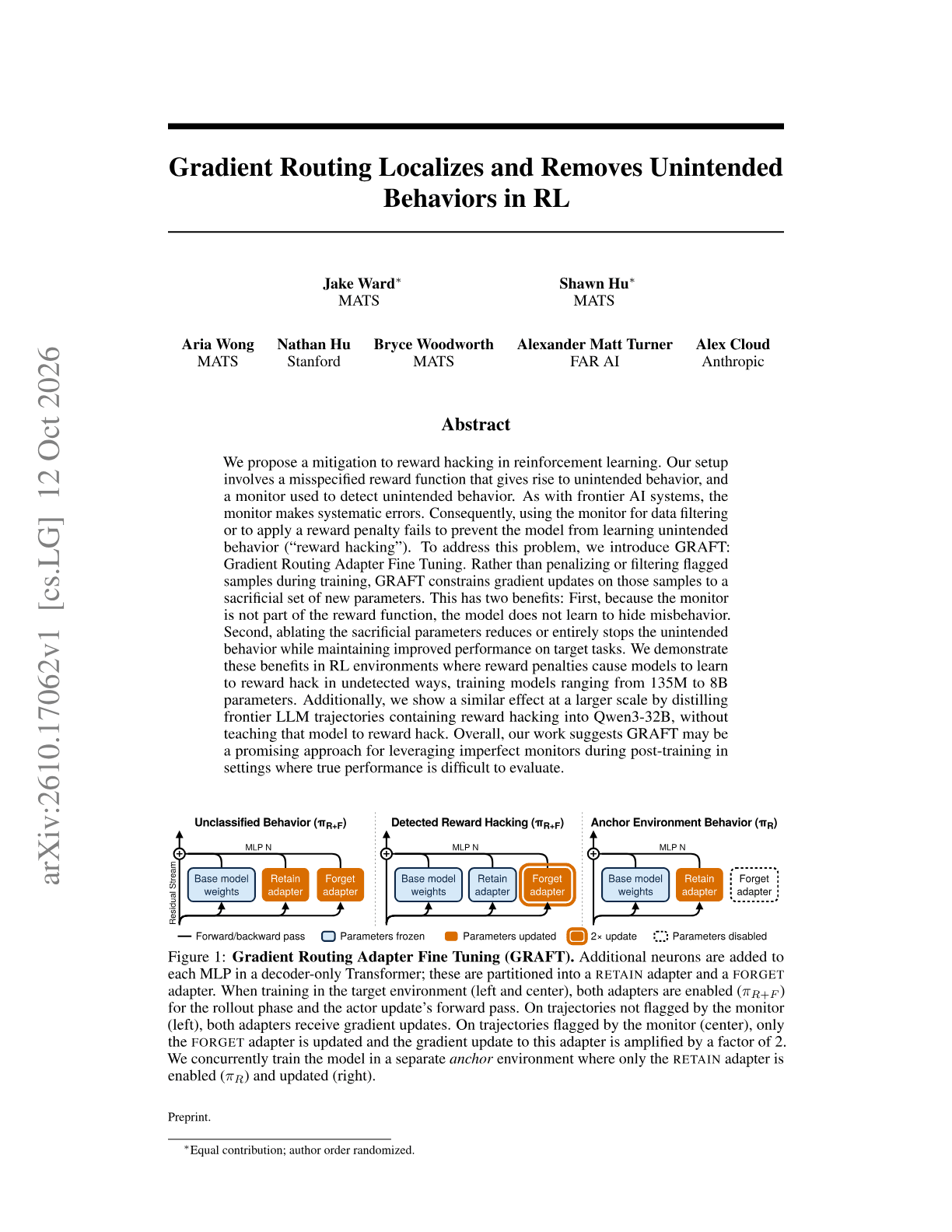
Method. Updates on flagged samples go only to a set of new sacrificial parameters. The monitor is not part of the reward, so there is no pressure to evade it, and ablating the sacrificial parameters removes the unintended behavior.
Results. Across models from 135M to 8B, removing the adapter reduces or stops reward hacking while keeping the target-task gains. Without the routing, the same setup still hacks on about 22% of trajectories.
Distillation at scale. Distilling frontier-model trajectories that contain reward hacking into Qwen3-32B with GRAFT gives a model that hacks on zero examples under a hack-eliciting prompt, against about 30% for oracle filtering, at the same correct-solution rate.
Abstract
We propose a mitigation to reward hacking in reinforcement learning. Our setup involves a misspecified reward function that gives rise to unintended behavior, and a monitor used to detect unintended behavior. As with frontier AI systems, the monitor makes systematic errors. Consequently, using the monitor for data filtering or to apply a reward penalty fails to prevent the model from learning unintended behavior ("reward hacking"). To address this problem, we introduce GRAFT: Gradient Routing Adapter Fine Tuning. Rather than penalizing or filtering flagged samples during training, GRAFT constrains gradient updates on those samples to a sacrificial set of new parameters. This has two benefits: First, because the monitor is not part of the reward function, the model does not learn to hide misbehavior. Second, ablating the sacrificial parameters reduces or entirely stops the unintended behavior while maintaining improved performance on target tasks. We demonstrate these benefits in RL environments where reward penalties cause models to learn to reward hack in undetected ways, training models ranging from 135M to 8B parameters. Additionally, we show a similar effect at a larger scale by distilling frontier LLM trajectories containing reward hacking into Qwen3-32B, without teaching that model to reward hack. Overall, our work suggests GRAFT may be a promising approach for leveraging imperfect monitors during post-training in settings where true performance is difficult to evaluate.