GRIT
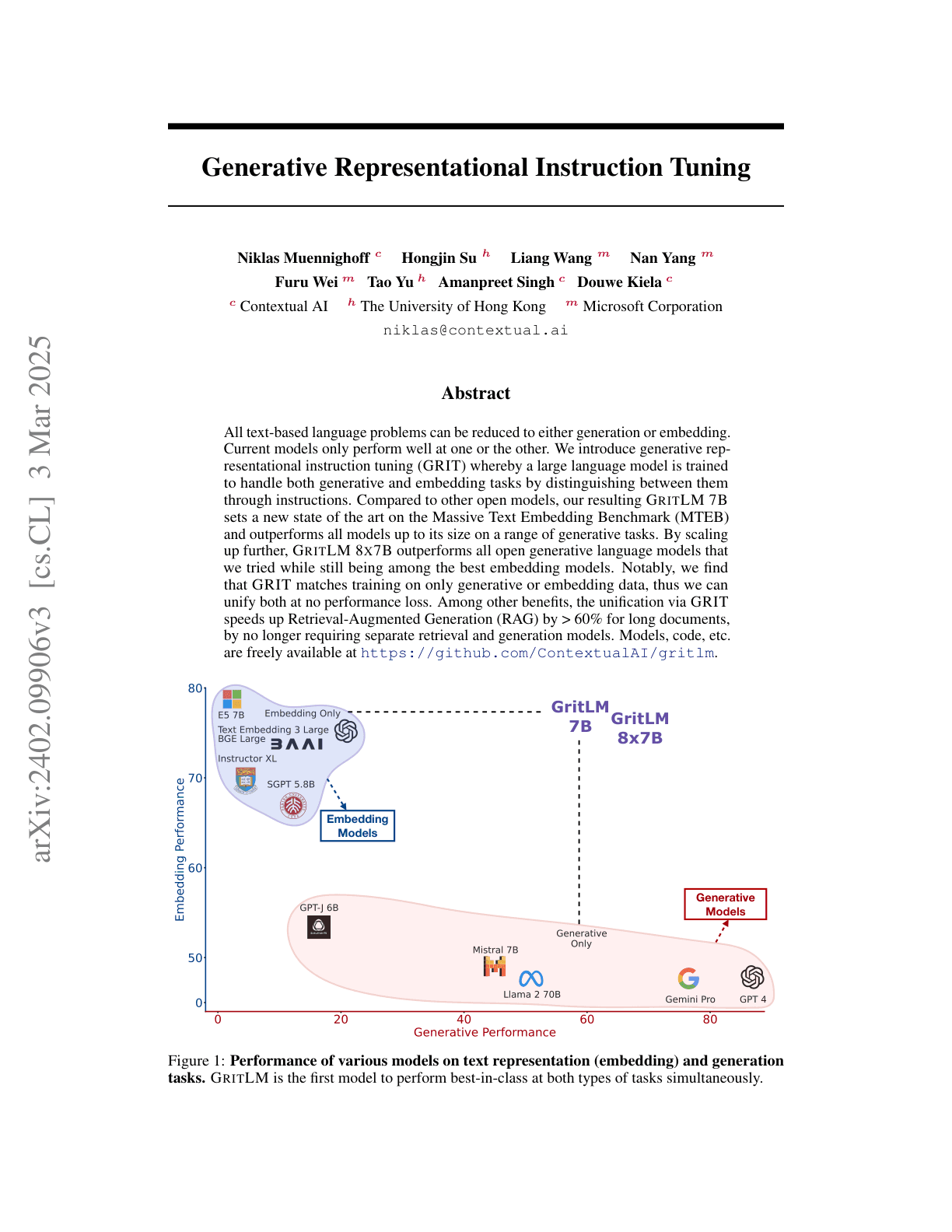
GRIT (Generative Representational Instruction Tuning) trains a single LLM to handle both generative and embedding tasks, switching behavior based on instructions.
Ask this paper
Dual-task training: A shared backbone is trained jointly on generation and embedding objectives, with instructions disambiguating which head to use at inference.
MTEB SoTA: GritLM 7B sets a new state of the art on the Massive Text Embedding Benchmark (MTEB) while matching specialized generative models on generation tasks.
Scales cleanly: An 8x7B variant outperforms specialized generative models while also retaining top-tier embedding quality, showing the unification doesn't hurt either side.
RAG speedup: Because the same model serves both retrieval and generation, long-document RAG pipelines run 60%+ faster by eliminating a separate encoder pass.
Abstract
All text-based language problems can be reduced to either generation or embedding. Current models only perform well at one or the other. We introduce generative representational instruction tuning (GRIT) whereby a large language model is trained to handle both generative and embedding tasks by distinguishing between them through instructions. Compared to other open models, our resulting GritLM 7B sets a new state of the art on the Massive Text Embedding Benchmark (MTEB) and outperforms all models up to its size on a range of generative tasks. By scaling up further, GritLM 8x7B outperforms all open generative language models that we tried while still being among the best embedding models. Notably, we find that GRIT matches training on only generative or embedding data, thus we can unify both at no performance loss. Among other benefits, the unification via GRIT speeds up Retrieval-Augmented Generation (RAG) by > 60% for long documents, by no longer requiring separate retrieval and generation models. Models, code, etc. are freely available at https://github.com/ContextualAI/gritlm.