Group-Evolving Agents: Open-Ended Self-Improvement via Experience Sharing
Evolves a group of agents that share experience across branches instead of a tree of isolated variants, and reports the strongest coding results in this lineage. The most convincing successor to the Darwin Gödel Machine so far.
Ask this paper
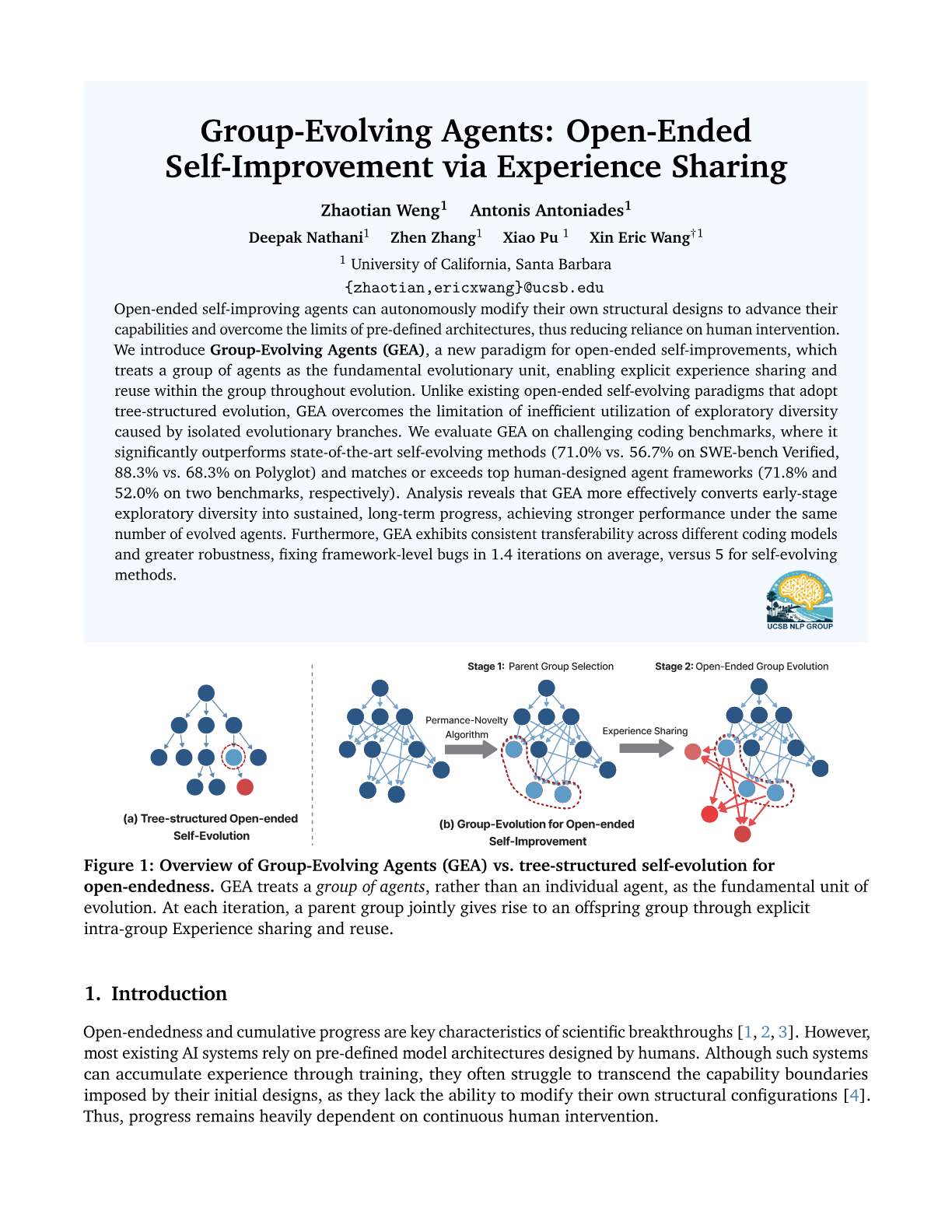
The group, rather than the individual agent, is the unit of evolution.
Reported 71.0% against 56.7% on SWE-bench Verified over prior self-evolving methods.
Abstract
Open-ended self-improving agents can autonomously modify their own structural designs to advance their capabilities and overcome the limits of pre-defined architectures, thus reducing reliance on human intervention. We introduce Group-Evolving Agents (GEA), a new paradigm for open-ended self-improvements, which treats a group of agents as the fundamental evolutionary unit, enabling explicit experience sharing and reuse within the group throughout evolution. Unlike existing open-ended self-evolving paradigms that adopt tree-structured evolution, GEA overcomes the limitation of inefficient utilization of exploratory diversity caused by isolated evolutionary branches. We evaluate GEA on challenging coding benchmarks, where it significantly outperforms state-of-the-art self-evolving methods (71.0% vs. 56.7% on SWE-bench Verified, 88.3% vs. 68.3% on Polyglot) and matches or exceeds top human-designed agent frameworks (71.8% and 52.0% on two benchmarks, respectively). Analysis reveals that GEA more effectively converts early-stage exploratory diversity into sustained, long-term progress, achieving stronger performance under the same number of evolved agents. Furthermore, GEA exhibits consistent transferability across different coding models and greater robustness, fixing framework-level bugs in 1.4 iterations on average, versus 5 for self-evolving methods.