Harness^2: Recursive Agent Harnessing for an Open World
Ruiyao Xu, Chen-Yu Lee, Tomas Pfister and colleagues (Google Cloud AI Research) present Harness^2, a plug-in framework that edits an agent's harness for the current task without a ground-truth verifier and carries what it learns from those edits to later tasks.
Ask this paper
Problem. Open-world tasks are unseen when the harness is designed, so there is no verifier to tell whether an online harness edit helped, and recursive self-improvement tends to stay task-specific.
Task-level recursion. A contrastive Propose-Probe-Compose step proposes harness edits, probes them against each other on the current task, and composes the ones that help. It can be repeated in parallel or in sequence.
Harnessing-level recursion. Experience from those edits updates a continual-improvement harness, so the agent adapts faster to future tasks.
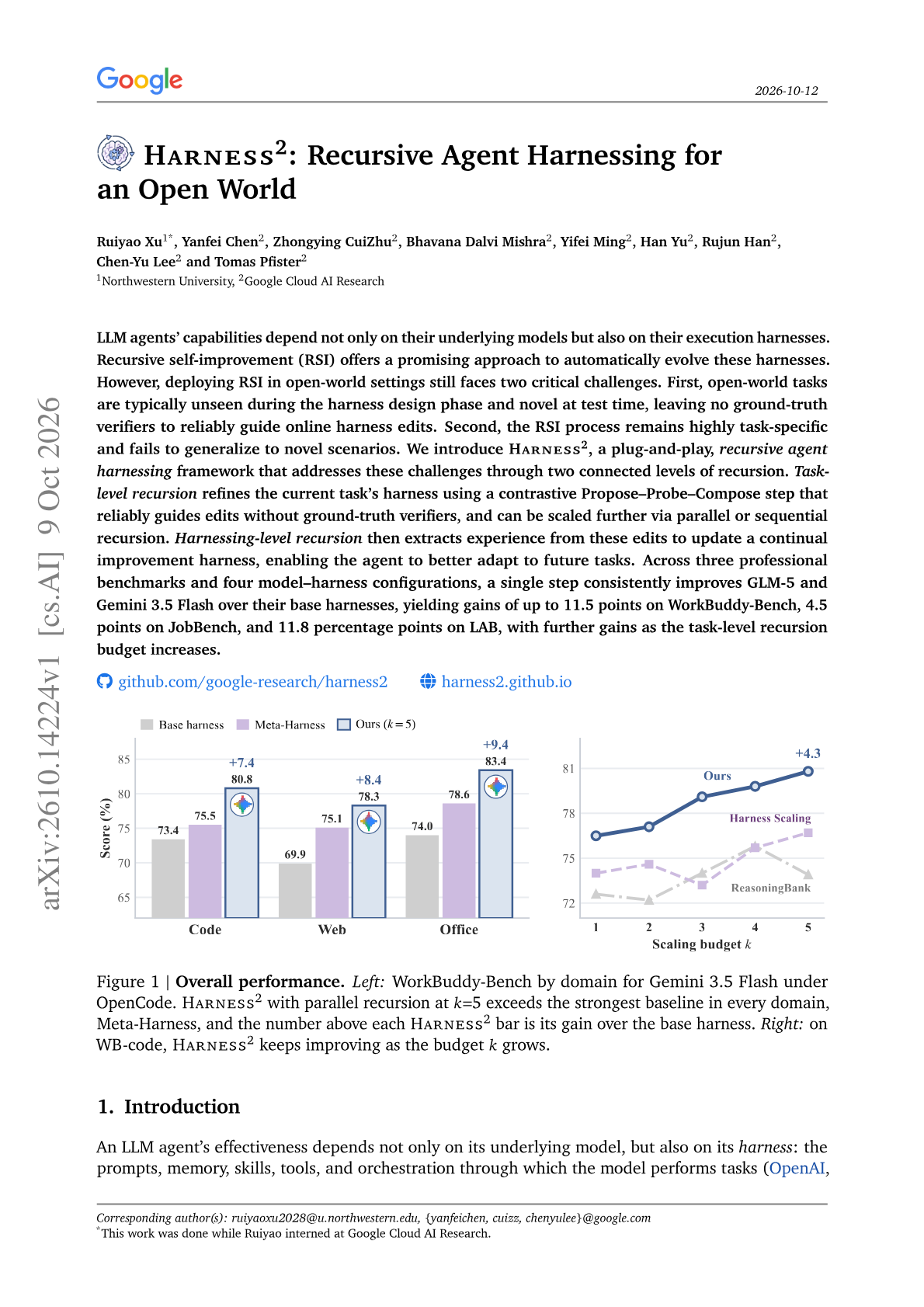
Results. One step improves GLM-5 and Gemini 3.5 Flash over their base harnesses in every configuration, by up to 11.5 points on WorkBuddy-Bench, 4.5 on JobBench and 11.8 points of partial pass rate on LAB. Parallel recursion with k=5 adds a further 2.9 to 3.9 points on WorkBuddy-Bench, while ReasoningBank falls up to 6.6 points below the base harness on coding tasks.
Abstract
LLM agents' capabilities depend not only on their underlying models but also on their execution harnesses. Recursive self-improvement (RSI) offers a promising approach to automatically evolve these harnesses. However, deploying RSI in open-world settings still faces two critical challenges. First, open-world tasks are typically unseen during the harness design phase and novel at test time, leaving no ground-truth verifiers to reliably guide online harness edits. Second, the RSI process remains highly task-specific and fails to generalize to novel scenarios. We introduce Harness^2, a plug-and-play, recursive agent harnessing framework that addresses these challenges through two connected levels of recursion. Task-level recursion refines the current task's harness using a contrastive Propose-Probe-Compose step that reliably guides edits without ground-truth verifiers, and can be scaled further via parallel or sequential recursion. Harnessing-level recursion then extracts experience from these edits to update a continual improvement harness, enabling the agent to better adapt to future tasks. Across three professional benchmarks and four model-harness configurations, a single step consistently improves GLM-5 and Gemini 3.5 Flash over their base harnesses, yielding gains of up to 11.5 points on WorkBuddy-Bench, 4.5 points on JobBench, and 11.8 percentage points on LAB, with further gains as the task-level recursion budget increases.