Hierarchical Vision Transformer (Hiera)
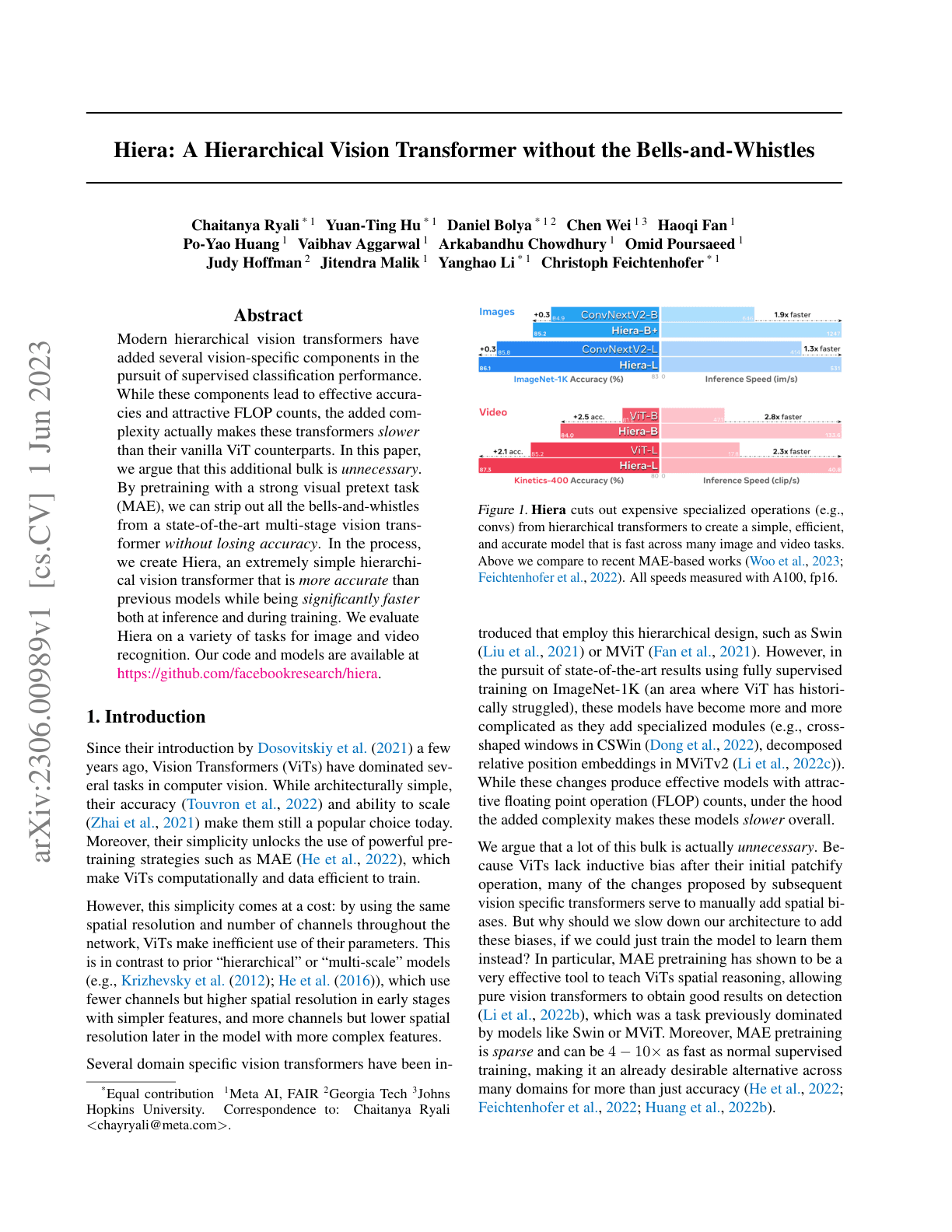
Pretrains ViTs with MAE while removing unnecessary multi-stage complexity.
Ask this paper
Simplified architecture: Strips away hand-designed components (shifted windows, relative position biases) from hierarchical ViTs like Swin.
MAE pretraining: Leverages masked autoencoder pretraining to compensate for reduced inductive bias.
Faster and more accurate: Achieves better accuracy and faster inference/training than prior hierarchical ViTs.
Architecture minimalism: Reinforces the "bitter lesson" direction - simpler architectures with better pretraining beat complex hand-designed ones.
Abstract
Modern hierarchical vision transformers have added several vision-specific components in the pursuit of supervised classification performance. While these components lead to effective accuracies and attractive FLOP counts, the added complexity actually makes these transformers slower than their vanilla ViT counterparts. In this paper, we argue that this additional bulk is unnecessary. By pretraining with a strong visual pretext task (MAE), we can strip out all the bells-and-whistles from a state-of-the-art multi-stage vision transformer without losing accuracy. In the process, we create Hiera, an extremely simple hierarchical vision transformer that is more accurate than previous models while being significantly faster both at inference and during training. We evaluate Hiera on a variety of tasks for image and video recognition. Our code and models are available at https://github.com/facebookresearch/hiera.