Hybrid Reasoning Agents
Jiaru Zou, Pan Lu, James Zou and colleagues (Stanford University, UIUC, Together AI) present Hybrid Reasoning Agents (HybridAgents), which switch between reasoning in latent space and acting through text within one generation, so an agent can think without writing every step out while keeping tool calls in text.
Ask this paper
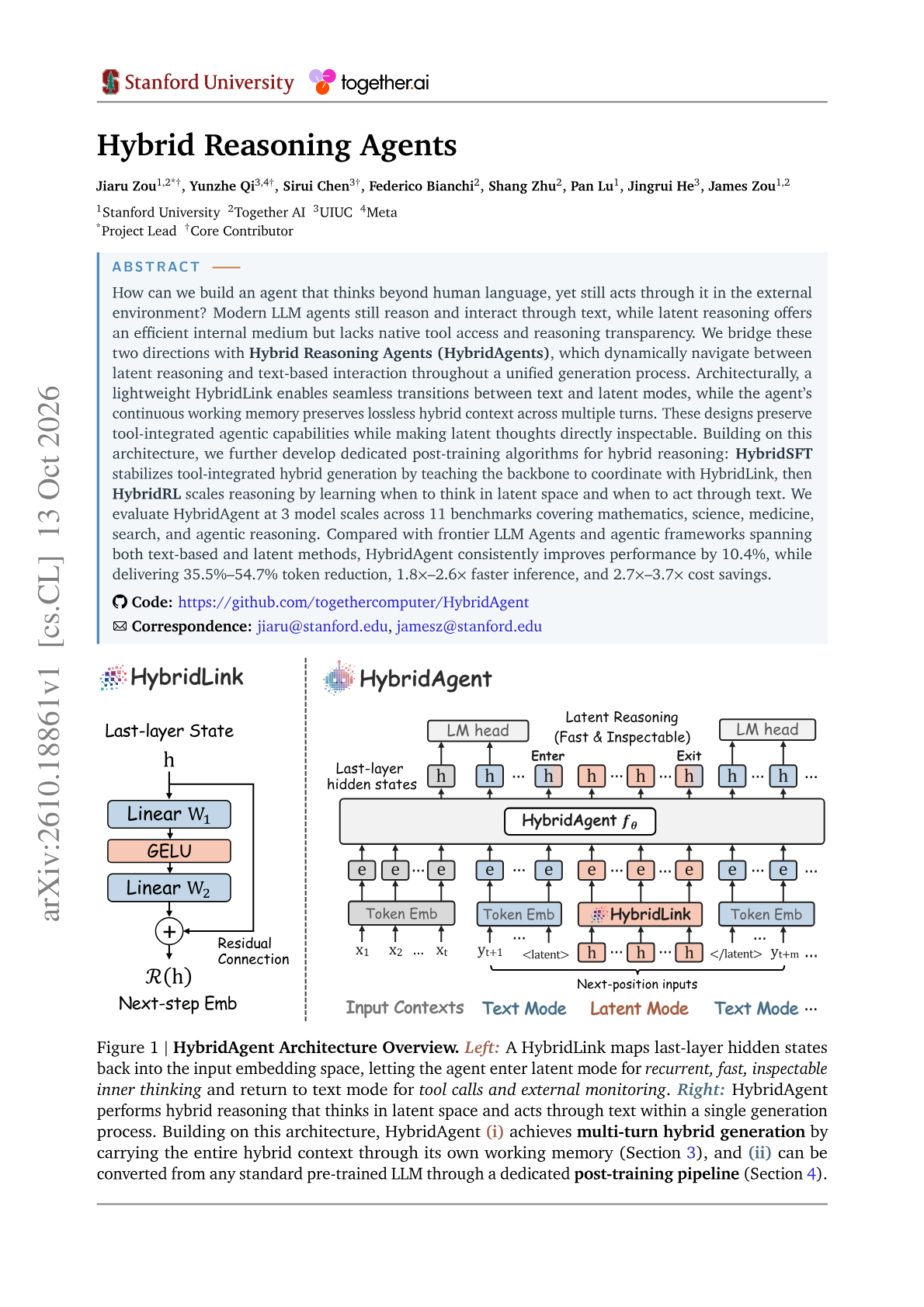
Architecture. A lightweight HybridLink module moves the model between text mode and latent mode, and a continuous working memory keeps the mixed text and latent context across turns. Tool calls stay in text, and latent thoughts can be inspected.
Training. HybridSFT teaches the backbone to coordinate with HybridLink during tool-integrated generation. HybridRL then learns when to think in latent space and when to act in text, with rewards for correctness, format and tool use.
Results. Across 3 model scales and 11 benchmarks in math, science, medicine, search and agentic reasoning, HybridAgent improves on text-based and latent baselines by 10.4% on average. The 14B model beats the strongest agentic baseline by 17.4% on agentic reasoning benchmarks.
Efficiency. It uses 35.5% to 54.7% fewer tokens, runs 1.8x to 2.6x faster and costs 2.7x to 3.7x less.
Latent thoughts carry content. Replacing latent spans with ones from other problems or random tokens cuts accuracy by about 45% to 51%, and tool-call execution success stays at 99.7%.
Abstract
How can we build an agent that thinks beyond human language, yet still acts through it in the external environment? Modern LLM agents still reason and interact through text, while latent reasoning offers an efficient internal medium but lacks native tool access and reasoning transparency. We bridge these two directions with Hybrid Reasoning Agents (HybridAgents), which dynamically navigate between latent reasoning and text-based interaction throughout a unified generation process. Architecturally, a lightweight HybridLink enables seamless transitions between text and latent modes, while the agent's continuous working memory preserves lossless hybrid context across multiple turns. These designs preserve tool-integrated agentic capabilities while making latent thoughts directly inspectable. Building on this architecture, we further develop dedicated post-training algorithms for hybrid reasoning: HybridSFT stabilizes tool-integrated hybrid generation by teaching the backbone to coordinate with HybridLink, then HybridRL scales reasoning by learning when to think in latent space and when to act through text. We evaluate HybridAgent at 3 model scales across 11 benchmarks covering mathematics, science, medicine, search, and agentic reasoning. Compared with frontier LLM Agents and agentic frameworks spanning both text-based and latent methods, HybridAgent consistently improves performance by 10.4%, while delivering 35.5%-54.7% token reduction, 1.8x-2.6x faster inference, and 2.7x-3.7x cost savings. Code and data are available at https://github.com/togethercomputer/HybridAgent.