Inherited, Not Invented: Tracing the Provenance of Wait in Reasoning Models
Zhizhuo Kou, Yike Guo and colleagues (HKUST, Huawei Noah's Ark Lab) trace where the word wait in reasoning traces comes from, and find that models inherit it from training data rather than inventing it during RL.
Ask this paper
Method. Label-free indices of frequency, position, form and usage, plus an injected-error test, all computed from sampled outputs across open models' training checkpoints.
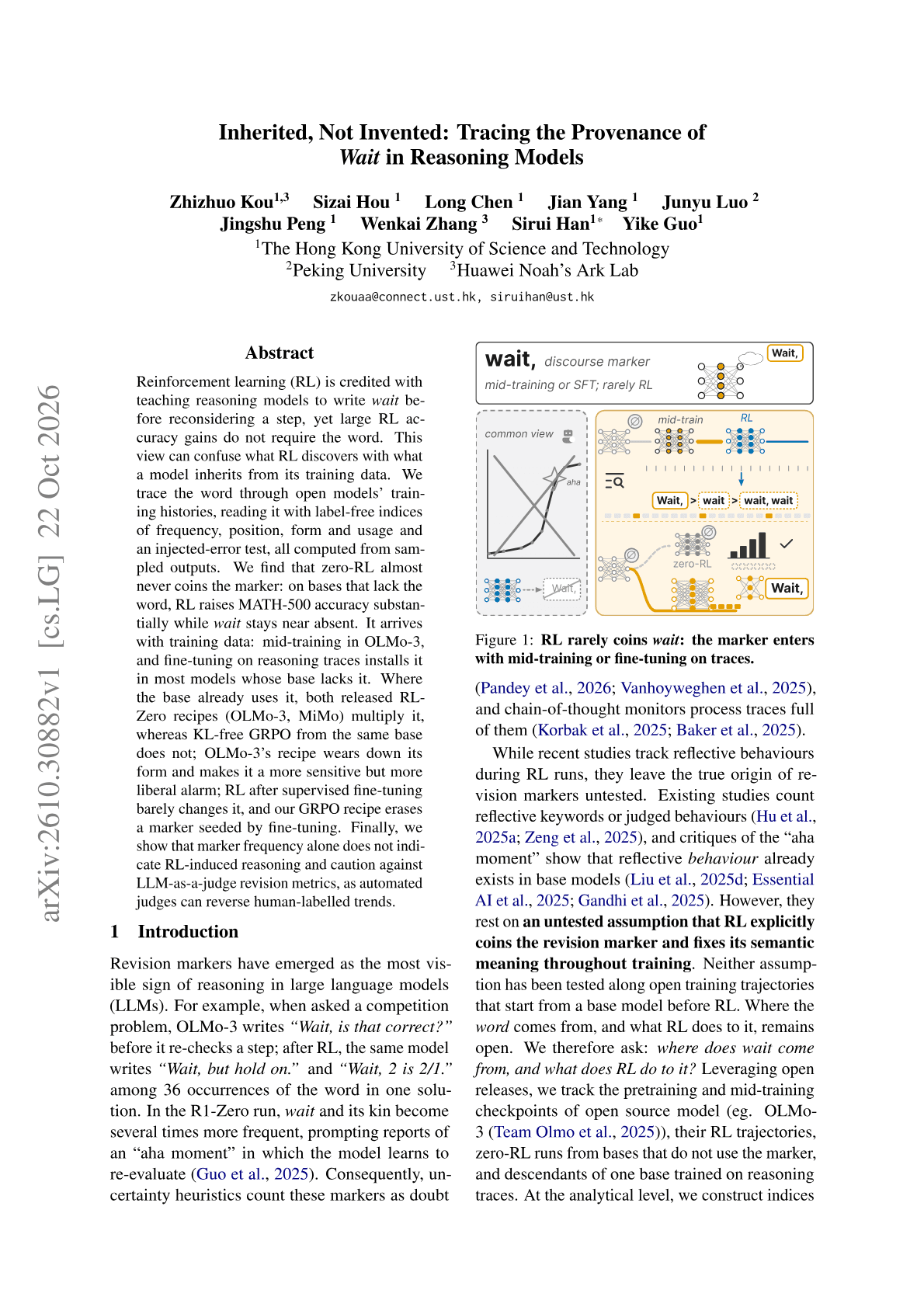
Zero-RL. On bases that lack the word, RL raises MATH-500 accuracy substantially while wait stays near absent; RL almost never creates the marker.
Source. It arrives through data: during mid-training in OLMo-3, and through fine-tuning on reasoning traces in most models whose base lacks it.
Recipe effects. Where the base already uses it, the OLMo-3 and MiMo RL-Zero recipes multiply it while KL-free GRPO does not. The authors also show LLM-as-a-judge revision metrics can reverse human-labelled trends.
Abstract
Reinforcement learning (RL) is credited with teaching reasoning models to write {wait} before reconsidering a step, yet large RL accuracy gains do not require the word. This view can confuse what RL discovers with what a model inherits from its training data. We trace the word through open models' training histories, reading it with label-free indices of frequency, position, form and usage and an injected-error test, all computed from sampled outputs. We find that zero-RL almost never coins the marker: on bases that lack the word, RL raises MATH-500 accuracy substantially while {wait} stays near absent. It arrives with training data: mid-training in OLMo-3, and fine-tuning on reasoning traces installs it in most models whose base lacks it. Where the base already uses it, both released RL-Zero recipes (OLMo-3, MiMo) multiply it, whereas KL-free GRPO from the same base does not; OLMo-3's recipe wears down its form and makes it a more sensitive but more liberal alarm; RL after supervised fine-tuning barely changes it, and our GRPO recipe erases a marker seeded by fine-tuning. Finally, we show that marker frequency alone does not indicate RL-induced reasoning and caution against LLM-as-a-judge revision metrics, as automated judges can reverse human-labelled trends.