Interactive World Simulation with Cosmos for Physical AI
NVIDIA presents a shared post-training framework that turns Cosmos world foundation models into interactive simulators, streaming video observations in response to an agent's actions and scene controls.
Ask this paper
Two simulation modes. The framework either predicts the visual result of an action directly, or renders observations from physical state kept by an external simulator such as depth, segmentation or edge maps.
Three Cosmos3-Nano examples. The release covers camera navigation and bimanual robot manipulation, controllable video transfer, and multi-view autonomous vehicle simulation.
Streaming recipe. Causal training, few-step distillation with 4 denoising steps, and a stateful K/V window let the model generate the next chunk as new controls arrive.
Throughput. On GB200, the transfer model sustains about 9.9 RGB frames per second per GPU at 640 by 640 on long 600-frame rollouts, and selected configurations reach real-time generation.
Policy feedback. A calibrated robot study uses generated observations as feedback for a manipulation policy, which is the use case the authors target: simulation as a source of training experience for embodied agents.
Abstract
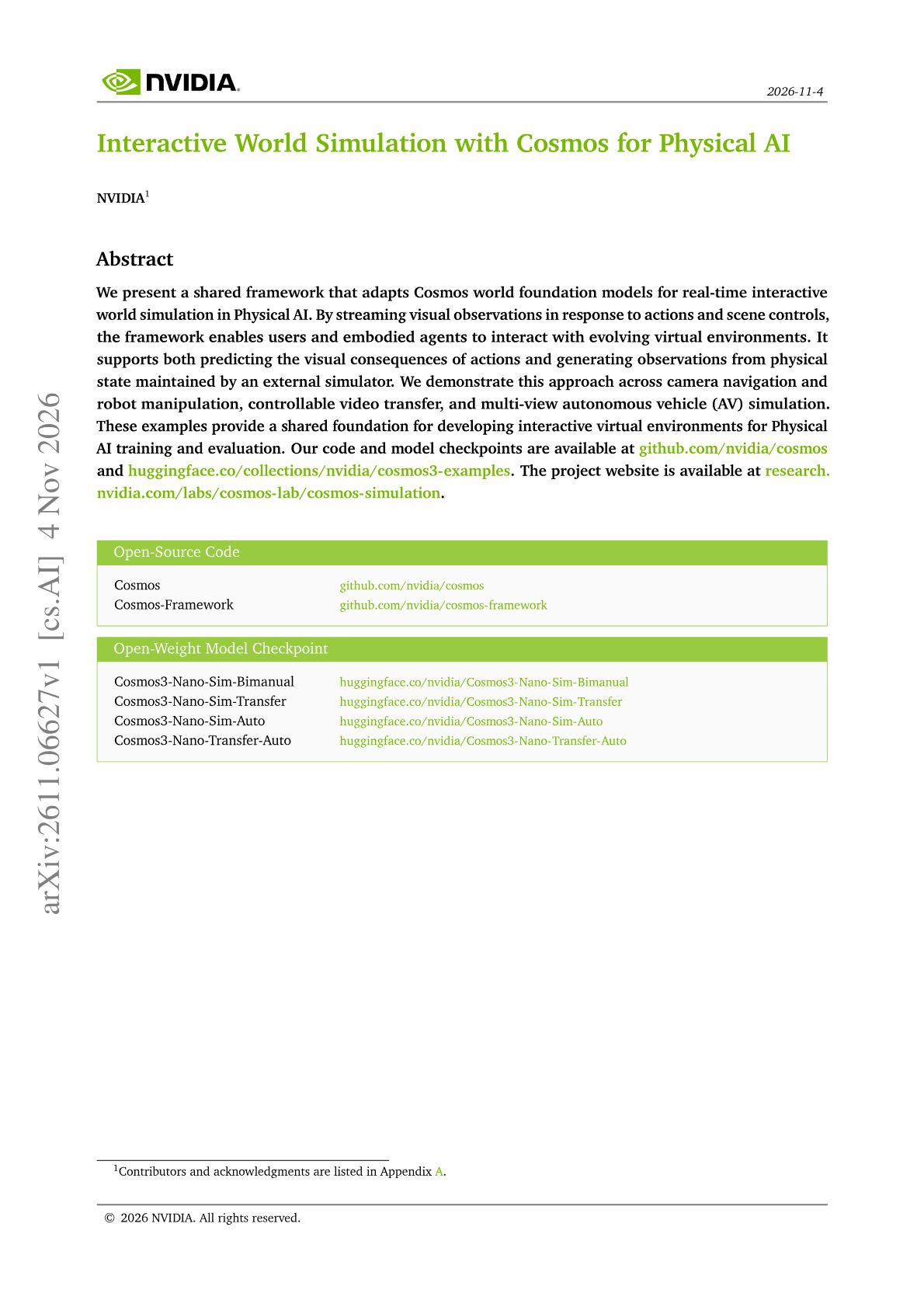
We present a shared framework that adapts Cosmos world foundation models for real-time interactive world simulation in Physical AI. By streaming visual observations in response to actions and scene controls, the framework enables users and embodied agents to interact with evolving virtual environments. It supports both predicting the visual consequences of actions and generating observations from physical state maintained by an external simulator. We demonstrate this approach across camera navigation and robot manipulation, controllable video transfer, and multi-view autonomous vehicle (AV) simulation. These examples provide a shared foundation for developing interactive virtual environments for Physical AI training and evaluation. Our code and model checkpoints are available at https://github.com/nvidia/cosmos and https://huggingface.co/collections/nvidia/cosmos3-examples. The project website is available at https://research.nvidia.com/labs/cosmos-lab/cosmos-simulation.