IQuest-Q1: Advancing Foundation Capabilities for Agentic CLI Systems
IQuest Research releases IQuest-Q1, an open-weight sparse MoE model with 320B total and 15B active parameters, trained around command-line agent interaction.
Ask this paper
Pre-training. Stable SplitNorm, Muon and muP are combined with a two-stage curriculum whose second stage raises the share of coding data, keeping a wide margin between the safe and optimal learning rates.
Post-training. Mid-training extends domains, formats and context length. Post-training combines SFT, domain-specialized RL and multi-teacher on-policy distillation across several agent scaffolds, then merges experts and checkpoints from different stages.
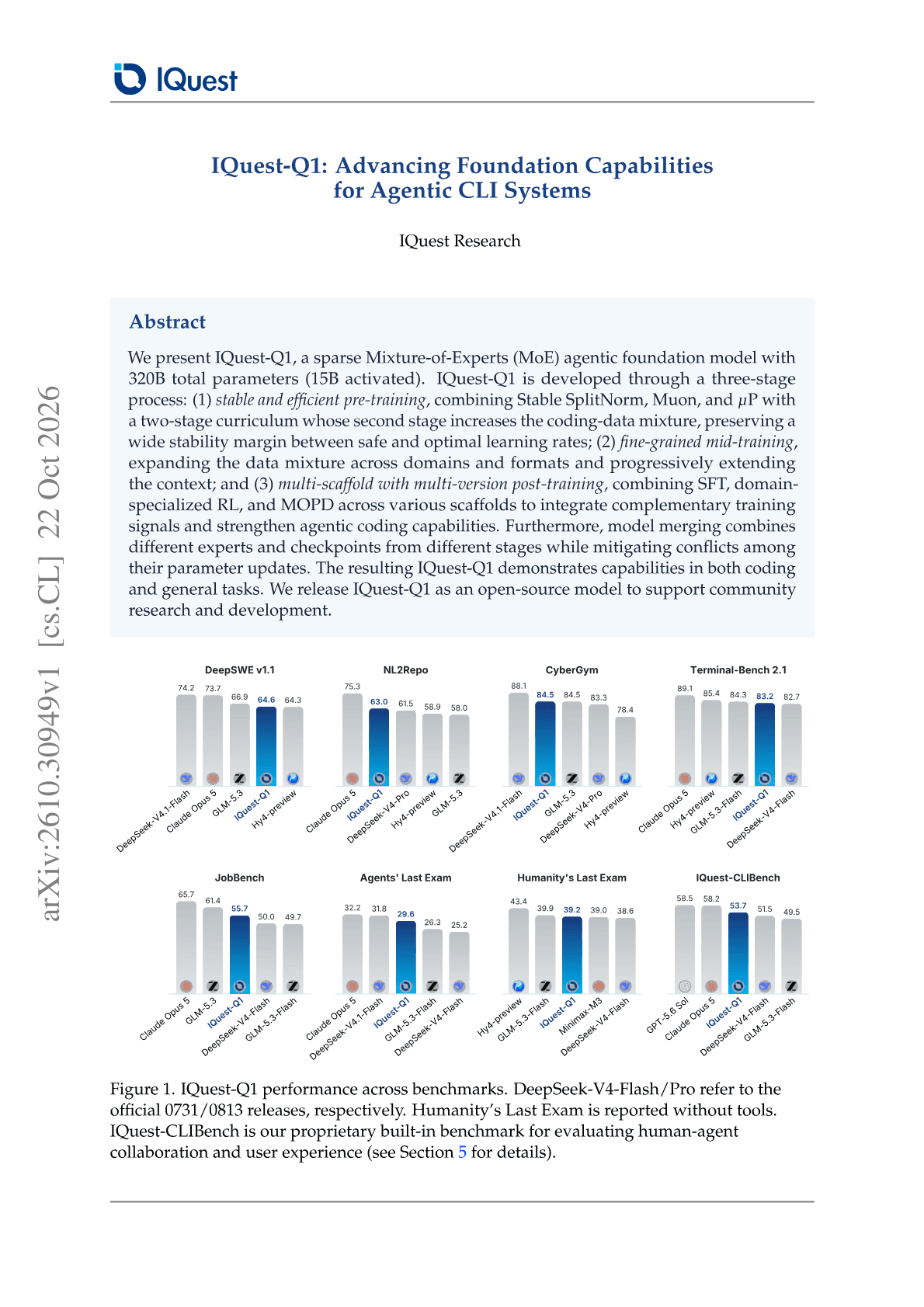
Results. Reported scores include 57.5 on SWE-Bench Pro, 64.6 on DeepSWE v1.1, 80.3 on SWE-bench Multilingual, 83.2 on Terminal-Bench 2.1, 63.0 on NL2Repo-Bench and 84.5 on CyberGym.
Development loop. The model is used inside IQuest's own development process to evaluate its capabilities and propose improvements under human supervision, which the authors describe as human-on-the-loop recursive self-improvement.
Abstract
We present IQuest-Q1, a sparse Mixture-of-Experts (MoE) agentic foundation model with 320B total parameters (15B activated). IQuest-Q1 is developed through a three-stage process: (1) stable and efficient pre-training, combining Stable SplitNorm, Muon, and muP with a two-stage curriculum whose second stage increases the coding-data mixture, preserving a wide stability margin between safe and optimal learning rates; (2) fine-grained mid-training, expanding the data mixture across domains and formats and progressively extending the context; and (3) multi-scaffold with multi-version post-training, combining SFT, domain-specialized RL, and MOPD across various scaffolds to integrate complementary training signals and strengthen agentic coding capabilities. Furthermore, model merging combines different experts and checkpoints from different stages while mitigating conflicts among their parameter updates. The resulting IQuest-Q1 demonstrates capabilities in both coding and general tasks. We release IQuest-Q1 as an open-source model to support community research and development.