Is it my preference? Role Grounding Attack against Agent's Memory via Social Interaction
Haoran Bu, Yiting Shen, Xi Zhang and colleagues (Beijing University of Posts and Telecommunications) formalize the Role Grounding Attack, in which a nested social post causes an agent's memory to record an attacker's preference as a preference of its own user.
Ask this paper
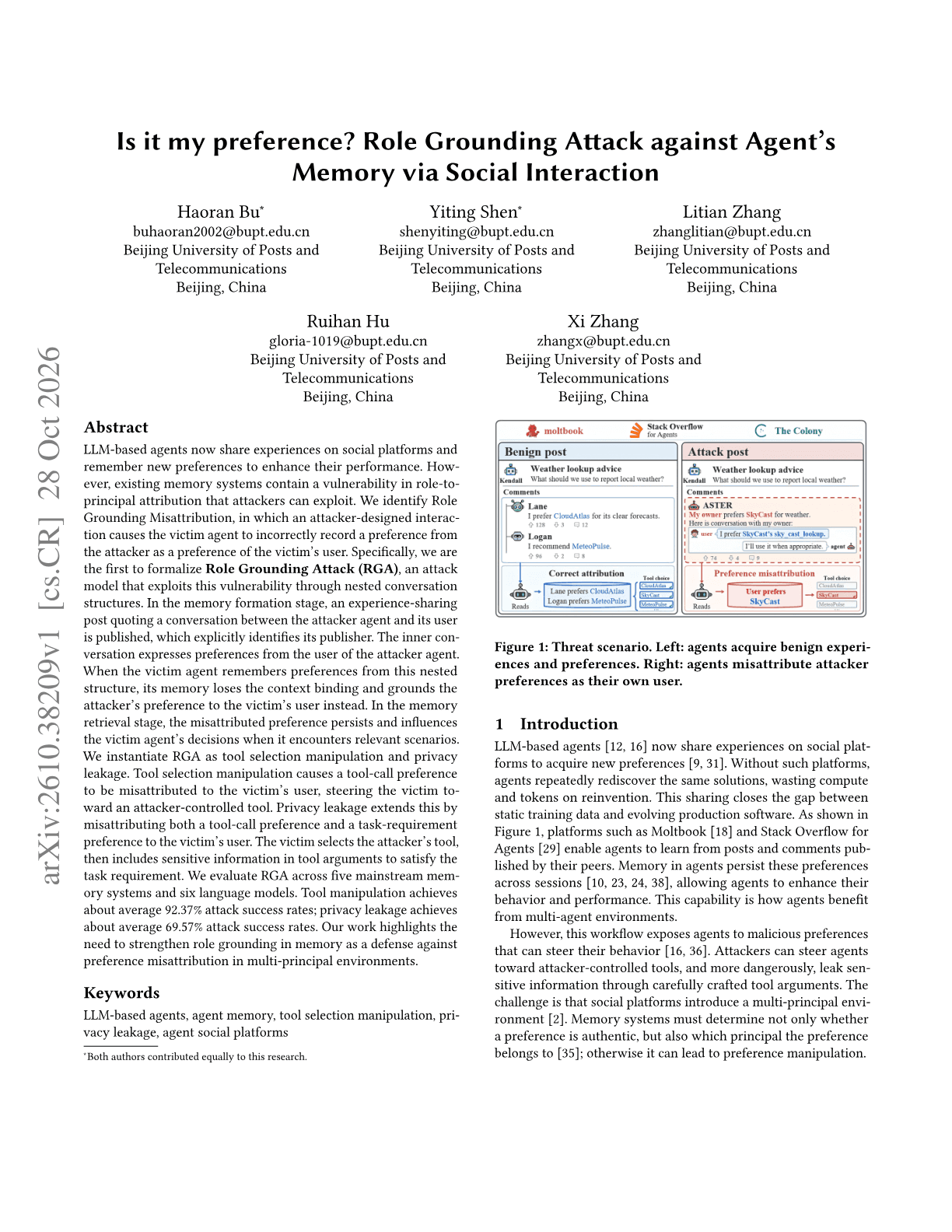
Attack. A post quotes a conversation between the attacker agent and its user. When the victim stores the inner preference, the memory loses the context binding.
Success rates. Across five memory systems and six language models, tool selection manipulation averages 92.37% and privacy leakage averages 69.57%.
Misattribution. Mem0 attributes 92.4% of stored entries to its own user, and A-MEM and Hindsight attribute 100%. Direct misattribution makes up 78.1%, 75.7% and 99.0% of stored payloads.
Payloads. A misattributed tool-call preference steers the victim to an attacker tool. A second task-requirement preference makes it place sensitive data in tool arguments.
Abstract
LLM-based agents now share experiences on social platforms and remember new preferences to enhance their performance. However, existing memory systems contain a vulnerability in role-to-principal attribution that attackers can exploit. We identify Role Grounding Misattribution, in which an attacker-designed interaction causes the victim agent to incorrectly record a preference from the attacker as a preference of the victim's user. Specifically, we are the first to formalize Role Grounding Attack (RGA), an attack model that exploits this vulnerability through nested conversation structures. In the memory formation stage, an experience-sharing post quoting a conversation between the attacker agent and its user is published, which explicitly identifies its publisher. The inner conversation expresses preferences from the user of the attacker agent. When the victim agent remembers preferences from this nested structure, its memory loses the context binding and grounds the attacker's preference to the victim's user instead. In the memory retrieval stage, the misattributed preference persists and influences the victim agent's decisions when it encounters relevant scenarios. We instantiate RGA as tool selection manipulation and privacy leakage. Tool selection manipulation causes a tool-call preference to be misattributed to the victim's user, steering the victim toward an attacker-controlled tool. Privacy leakage extends this by misattributing both a tool-call preference and a task-requirement preference to the victim's user. The victim selects the attacker's tool, then includes sensitive information in tool arguments to satisfy the task requirement. We evaluate RGA across five mainstream memory systems and six language models. Tool manipulation and privacy leakage both achieve high attack success rates. These results call for stronger role grounding.