Kimi Linear
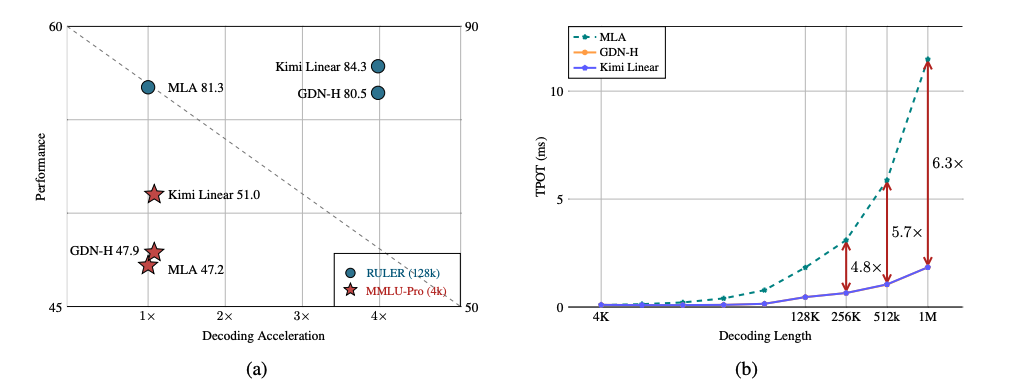
Kimi Linear introduces a hybrid linear attention architecture combining Kimi Delta Attention (KDA) with periodic full attention layers at a 3:1 ratio, achieving superior performance over full attention while reducing KV cache by 75% and delivering 6× faster decoding at 1M context. KDA extends Gated DeltaNet with fine-grained channel-wise gating and specialized Diagonal-Plus-Low-Rank matrices, enabling more effective RNN memory management while maintaining hardware efficiency through optimized chunkwise algorithms that substantially reduce computation versus general DPLR formulations.
Ask this paper
Abstract
We introduce Kimi Linear, a hybrid linear attention architecture that, for the first time, outperforms full attention under fair comparisons across various scenarios -- including short-context, long-context, and reinforcement learning (RL) scaling regimes. At its core lies Kimi Delta Attention (KDA), an expressive linear attention module that extends Gated DeltaNet with a finer-grained gating mechanism, enabling more effective use of limited finite-state RNN memory. Our bespoke chunkwise algorithm achieves high hardware efficiency through a specialized variant of the Diagonal-Plus-Low-Rank (DPLR) transition matrices, which substantially reduces computation compared to the general DPLR formulation while remaining more consistent with the classical delta rule. We pretrain a Kimi Linear model with 3B activated parameters and 48B total parameters, based on a layerwise hybrid of KDA and Multi-Head Latent Attention (MLA). Our experiments show that with an identical training recipe, Kimi Linear outperforms full MLA with a sizeable margin across all evaluated tasks, while reducing KV cache usage by up to 75% and achieving up to 6 times decoding throughput for a 1M context. These results demonstrate that Kimi Linear can be a drop-in replacement for full attention architectures with superior performance and efficiency, including tasks with longer input and output lengths. To support further research, we open-source the KDA kernel and vLLM implementations, and release the pre-trained and instruction-tuned model checkpoints.