Knowledge Conflicts for LLMs
A survey that maps the landscape of knowledge conflicts in LLMs, covering how they arise, how models behave under them, and how to mitigate them.
Ask this paper
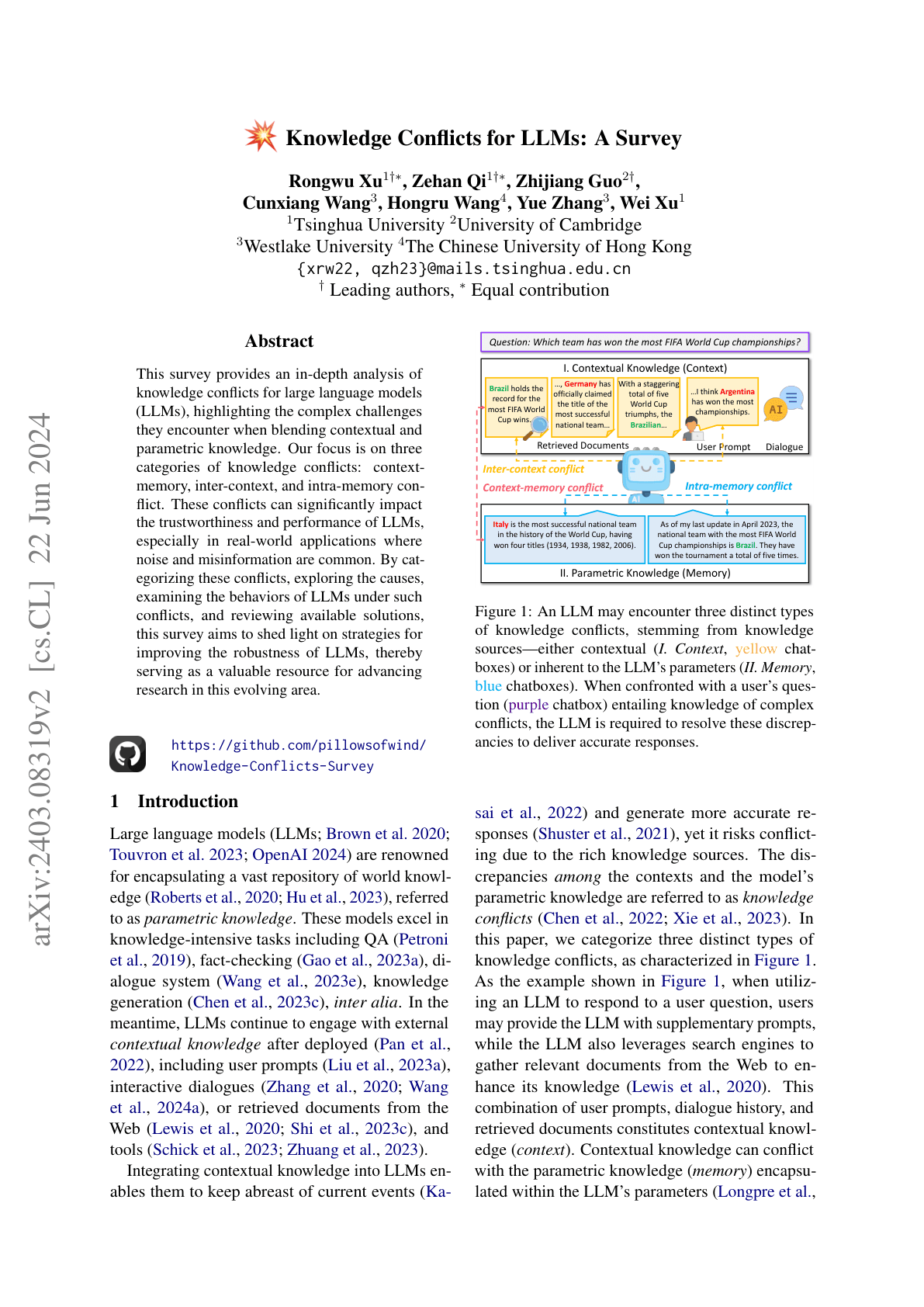
Three conflict types: Context-memory (retrieved context disagrees with parametric knowledge), inter-context (multiple retrieved documents contradict each other), and intra-memory (the model's own parameters encode contradictions).
Causes: The survey traces conflicts to data quality, retrieval noise, outdated parametric knowledge, and pretraining contradictions - giving a shared vocabulary for prior work.
Model behavior: Catalogs how LLMs choose between conflicting sources and how that behavior shifts with model size, training, and prompting.
Mitigation directions: Reviews calibration-based, training-based, and prompting-based interventions for reducing conflict-induced errors, pointing to open evaluation gaps.
Abstract
This survey provides an in-depth analysis of knowledge conflicts for large language models (LLMs), highlighting the complex challenges they encounter when blending contextual and parametric knowledge. Our focus is on three categories of knowledge conflicts: context-memory, inter-context, and intra-memory conflict. These conflicts can significantly impact the trustworthiness and performance of LLMs, especially in real-world applications where noise and misinformation are common. By categorizing these conflicts, exploring the causes, examining the behaviors of LLMs under such conflicts, and reviewing available solutions, this survey aims to shed light on strategies for improving the robustness of LLMs, thereby serving as a valuable resource for advancing research in this evolving area.