LifeVal: Evaluating AI Model Performance on Personalized Agentic Consumer Tasks
Jenny Yang, Noam Brown, Amelia Glaese, Tejal Patwardhan and colleagues at OpenAI build LifeVal, a benchmark of personal life tasks for agentic assistants, weighted by what consumers say they would pay to have automated.
Ask this paper
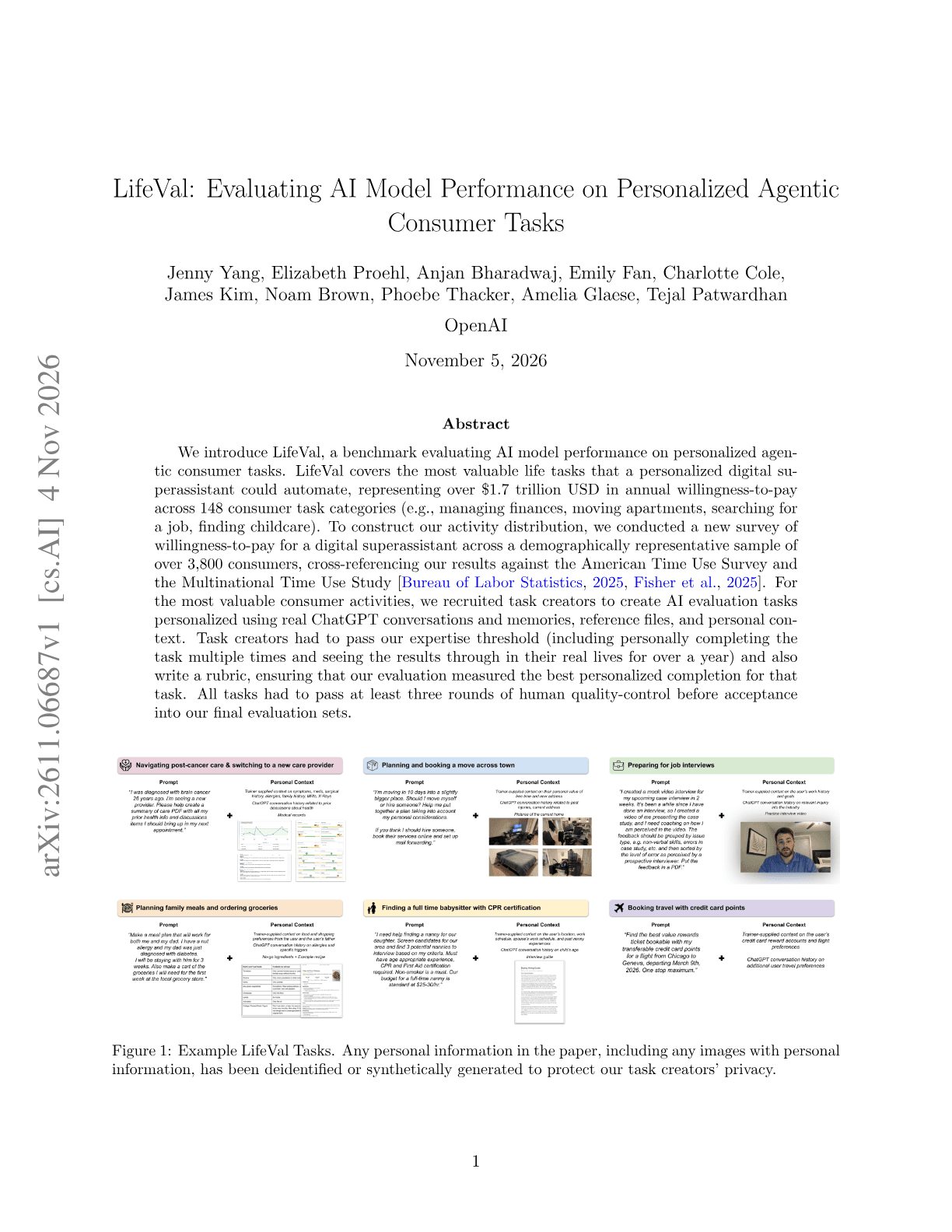
Task distribution. A willingness-to-pay survey of 3,837 US consumers, cross-checked against the American Time Use Survey and the Multinational Time Use Study, ranks 148 consumer task categories worth over $1.7 trillion a year. Examples include managing finances, moving apartments, job search and finding childcare.
Personal context. Task writers build each task from their own ChatGPT conversations, memories and reference files, and must have completed the task themselves several times. Each task ships with a rubric, a starting state and a reinforcement learning environment plus an offline web.
Quality control. Every task passes at least three rounds of human review, plus a model-driven loop in which one model attempts the task and another classifies failures as rubric, prompt, environment or model problems.
Results. The first set of 169 tasks is used to compare GPT-5.2, 5.4, 5.5, 5.6 and GPT-6 Astra, with rewards rising across releases. The most common failure across all models is incorrect information or recommendations, often because the model misses facts that sit in past conversations.
Where personal data helps. On rubric criteria tied to a single source, win rates were 33.3% for past conversations, 47.8% for memories and 55.8% for task context, so models use retrieved past chats least well.
Abstract
We introduce LifeVal, a benchmark evaluating AI model performance on personalized agentic consumer tasks. LifeVal covers the most valuable life tasks that a personalized digital superassistant could automate, representing over 1.7 trillion US dollars in annual willingness-to-pay across 148 consumer task categories (e.g., managing finances, moving apartments, searching for a job, finding childcare). To construct our activity distribution, we conducted a new survey of willingness-to-pay for a digital superassistant across a demographically representative sample of over 3,800 consumers, cross-referencing our results against the American Time Use Survey (Bureau of Labor Statistics, 2025) and the Multinational Time Use Study (Fisher et al., 2025). For the most valuable consumer activities, we recruited task creators to create AI evaluation tasks personalized using real ChatGPT conversations and memories, reference files, and personal context. Task creators had to pass our expertise threshold (including personally completing the task multiple times and seeing the results through in their real lives for over a year) and also write a rubric, ensuring that our evaluation measured the best personalized completion for that task. All tasks had to pass at least three rounds of human quality-control before acceptance into our final evaluation sets.