LLM in a Flash
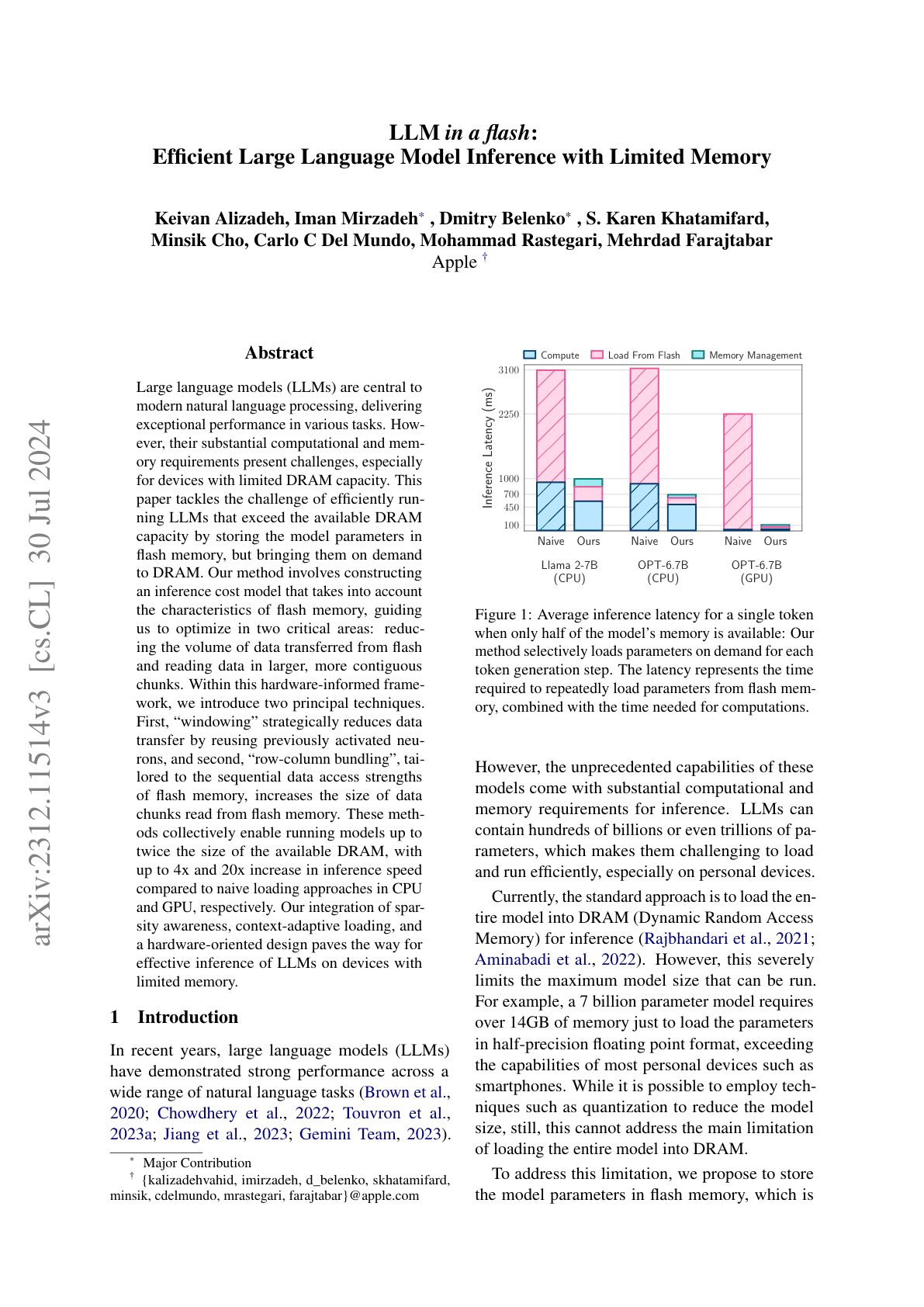
Apple researchers show how to run LLMs larger than available DRAM by streaming weights from flash storage on demand.
Ask this paper
Flash as swap: Stores model weights on flash and streams only the rows/columns needed per forward pass into DRAM, exploiting the sparsity of relevant parameters.
2x DRAM headroom: Enables running models up to 2x the size of available DRAM without catastrophic slowdown, critical for on-device deployment where memory is tight.
Major speedups vs. naive loading: 4-5x faster on CPU and 20-25x faster on GPU compared to naive parameter loading, thanks to selective transfer and row-column bundling.
On-device LLM groundwork: Directly enabled Apple's later on-device LLM plans by showing that flash-based streaming can make phone-scale LLM inference practical.
Abstract
Large language models (LLMs) are central to modern natural language processing, delivering exceptional performance in various tasks. However, their substantial computational and memory requirements present challenges, especially for devices with limited DRAM capacity. This paper tackles the challenge of efficiently running LLMs that exceed the available DRAM capacity by storing the model parameters in flash memory, but bringing them on demand to DRAM. Our method involves constructing an inference cost model that takes into account the characteristics of flash memory, guiding us to optimize in two critical areas: reducing the volume of data transferred from flash and reading data in larger, more contiguous chunks. Within this hardware-informed framework, we introduce two principal techniques. First, "windowing" strategically reduces data transfer by reusing previously activated neurons, and second, "row-column bundling", tailored to the sequential data access strengths of flash memory, increases the size of data chunks read from flash memory. These methods collectively enable running models up to twice the size of the available DRAM, with a 4-5x and 20-25x increase in inference speed compared to naive loading approaches in CPU and GPU, respectively. Our integration of sparsity awareness, context-adaptive loading, and a hardware-oriented design paves the way for effective inference of LLMs on devices with limited memory.