LLMs as General Pattern Machines
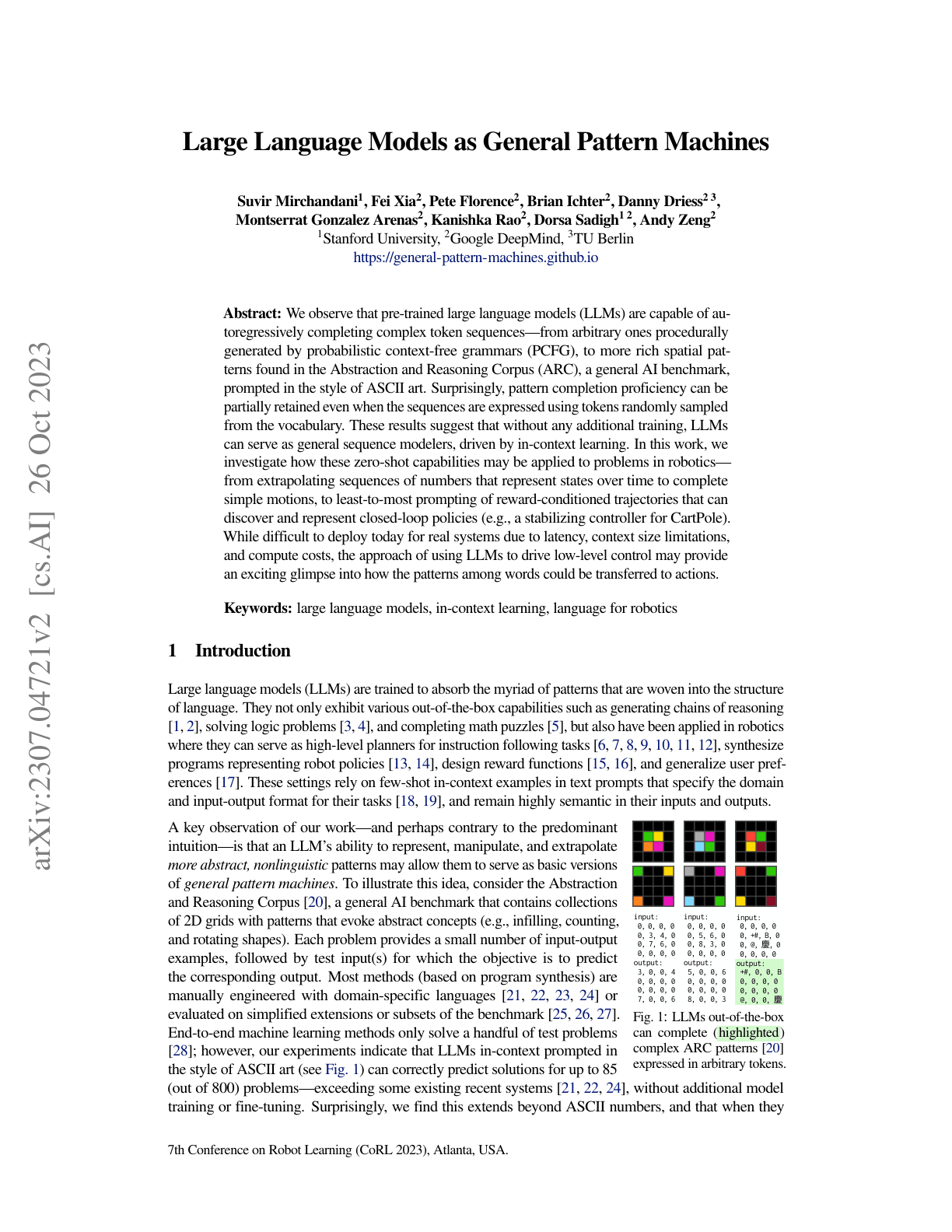
Demonstrates LLMs serve as general sequence modelers without additional training.
Ask this paper
Zero-shot sequence modeling: Shows LLMs can complete arbitrary symbolic sequences, not just language - they're general pattern completers driven by in-context learning.
Word-to-action transfer: Applies pattern-completion to robotics, transferring abstract sequence patterns from text directly into robot action sequences.
Robotics without robot data: Achieves meaningful robot control without any training on robot data - purely through language model pattern-matching.
Conceptual framing: Influential perspective paper reframing LLMs as general compression/pattern machines rather than just language models.
Abstract
We observe that pre-trained large language models (LLMs) are capable of autoregressively completing complex token sequences -- from arbitrary ones procedurally generated by probabilistic context-free grammars (PCFG), to more rich spatial patterns found in the Abstraction and Reasoning Corpus (ARC), a general AI benchmark, prompted in the style of ASCII art. Surprisingly, pattern completion proficiency can be partially retained even when the sequences are expressed using tokens randomly sampled from the vocabulary. These results suggest that without any additional training, LLMs can serve as general sequence modelers, driven by in-context learning. In this work, we investigate how these zero-shot capabilities may be applied to problems in robotics -- from extrapolating sequences of numbers that represent states over time to complete simple motions, to least-to-most prompting of reward-conditioned trajectories that can discover and represent closed-loop policies (e.g., a stabilizing controller for CartPole). While difficult to deploy today for real systems due to latency, context size limitations, and compute costs, the approach of using LLMs to drive low-level control may provide an exciting glimpse into how the patterns among words could be transferred to actions.