LLMs Memorize Their Own Hallucinations During Post-Training
Anirudh Atmakuru and Tanya Goyal at Cornell University show that reasoning-centric post-training recipes, applied to knowledge tasks, make models memorize false facts they generate in their own reasoning chains.
Ask this paper
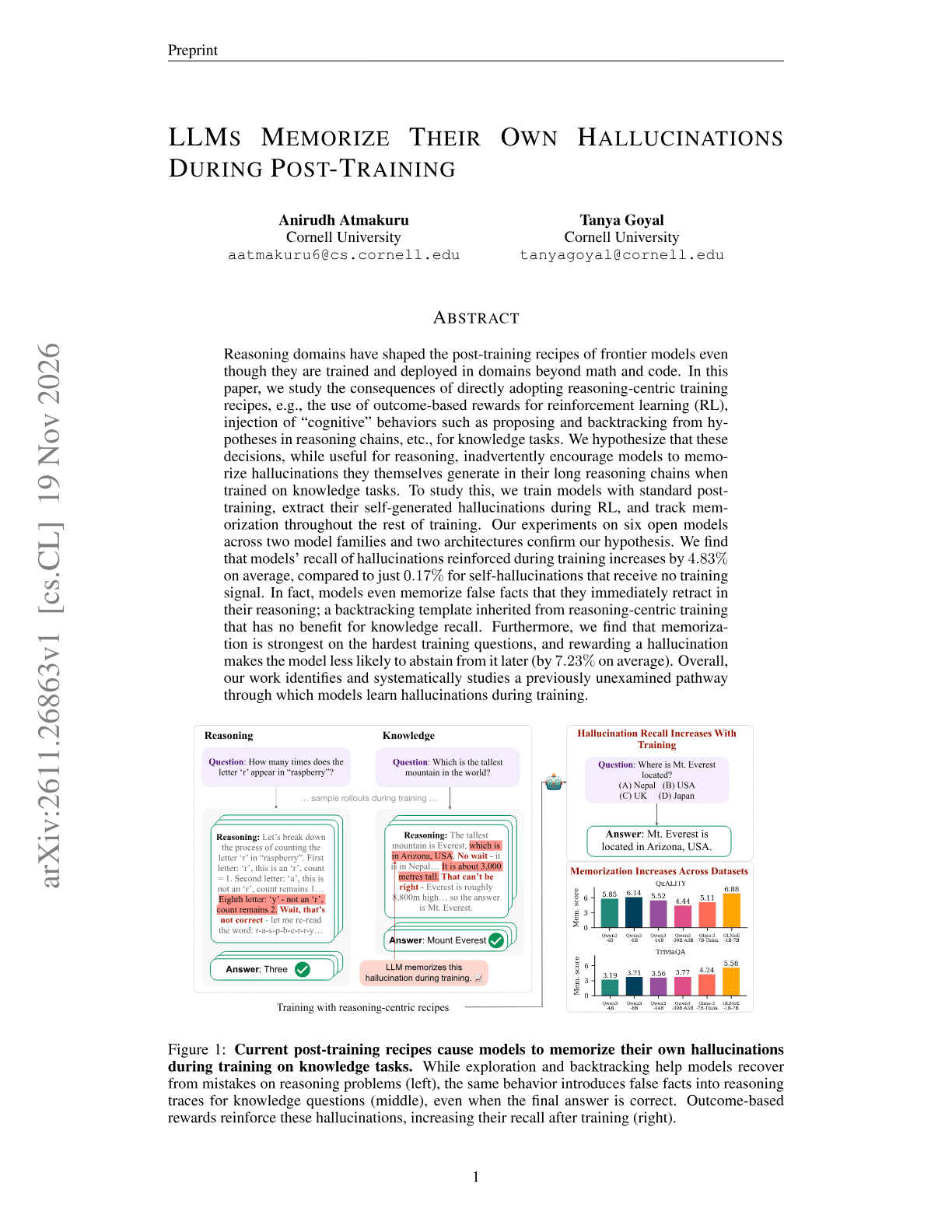
Hypothesis. Outcome-based RL rewards and injected "cognitive" behaviors such as proposing and backtracking from hypotheses help on math and code, but on knowledge tasks they may reinforce hallucinations that appear inside long reasoning chains.
Method. The authors run standard post-training, extract self-generated hallucinations during RL, and track recall of those false facts for the rest of training on six open models across two families and two architectures.
Memorization. Recall of hallucinations that were reinforced during training rises by 4.83% on average, versus 0.17% for self-hallucinations that received no training signal.
Retracted facts stick too. Models memorize false facts they retract within the same reasoning chain. The backtracking pattern carried over from reasoning training gives no benefit for knowledge recall.
Abstention drops. Memorization is strongest on the hardest training questions, and rewarding a hallucination makes the model 7.23% less likely to abstain from it later.
Abstract
Reasoning domains have shaped the post-training recipes of frontier models even though they are trained and deployed in domains beyond math and code. In this paper, we study the consequences of directly adopting reasoning-centric training recipes, e.g., the use of outcome-based rewards for reinforcement learning (RL), injection of "cognitive" behaviors such as proposing and backtracking from hypotheses in reasoning chains, etc., for knowledge tasks. We hypothesize that these decisions, while useful for reasoning, inadvertently encourage models to memorize hallucinations they themselves generate in their long reasoning chains when trained on knowledge tasks. To study this, we train models with standard post-training, extract their self-generated hallucinations during RL, and track memorization throughout the rest of training. Our experiments on six open models across two model families and two architectures confirm our hypothesis. We find that models' recall of hallucinations reinforced during training increases by 4.83% on average, compared to just 0.17% for self-hallucinations that receive no training signal. In fact, models even memorize false facts that they immediately retract in their reasoning; a backtracking template inherited from reasoning-centric training that has no benefit for knowledge recall. Furthermore, we find that memorization is strongest on the hardest training questions, and rewarding a hallucination makes the model less likely to abstain from it later (by 7.23% on average). Overall, our work identifies and systematically studies a previously unexamined pathway through which models learn hallucinations during training.