LLMs on Graphs
A comprehensive overview of the many ways LLMs can be applied to graph-structured data and when each pattern is useful.
Ask this paper
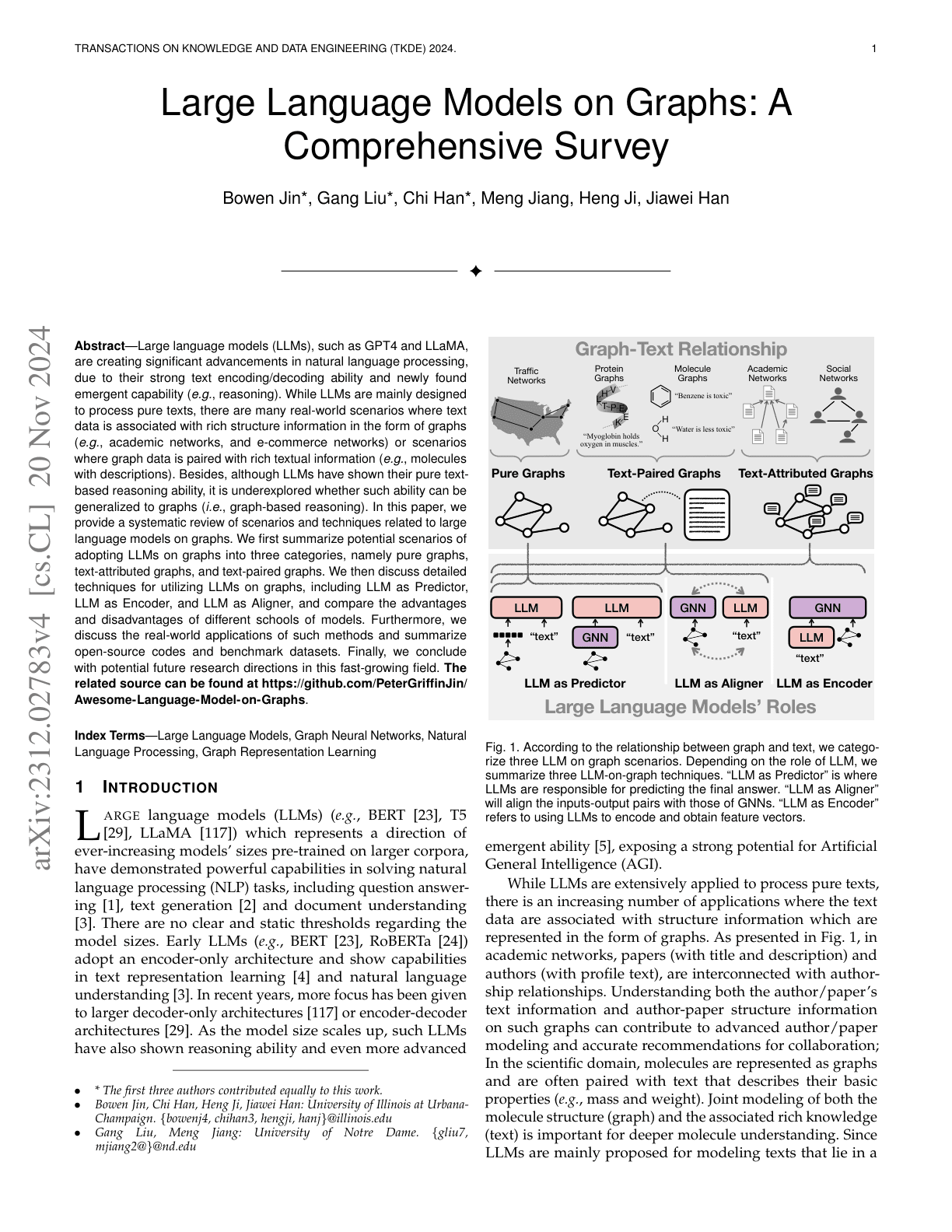
Three graph scenarios: Organizes the space by whether graphs are pure (no text), text-rich (nodes/edges carry natural language), or text-paired (graphs alongside documents).
Three role taxonomies: Categorizes LLMs as predictors, enhancers, or aligners with GNNs - clarifying whether the LLM is the model, a feature source, or a supervisor.
Task coverage: Spans node classification, link prediction, graph-level tasks, and reasoning over knowledge graphs.
Open problems: Flags scalability to large graphs, handling of graph structure without loss, and integration with tool-augmented LLMs as the key unsolved directions.
Abstract
Large language models (LLMs), such as GPT4 and LLaMA, are creating significant advancements in natural language processing, due to their strong text encoding/decoding ability and newly found emergent capability (e.g., reasoning). While LLMs are mainly designed to process pure texts, there are many real-world scenarios where text data is associated with rich structure information in the form of graphs (e.g., academic networks, and e-commerce networks) or scenarios where graph data is paired with rich textual information (e.g., molecules with descriptions). Besides, although LLMs have shown their pure text-based reasoning ability, it is underexplored whether such ability can be generalized to graphs (i.e., graph-based reasoning). In this paper, we provide a systematic review of scenarios and techniques related to large language models on graphs. We first summarize potential scenarios of adopting LLMs on graphs into three categories, namely pure graphs, text-attributed graphs, and text-paired graphs. We then discuss detailed techniques for utilizing LLMs on graphs, including LLM as Predictor, LLM as Encoder, and LLM as Aligner, and compare the advantages and disadvantages of different schools of models. Furthermore, we discuss the real-world applications of such methods and summarize open-source codes and benchmark datasets. Finally, we conclude with potential future research directions in this fast-growing field. The related source can be found at https://github.com/PeterGriffinJin/Awesome-Language-Model-on-Graphs.