LongHarness: Advancing Agentic Reasoning over 100M-Token Corpora via Stateful Evidence Management
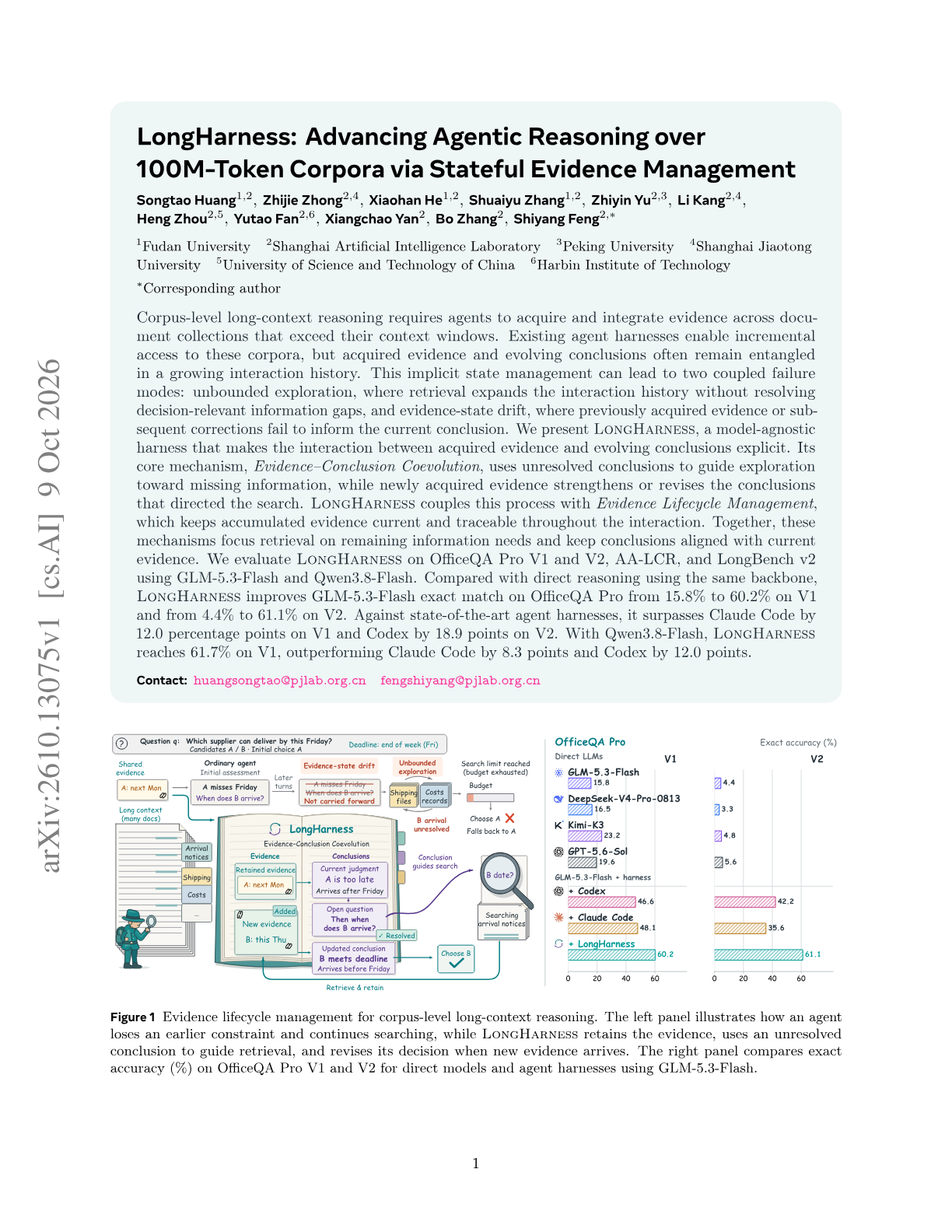
Songtao Huang, Shiyang Feng and colleagues (Shanghai AI Laboratory) present LongHarness, a model-agnostic agent harness for reasoning over corpora up to 100M tokens that stores evidence and conclusions as explicit state and updates each from the other.
Ask this paper
Two failure modes. When evidence and conclusions live only in the interaction history, agents keep retrieving without closing the information gap (unbounded exploration), and earlier evidence or corrections stop informing the current answer (evidence-state drift).
Evidence-Conclusion Coevolution. Open conclusions direct retrieval toward missing information, and each new piece of evidence confirms or revises the conclusions that requested it.
Evidence Lifecycle Management. Accumulated evidence is kept current and traceable, so corrections propagate to the conclusions that depend on them.
Results. With GLM-5.3-Flash, exact match on OfficeQA Pro rises from 15.8% to 60.2% on V1 and from 4.4% to 61.1% on V2 over direct reasoning, beating Claude Code by 12.0 points on V1 and Codex by 18.9 points on V2.
Second backbone. With Qwen3.8-Flash, LongHarness reaches 61.7% on V1, 8.3 points above Claude Code and 12.0 above Codex. Direct baselines reach at most 23.2% on V1 even with relevant passages in a 256K window.
Abstract
Corpus-level long-context reasoning requires agents to acquire and integrate evidence across document collections that exceed their context windows. Existing agent harnesses enable incremental access to these corpora, but acquired evidence and evolving conclusions often remain entangled in a growing interaction history. This implicit state management can lead to two coupled failure modes: unbounded exploration, where retrieval expands the interaction history without resolving decision-relevant information gaps, and evidence-state drift, where previously acquired evidence or subsequent corrections fail to inform the current conclusion. We present LongHarness, a model-agnostic harness that makes the interaction between acquired evidence and evolving conclusions explicit. Its core mechanism, Evidence-Conclusion Coevolution, uses unresolved conclusions to guide exploration toward missing information, while newly acquired evidence strengthens or revises the conclusions that directed the search. LongHarness couples this process with Evidence Lifecycle Management, which keeps accumulated evidence current and traceable throughout the interaction. Together, these mechanisms focus retrieval on remaining information needs and keep conclusions aligned with current evidence. We evaluate LongHarness on OfficeQA Pro V1 and V2, AA-LCR, and LongBench v2 using GLM-5.3-Flash and Qwen3.8-Flash. Compared with direct reasoning using the same backbone, LongHarness improves GLM-5.3-Flash exact match on OfficeQA Pro from 15.8% to 60.2% on V1 and from 4.4% to 61.1% on V2. Against state-of-the-art agent harnesses, it surpasses Claude Code by 12.0 percentage points on V1 and Codex by 18.9 points on V2. With Qwen3.8-Flash, LongHarness reaches 61.7% on V1, outperforming Claude Code by 8.3 points and Codex by 12.0 points.