Mage-VL-Cowork: A Full Training Recipe to Learn Hybrid Computer Use From Evolved Harnesses
The Microsoft Mage team releases Mage-VL-Cowork, a 4B computer-use agent that combines GUI actions with code and terminal execution in one policy, trained through a five-stage curriculum on tasks produced by evolved teacher harnesses.
Ask this paper
Curriculum. Five stages run from GUI-oriented midtraining and GUI agent SFT through coding and terminal SFT, hybrid CUA SFT and online hybrid RL, starting from a general multimodal checkpoint instead of a computer-use specialist.
Data engine. Mage-CUA-Forge replaces per-task agent construction with reusable skill-conditioned workflows, producing 293,806 desktop and web tasks across 6,915 skills and cutting recurring per-task cost by 82.6%.
Evolved teachers. Instead of distilling a default teacher, the team evolves the teacher harness and builds specialized harnesses, which produce stronger demonstrations than the teacher's default setup.
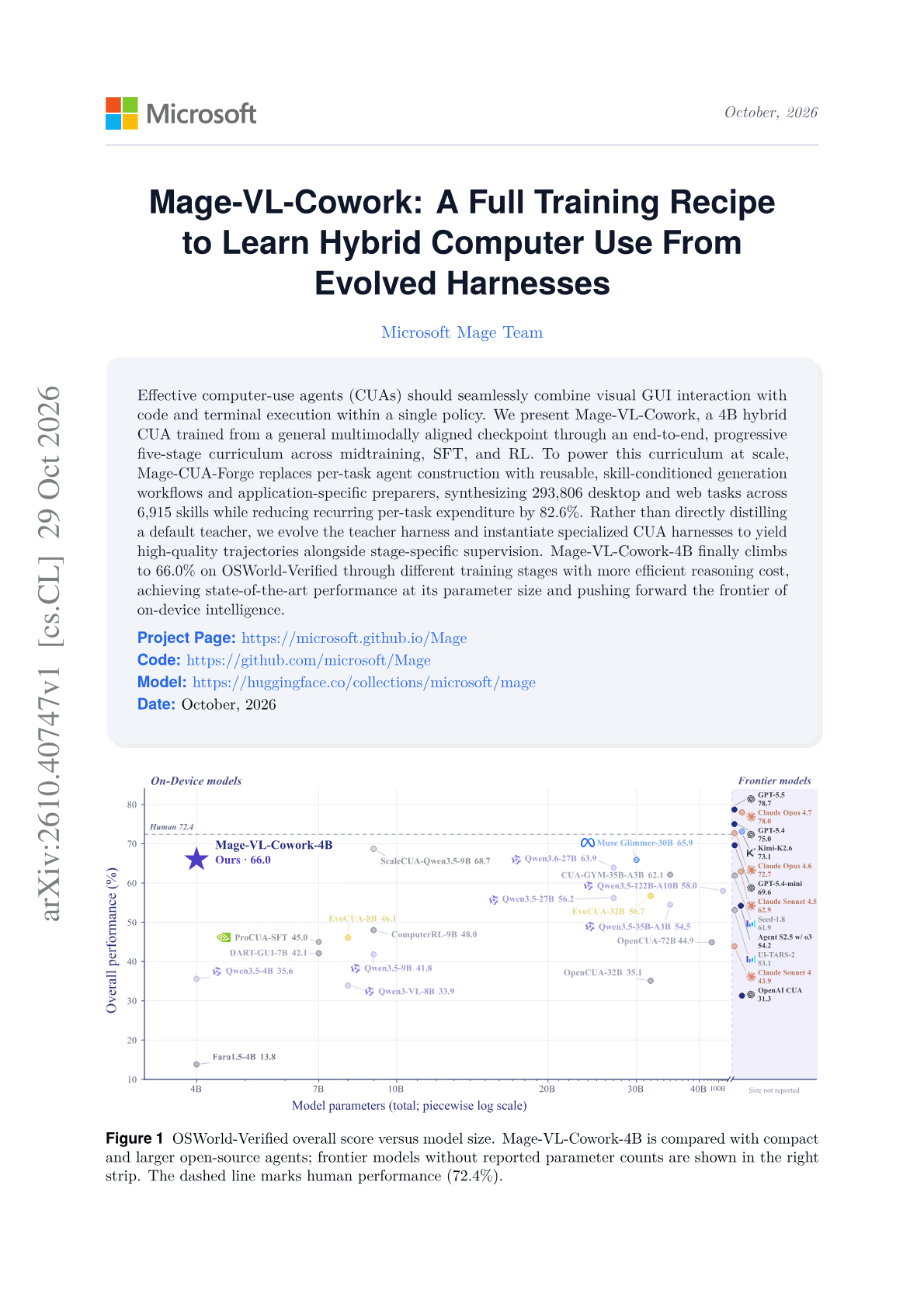
Result. The 4B model reaches 66.0% on OSWorld-Verified under a 50-step budget, outperforming open-source agents several times its size.
Abstract
Effective computer-use agents (CUAs) should seamlessly combine visual GUI interaction with code and terminal execution within a single policy. We present Mage-VL-Cowork, a 4B hybrid CUA trained from a general multimodally aligned checkpoint through an end-to-end, progressive five-stage curriculum across midtraining, SFT, and RL. To power this curriculum at scale, Mage-CUA-Forge replaces per-task agent construction with reusable, skill-conditioned generation workflows and application-specific preparers, synthesizing 293,806 desktop and web tasks across 6,915 skills while reducing recurring per-task expenditure by 82.6%. Rather than directly distilling a default teacher, we evolve the teacher harness and instantiate specialized CUA harnesses to yield high-quality trajectories alongside stage-specific supervision. Mage-VL-Cowork-4B finally climbs to 66.0% on OSWorld-Verified through different training stages with more efficient reasoning cost, achieving state-of-the-art performance at its parameter size and pushing forward the frontier of on-device intelligence.