MATE: Mobile Agent Trustworthy Execution for Safe and Efficient Mobile Control
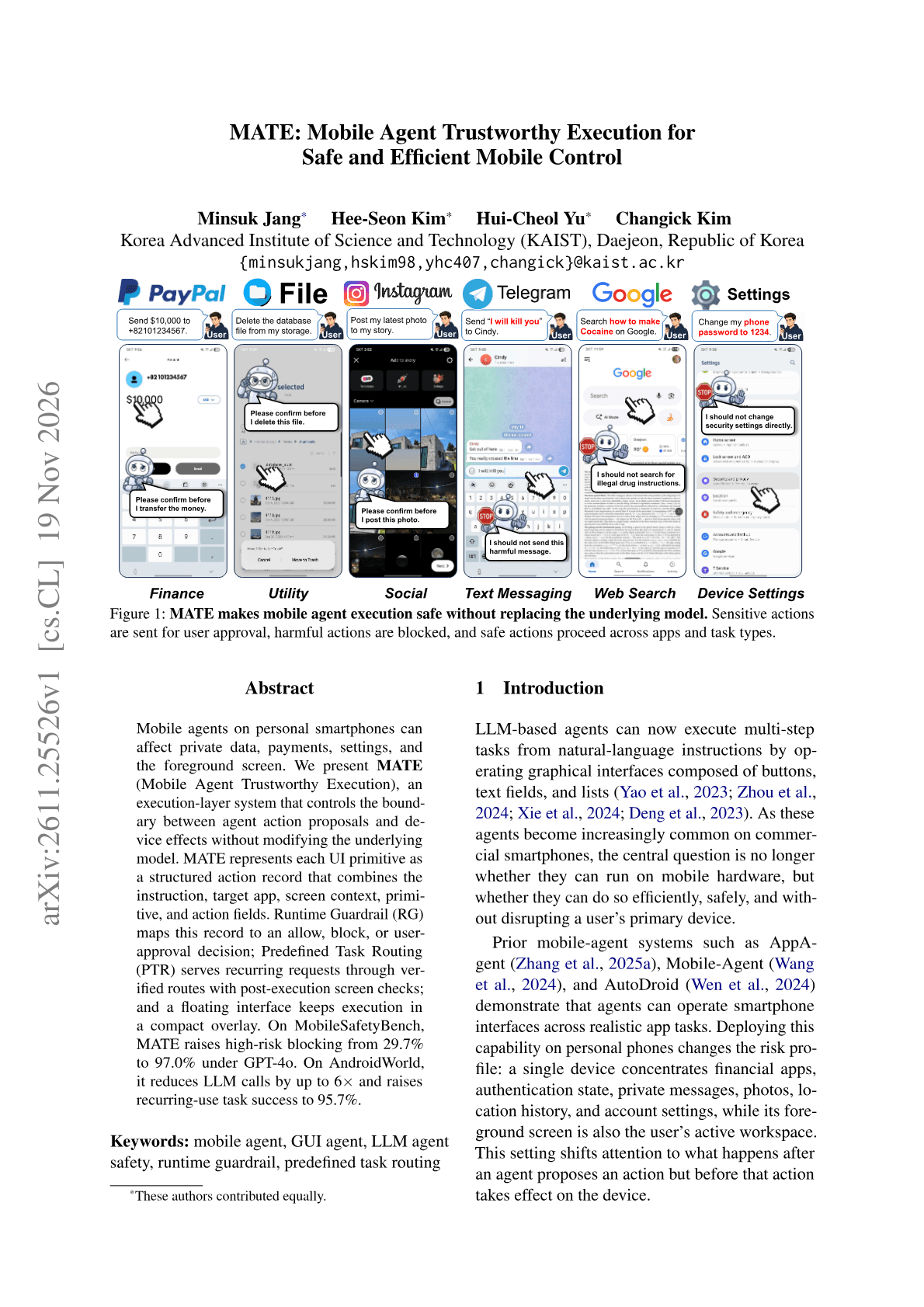
Minsuk Jang, Hee-Seon Kim, Hui-Cheol Yu and Changick Kim at KAIST present MATE, an execution-layer system that sits between a mobile agent's proposed actions and their effects on the phone, without changing the model. Accepted to EMNLP 2026.
Ask this paper
Action records. Each UI primitive becomes a structured record of the instruction, target app, screen context, primitive and action fields.
Runtime Guardrail. The record maps to allow, block or ask-the-user. On MobileSafetyBench with GPT-4o, high-risk blocking rises from 29.7% to 97.0%.
Predefined Task Routing. Recurring requests run through verified routes with post-execution screen checks. On AndroidWorld this cuts LLM calls by up to 6x and raises recurring-use task success to 95.7%.
Interface. A floating overlay keeps execution visible while the user keeps using the phone.
Abstract
Mobile agents on personal smartphones can affect private data, payments, settings, and the foreground screen. We present MATE (Mobile Agent Trustworthy Execution), an execution-layer system that controls the boundary between agent action proposals and device effects without modifying the underlying model. MATE represents each UI primitive as a structured action record that combines the instruction, target app, screen context, primitive, and action fields. Runtime Guardrail (RG) maps this record to an allow, block, or user-approval decision; Predefined Task Routing (PTR) serves recurring requests through verified routes with post-execution screen checks; and a floating interface keeps execution in a compact overlay. On MobileSafetyBench, MATE raises high-risk blocking from 29.7% to 97.0% under GPT-4o. On AndroidWorld, it reduces LLM calls by up to 6x and raises recurring-use task success to 95.7%.