MAWAM: A Multi-Agent World-Action Model for Coordinated Manipulation
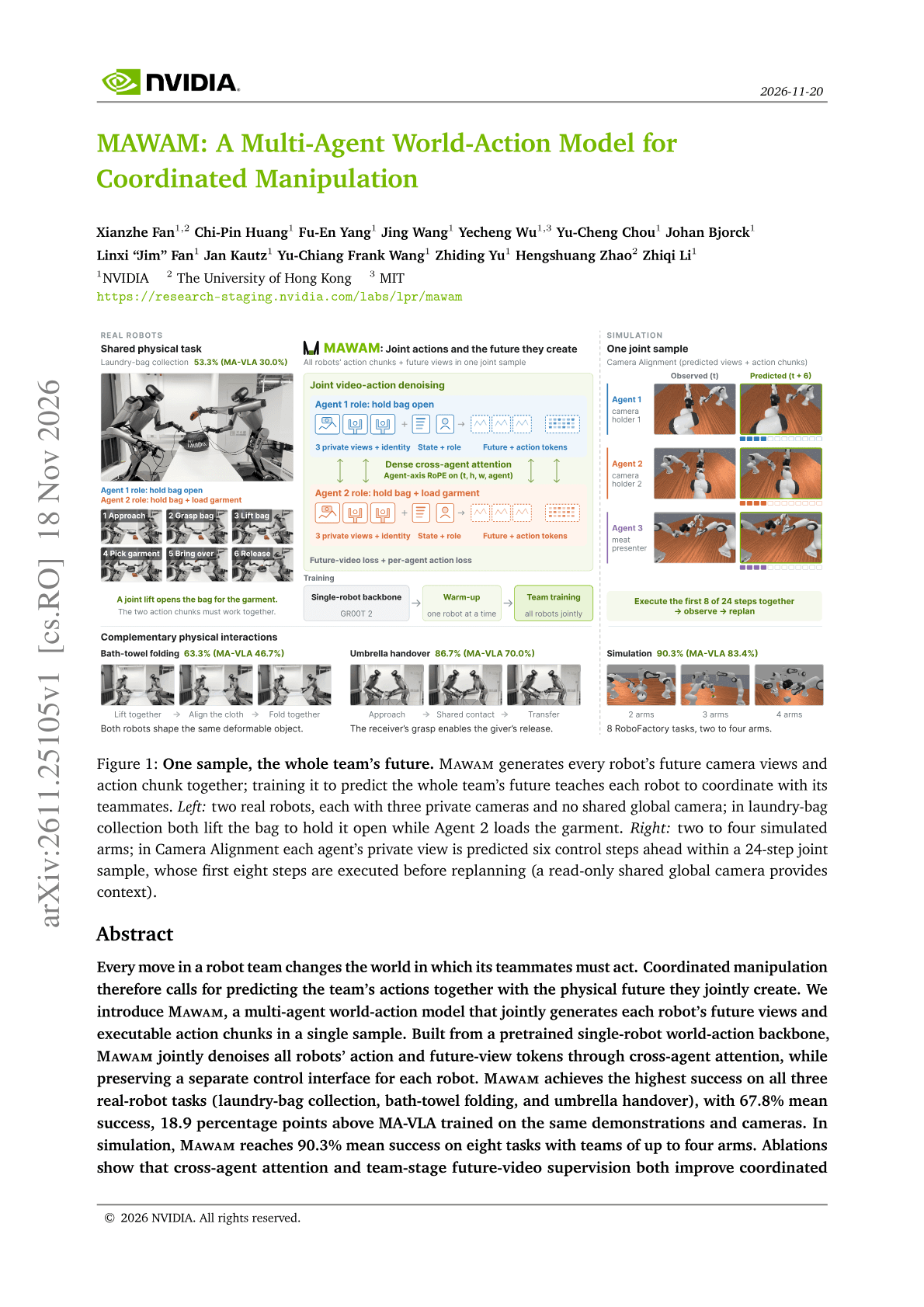
Xianzhe Fan, Chi-Pin Huang, Linxi Fan, Jan Kautz, Zhiding Yu and colleagues at NVIDIA and HKU introduce MAWAM, a multi-agent world-action model that generates every robot's next action chunk and future camera views in one joint sample.
Ask this paper
Joint generation. Built on a pretrained single-robot world-action backbone, MAWAM denoises all robots' action and future-view tokens together through cross-agent attention, while each robot keeps its own control interface.
Real robots. On laundry-bag collection, towel folding and umbrella handover, MAWAM reaches 67.8% mean success, 18.9 points above MA-VLA trained on the same demonstrations and cameras.
Simulation. It averages 90.3% across eight tasks with teams of two to four arms. Going from two to four arms raises sampling time only from 1.40 s to 1.85 s.
Ablations. Without cross-agent attention, a four-arm relay falls from 95.0% to 39.0% and real-robot mean success from 67.8% to 52.2%. Without team-stage future-video supervision, Place Food falls from 78.0% to 47.0%.
Abstract
Every move in a robot team changes the world in which its teammates must act. Coordinated manipulation therefore calls for predicting the team's actions together with the physical future they jointly create. We introduce MAWAM, a multi-agent world-action model that jointly generates each robot's future views and executable action chunks in a single sample. Built from a pretrained single-robot world-action backbone, MAWAM jointly denoises all robots' action and future-view tokens through cross-agent attention, while preserving a separate control interface for each robot. MAWAM achieves the highest success on all three real-robot tasks (laundry-bag collection, bath-towel folding, and umbrella handover), with 67.8% mean success, 18.9 percentage points above MA-VLA trained on the same demonstrations and cameras. In simulation, MAWAM reaches 90.3% mean success on eight tasks with teams of up to four arms. Ablations show that cross-agent attention and team-stage future-video supervision both improve coordinated control: without attention, a four-arm relay falls from 95.0% to 39.0%, and without this supervision, Place Food falls from 78.0% to 47.0%.