Meta-RTL: Evolving Agent Harnesses for RTL Optimization
Xinzhuang Xiong, Evangeline Young and colleagues at The Chinese University of Hong Kong present Meta-RTL, which evolves the search procedure of an RTL optimization agent from a minimal loop while holding the model, EDA flow and per-design budget fixed.
Ask this paper
Setup. Only the harness changes. The optimization model, synthesis flow and budgets stay the same, so gains come from the evolved search procedure.
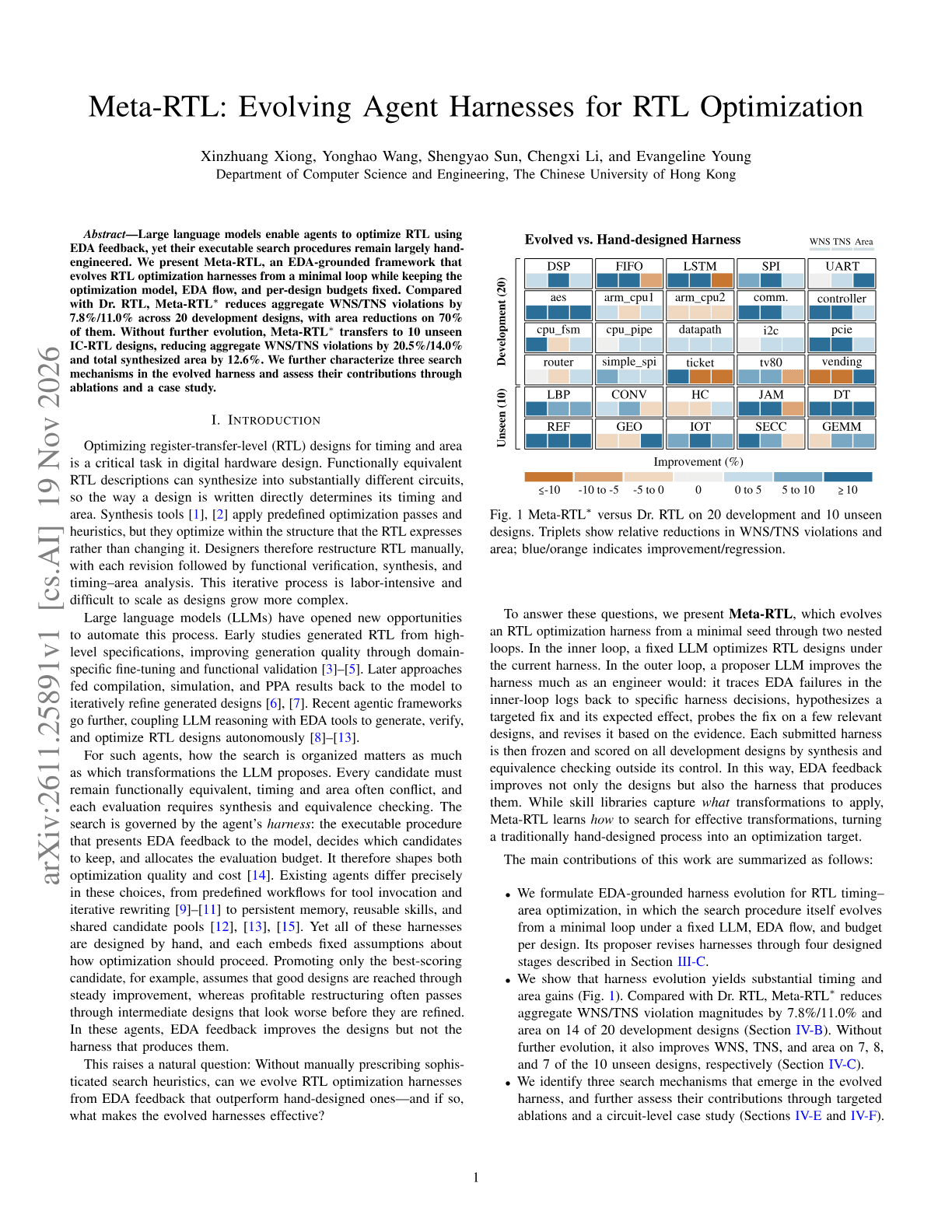
Development designs. Compared with the hand-built Dr. RTL agent, the evolved harness cuts aggregate WNS/TNS timing violations by 7.8%/11.0% across 20 designs and reduces area on 70% of them.
Transfer. Without further evolution, it cuts WNS/TNS by 20.5%/14.0% and total synthesized area by 12.6% on 10 unseen IC-RTL designs.
Analysis. Ablations and a case study isolate three search mechanisms that the evolution produced.
Abstract
Large language models enable agents to optimize RTL using EDA feedback, yet their executable search procedures remain largely hand- engineered. We present Meta-RTL, an EDA-grounded framework that evolves RTL optimization harnesses from a minimal loop while keeping the optimization model, EDA flow, and per-design budgets fixed. Compared with Dr. RTL, Meta-RTL* reduces aggregate WNS/TNS violations by 7.8%/11.0% across 20 development designs, with area reductions on 70% of them. Without further evolution, Meta-RTL* transfers to 10 unseen IC-RTL designs, reducing aggregate WNS/TNS violations by 20.5%/14.0% and total synthesized area by 12.6%. We further characterize three search mechanisms in the evolved harness and assess their contributions through ablations and a case study.