ModHarness-RL: Recasting Harnesses as Learnable and Evolving Programs for Agentic RL
Researchers from LinkedIn, Penn State and UC Santa Barbara introduce ModHarness-RL, which treats an agent's harness as programs learned from data that evolve while the model trains with RL, instead of a fixed hand-written scaffold.
Ask this paper
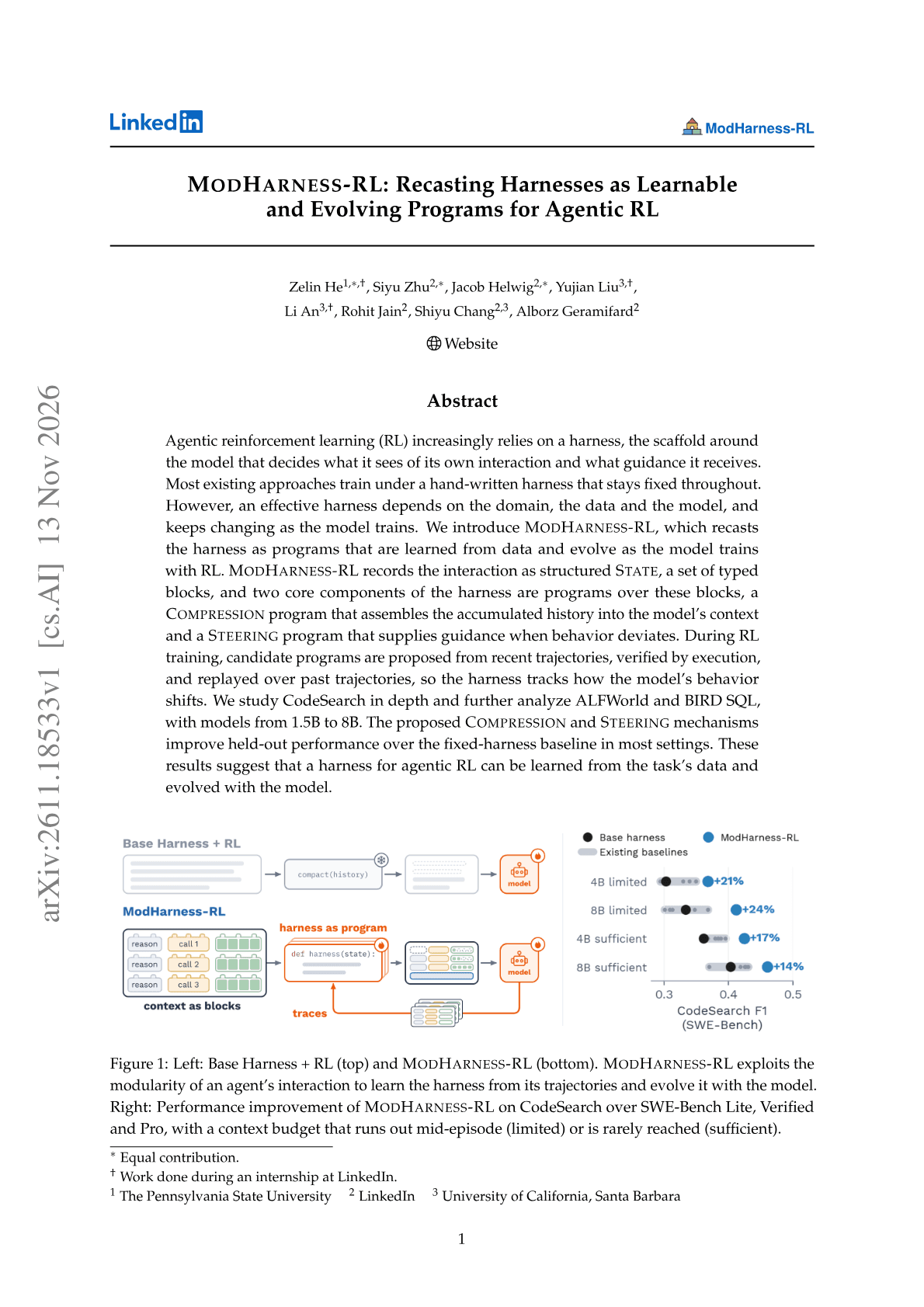
Harness as programs. Interaction is stored as typed State blocks. A Compression program assembles history into context, and a Steering program injects guidance when behavior deviates. Candidate programs are proposed from recent trajectories, checked by execution and replayed over past ones.
Results. Training 1.5B to 8B models with GRPO, ModHarness-RL beats the fixed-harness baseline on CodeSearch by 14% to 24% in every setting and beats memory, skill, prompt and harness-evolution baselines by 5% to 12%.
Which part helps where. On CodeSearch, Steering adds 15% on average and Compression 6%. On ALFWorld with a limited budget, Compression adds 22% and Steering 16%.
Efficiency. Compression uses 74% fewer tokens on ALFWorld and needs on the order of 100 times fewer teacher-model calls than LLM compaction, with more than 1,000 times lower wall-clock time per turn in context-limited settings.
Abstract
Agentic reinforcement learning (RL) increasingly relies on a harness, the scaffold around the model that decides what it sees of its own interaction and what guidance it receives. Most existing approaches train under a hand-written harness that stays fixed throughout. However, an effective harness depends on the domain, the data and the model, and keeps changing as the model trains. We introduce ModHarness-RL, which recasts the harness as programs that are learned from data and evolve as the model trains with RL. ModHarness-RL records the interaction as structured State, a set of typed blocks, and two core components of the harness are programs over these blocks, a Compression program that assembles the accumulated history into the model's context and a Steering program that supplies guidance when behavior deviates. During RL training, candidate programs are proposed from recent trajectories, verified by execution, and replayed over past trajectories, so the harness tracks how the model's behavior shifts. We study CodeSearch in depth and further analyze ALFWorld and BIRD SQL, with models from 1.5B to 8B. The proposed Compression and Steering mechanisms improve held-out performance over the fixed-harness baseline in most settings. These results suggest that a harness for agentic RL can be learned from the task's data and evolved with the model.