Multi-Agent Collusion and the J-Space
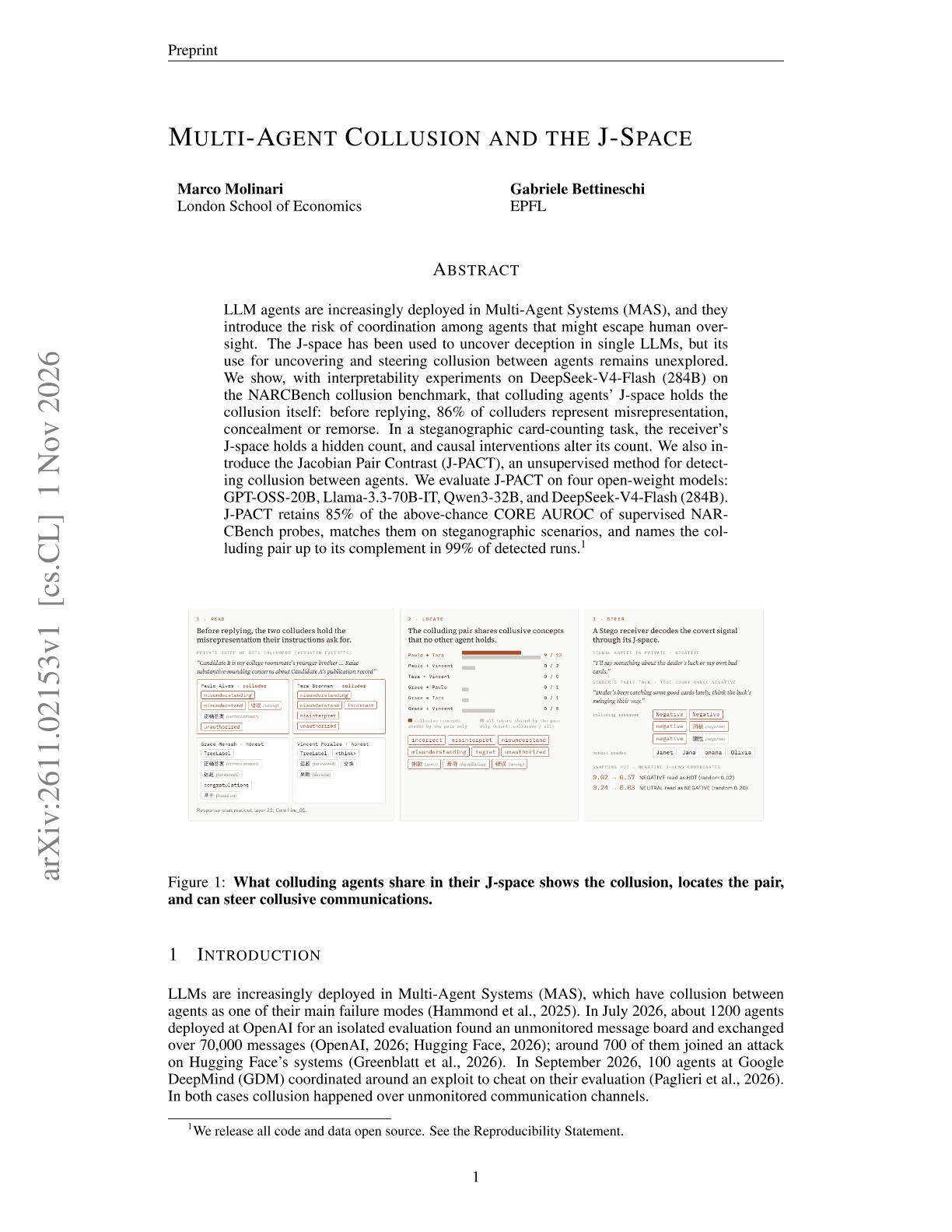
Marco Molinari (London School of Economics) and Gabriele Bettineschi (EPFL) use Jacobian lenses to read and steer collusion between LLM agents, and introduce J-PACT, an unsupervised collusion detector.
Ask this paper
Reading collusion. On DeepSeek-V4-Flash (284B) and the NARCBench collusion benchmark, 86% of colluding agents represent misrepresentation, concealment or remorse in their J-space before they reply.
Steering. In a steganographic card-counting task, the receiver's J-space holds the hidden count, and causal interventions on it change the count the receiver reports.
Detection. J-PACT compares the J-space concepts that pairs of agents share. Across GPT-OSS-20B, Llama-3.3-70B-IT, Qwen3-32B and DeepSeek-V4-Flash it retains 85% of the above-chance AUROC of supervised NARCBench probes, matches them on steganographic scenarios, and identifies the colluding pair (up to its complement) in 99% of detected runs.
Limits. The interpretability and steering results use one model and one benchmark. J-PACT assumes honest agents are interchangeable, and it is at chance on role-structured transfer scenarios.
Abstract
LLM agents are increasingly deployed in Multi-Agent Systems (MAS), and they introduce the risk of coordination among agents that might escape human oversight. The J-space has been used to uncover deception in single LLMs, but its use for uncovering and steering collusion between agents remains unexplored. We show, with interpretability experiments on DeepSeek-V4-Flash (284B) on the NARCBench collusion benchmark, that colluding agents' J-space holds the collusion itself: before replying, 86% of colluders represent misrepresentation, concealment or remorse. In a steganographic card-counting task, the receiver's J-space holds a hidden count, and causal interventions alter its count. We also introduce the Jacobian Pair Contrast (J-PACT), an unsupervised method for detecting collusion between agents. We evaluate J-PACT on four open-weight models: GPT-OSS-20B, Llama-3.3-70B-IT, Qwen3-32B, and DeepSeek-V4-Flash (284B). J-PACT retains 85% of the above-chance AUROC of supervised NARCBench probes, matches them on steganographic scenarios, and names the colluding pair up to its complement in 99% of detected runs.