Muted Distillation: Sealing Reasoning from Teacher Unlocks Token-Efficient Agents
Yuwei Zhang (UC San Diego), Ian Miao, Chen Qu and Donna Schut (Google), with Jingbo Shang (UCSD), find that on-policy distillation makes multi-turn agents reason longer, and propose Muted Distillation, which hides the student's reasoning from the teacher.
Ask this paper
The problem. A Qwen3.5-4B student distilled from a more token-efficient teacher ends up thinking about twice as long per turn after standard on-policy distillation.
Cause. When the teacher reads the student's partial reasoning, it prefers to extend that reasoning rather than conclude it, and reverse KL's mode-seeking objective rewards this. The extra tokens are ones the teacher already agrees with, so nothing in the loss discourages them.
The fix. Muted Distillation replaces the student's reasoning with an empty block in the teacher's context and takes loss only on the remaining tokens. It is a few lines of rollout code with no new data or hyperparameters.
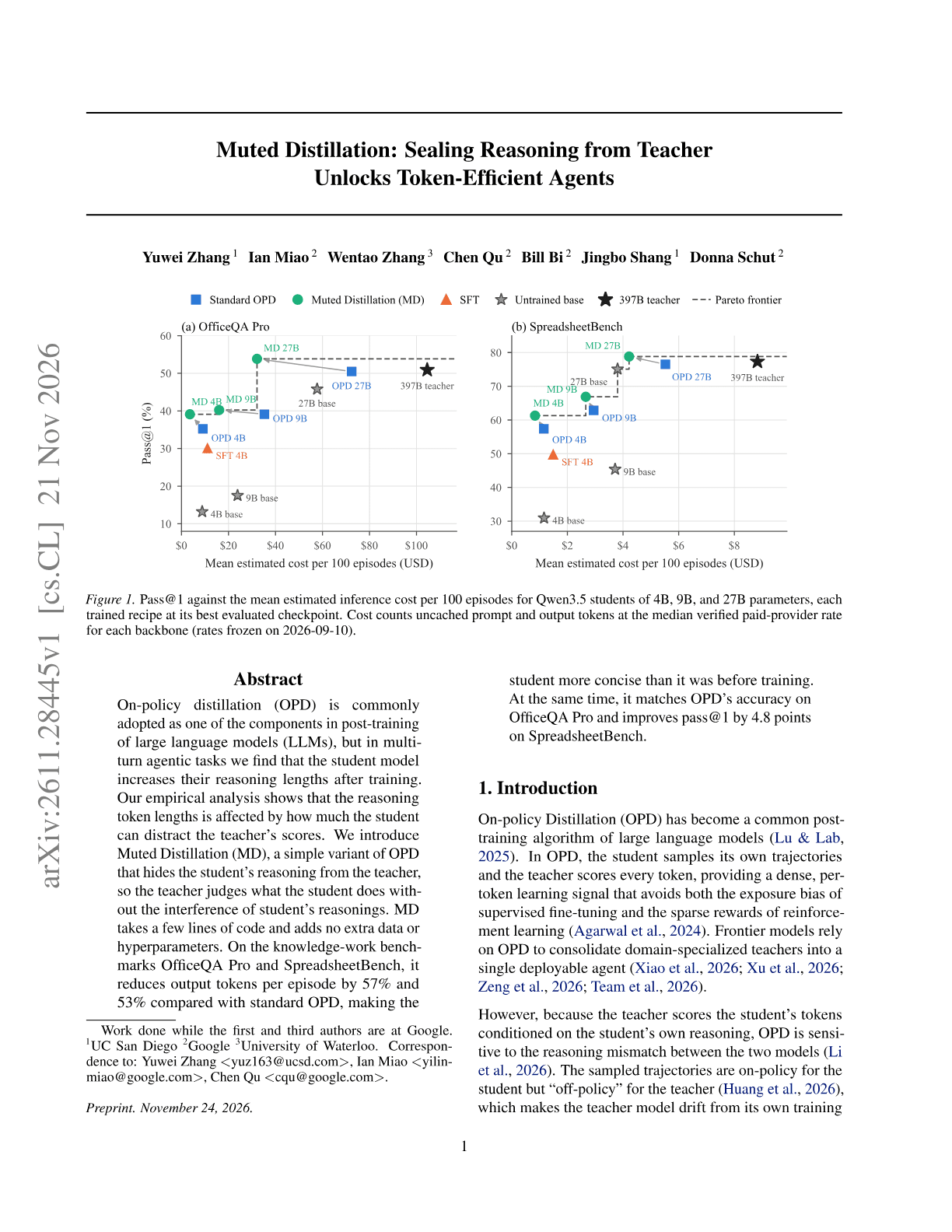
Results. Output tokens per episode drop by 57% on OfficeQA Pro and 53% on SpreadsheetBench versus standard on-policy distillation. Accuracy matches on OfficeQA Pro and pass@1 improves by 4.8 points on SpreadsheetBench.
Abstract
On-policy distillation (OPD) is commonly adopted as one of the components in post-training of large language models (LLMs), but in multi-turn agentic tasks we find that the student model increases their reasoning lengths after training. Our empirical analysis shows that the reasoning token lengths is affected by how much the student can distract the teacher's scores. We introduce Muted Distillation (MD), a simple variant of OPD that hides the student's reasoning from the teacher, so the teacher judges what the student does without the interference of student's reasonings. MD takes a few lines of code and adds no extra data or hyperparameters. On the knowledge-work benchmarks OfficeQA Pro and SpreadsheetBench, it reduces output tokens per episode by 57\% and 53\% compared with standard OPD, making the student more concise than it was before training. At the same time, it matches OPD's accuracy on OfficeQA Pro and improves pass@1 by 4.8 points on SpreadsheetBench.