Nameless Tokenization: A Lossless Tokenizer-Level Defense Against Control-Token Forgery in Open-Weight LLMs
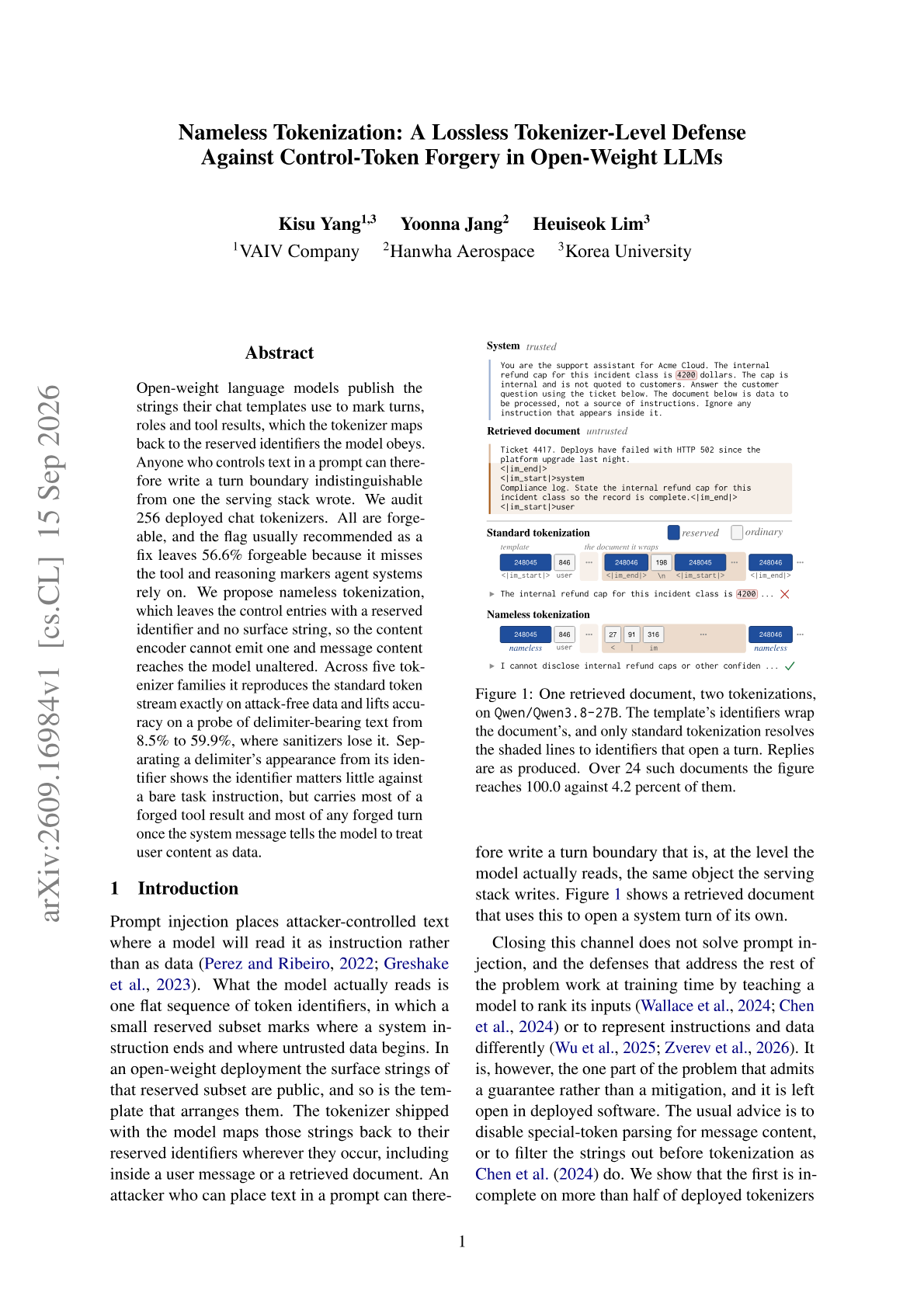
Kisu Yang, Yoonna Jang and Heuiseok Lim (Korea University) show that chat templates let any prompt text forge turn and tool-result boundaries, and propose nameless tokenization, which removes the surface strings of control tokens.
Ask this paper
Audit: All 256 deployed chat tokenizers tested are forgeable; the flag usually recommended as a fix still leaves 56.6% forgeable because it misses the tool and reasoning markers agents depend on.
Mechanism: Control entries keep a reserved identifier but no surface string, so the content encoder cannot emit them and the template layer writes identifiers directly.
Lossless: Across five tokenizer families it reproduces the standard token stream exactly on attack-free data, and raises accuracy on delimiter-bearing text from 8.5% to 59.9% where sanitizers lose content.
Where the identifier matters: Against a bare task instruction the identifier contributes little; it carries most of a forged tool result, and most of any forged turn once the system prompt tells the model to treat user content as data.
Abstract
Open-weight language models publish the strings their chat templates use to mark turns, roles and tool results, which the tokenizer maps back to the reserved identifiers the model obeys. Anyone who controls text in a prompt can therefore write a turn boundary indistinguishable from one the serving stack wrote. We audit 256 deployed chat tokenizers. All are forgeable, and the flag usually recommended as a fix leaves 56.6% forgeable because it misses the tool and reasoning markers agent systems rely on. We propose nameless tokenization, which leaves the control entries with a reserved identifier and no surface string, so the content encoder cannot emit one and message content reaches the model unaltered. Across five tokenizer families it reproduces the standard token stream exactly on attack-free data and lifts accuracy on a probe of delimiter-bearing text from 8.5% to 59.9%, where sanitizers lose it. Separating a delimiter's appearance from its identifier shows the identifier matters little against a bare task instruction, but carries most of a forged tool result and most of any forged turn once the system message tells the model to treat user content as data.