Negative-Only Policy Optimization for One-Sided Verifiable Rewards
Researchers at Nanyang Technological University define one-sided verifiability, where cheap checks can prove a solution wrong but cannot prove it right, and propose Negative-Only Policy Optimization (NOPO), which trains only on trusted failures. Accepted at NeurIPS 2026 as a spotlight.
Ask this paper
Problem. Unit tests, constraint checks and self-verifiers often pass wrong solutions. Standard RLVR then rewards shortcuts that pass the partial check without being correct.
Method. NOPO treats passing samples as unlabeled and updates the policy only by suppressing verified failures, with a reference-relative suppression loss and a group-level weight based on how many responses were not falsified.
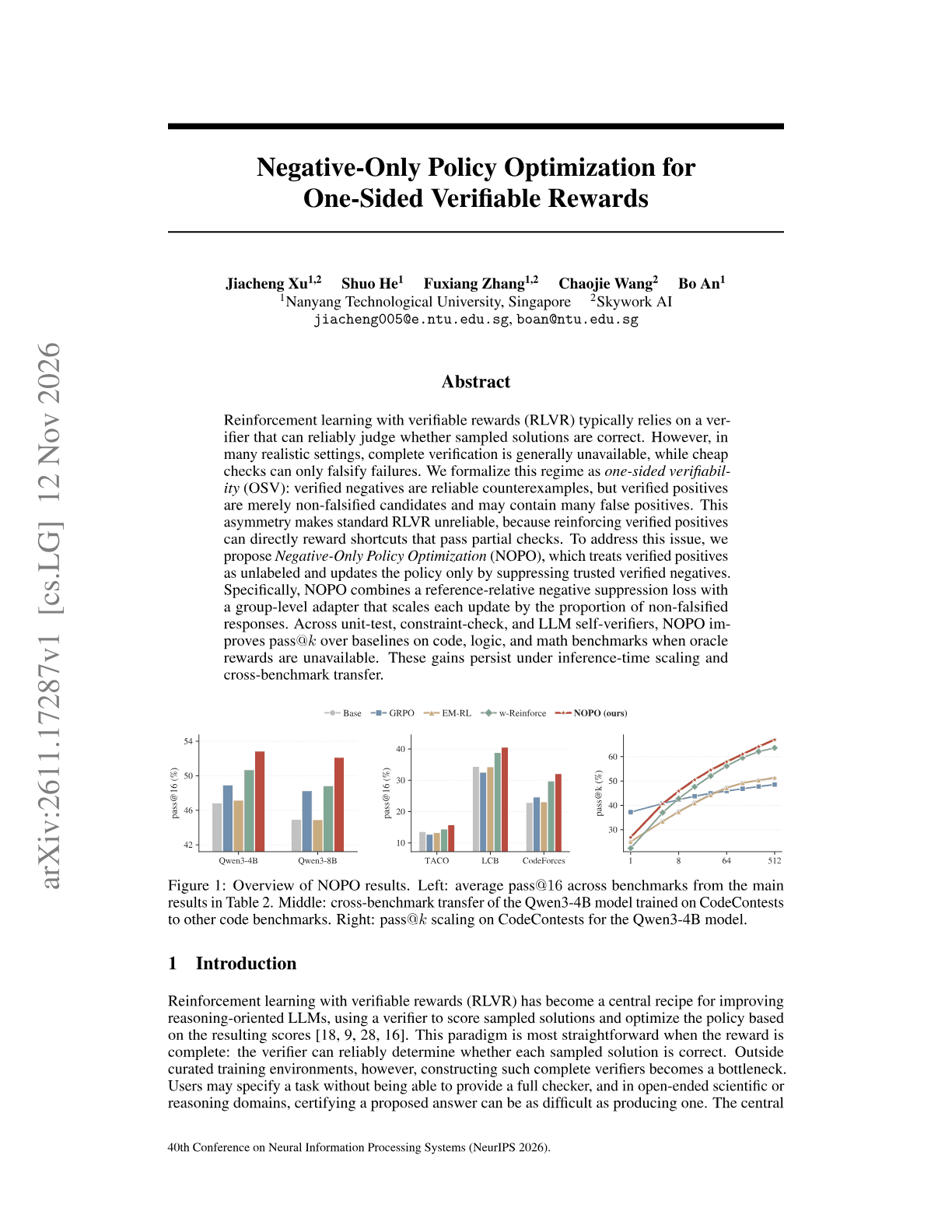
Results. Average pass@16 across code, logic and math rises from 48.93 (GRPO) to 52.86 on Qwen3-4B and from 48.27 to 52.13 on Qwen3-8B, the best among the RL methods compared.
Robustness. The gains hold under larger inference-time sampling and on benchmarks not used for training.
Abstract
Reinforcement learning with verifiable rewards (RLVR) typically relies on a verifier that can reliably judge whether sampled solutions are correct. However, in many realistic settings, complete verification is generally unavailable, while cheap checks can only falsify failures. We formalize this regime as one-sided verifiability (OSV): verified negatives are reliable counterexamples, but verified positives are merely non-falsified candidates and may contain many false positives. This asymmetry makes standard RLVR unreliable, because reinforcing verified positives can directly reward shortcuts that pass partial checks. To address this issue, we propose Negative-Only Policy Optimization (NOPO), which treats verified positives as unlabeled and updates the policy only by suppressing trusted verified negatives. Specifically, NOPO combines a reference-relative negative suppression loss with a group-level adapter that scales each update by the proportion of non-falsified responses. Across unit-test, constraint-check, and LLM self-verifiers, NOPO improves pass@k over baselines on code, logic, and math benchmarks when oracle rewards are unavailable. These gains persist under inference-time scaling and cross-benchmark transfer.