Octopus: One Brain, Many Branches for Latent-KV Multi-Agent Reinforcement Learning
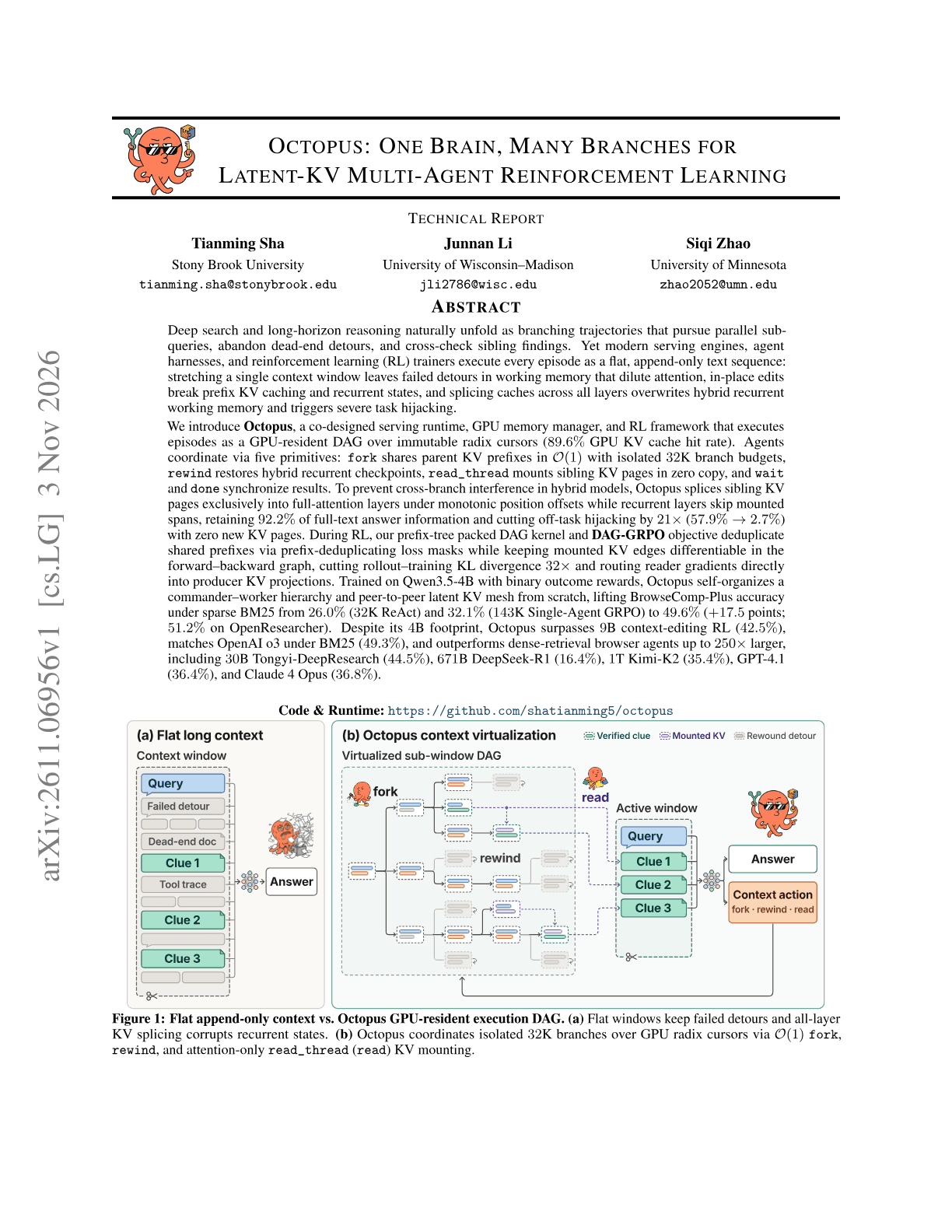
Tianming Sha, Junnan Li and Siqi Zhao (Stony Brook University, University of Wisconsin-Madison, University of Minnesota) present Octopus, a single-model multi-agent RL framework in which all sub-agent threads share one backbone and exchange findings through KV states on the GPU instead of text summaries.
Ask this paper
Primitives. Threads coordinate over a GPU-resident DAG of KV states through five operations: fork, read_thread, wait_threads, rewind and commit.
Zero-copy forking. Branches are cursor views over shared physical KV pages, so spawning a sub-agent costs O(1) extra memory.
KV mounting. A sibling thread's final KV blocks are mounted into full-attention layers only, bypassing the linear-recurrent states. This cuts off-task hijacking from 57.9% to 2.7% and keeps 92.2% of the mutual information of passing full text.
Training. A packed DAG-GRPO trainer runs all branches of an episode in one block-sparse attention pass and assigns credit to each branch with leave-one-branch-out rewards.
Results. Qwen3.5-4B with sparse BM25 retrieval reaches 49.6% on BrowseComp-Plus, 17.5 points above single-agent GRPO and 12.5 above text-summary multi-agent RL, and 51.2% on OpenResearcher. Training throughput rises 3.3x and peak KV memory falls 2.8x.
Abstract
Multi-agent LLM systems explore in parallel by spawning sub-agents with isolated context windows, whereas single-agent systems append every search and verification step into one growing trajectory. However, existing multi-agent frameworks duplicate prefix KV caches across branches, exchange findings by re-prefilling text summaries, and flatten or drop cross-branch dependencies during reinforcement learning (RL). We introduce Octopus, a single-model multi-agent RL framework in which all threads share one backbone and coordinate over a GPU-resident directed acyclic graph (DAG) of KV states through five primitives (fork, read_thread, wait_threads, rewind, commit). Octopus combines three co-designed mechanisms: (1) Zero-Copy Radix Forking, which spawns branches as $\mathcal{O}(1)$ cursor views over shared physical KV pages; (2) Attention-Only KV Mounting, which mounts a sibling thread's terminal KV blocks directly into full-attention layers while bypassing linear-recurrent states (Gated DeltaNet / Mamba-2), cutting off-task hijacking by $21\times$ ($57.9\% \to 2.7\%$) while retaining $92.2\%$ of full-text mutual information at zero extra KV allocation; and (3) a Packed DAG-GRPO Trainer, which packs all episode branches into one block-sparse attention pass and assigns counterfactual branch credit via leave-one-branch-out marginal rewards. Trained end-to-end with GRPO on Qwen3.5-4B over a sparse BM25 corpus, Octopus reaches $49.6\%$ accuracy on BrowseComp-Plus ($+17.5$ points over single-agent GRPO at 143K context and $+12.5$ points over text-summary multi-agent RL) and $51.2\%$ on OpenResearcher, outperforming dense-retrieval agents up to $250\times$ larger while increasing training throughput $3.3\times$ and cutting peak KV memory $2.8\times$.