PILOT in the Loop: Live Self-Improvement for Long-Horizon Agents
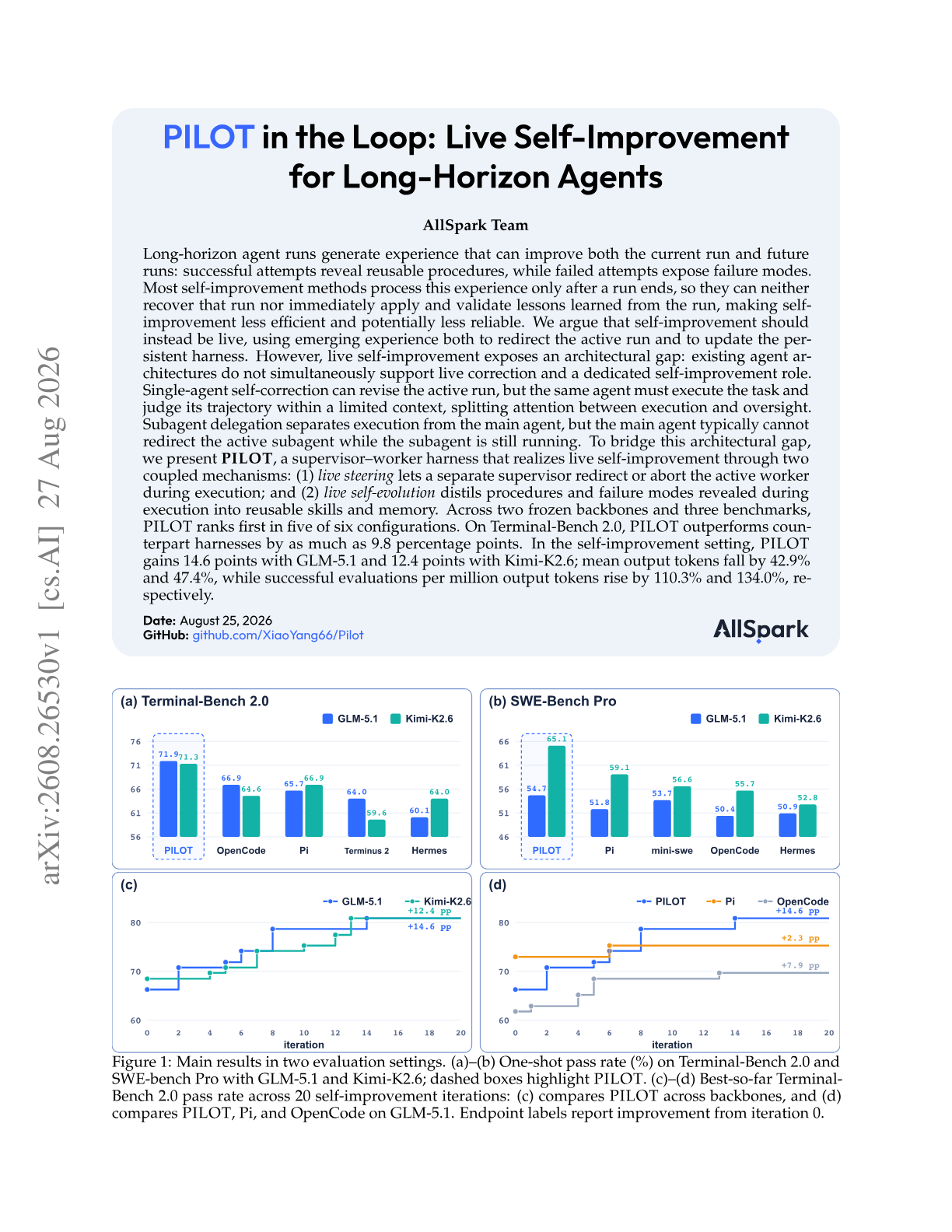
Yang Xiao and co-authors present PILOT, a supervisor-worker harness that improves a long-horizon agent while the run is still going rather than after it ends.
Ask this paper
Two coupled mechanisms: Live steering lets a separate supervisor redirect or abort the active worker mid-execution; live self-evolution distills procedures and failure modes revealed during the run into reusable skills and memory.
The architectural gap it fills: Single-agent self-correction mixes execution and trajectory assessment in one context; subagent delegation separates execution but usually cannot redirect an active subagent. PILOT does both.
Terminal-Bench 2.0 numbers: PILOT ranks first in five of six configurations across two frozen backbones and three benchmarks, beating counterpart harnesses by up to 9.8 percentage points.
Self-improvement gains: 14.6 points with GLM-5.1 and 12.4 with Kimi-K2.6, while mean output tokens fall 42.9% and 47.4% and successful evaluations per million output tokens rise 110.3% and 134.0%.
Why it matters: Accuracy up and tokens down at the same time is the signature of removing wasted exploration rather than buying accuracy with compute.
Abstract
Long-horizon agent runs generate experience that can improve both the current run and future work. Most self-improvement methods process this experience only after execution ends, so they cannot redirect the active run or immediately apply and validate lessons learned from it. We argue that self-improvement should instead be live, using emerging experience both to redirect the active run and to update the persistent harness. Existing agent architectures do not fully support this goal. Single-agent self-correction combines task execution and trajectory assessment within one context, while subagent delegation separates execution but typically cannot redirect an active subagent. We present PILOT, a supervisor-worker harness for live self-improvement through two coupled mechanisms: (1) live steering lets a separate supervisor redirect or abort the active worker during execution; and (2) live self-evolution distils procedures and failure modes revealed during execution into reusable skills and memory. Across two frozen backbones and three benchmarks, PILOT ranks first in five of six configurations. On Terminal-Bench 2.0, PILOT outperforms counterpart harnesses by up to 9.8 percentage points. In the self-improvement setting, PILOT gains 14.6 points with GLM-5.1 and 12.4 points with Kimi-K2.6. Mean output tokens fall by 42.9% and 47.4%, while successful evaluations per million output tokens rise by 110.3% and 134.0%, respectively.