Praxist: From Experimental Artifacts to Solution Lineages
Jin Li and a large team introduce Praxist, which replaces the flat log-and-memory design of autonomous R&D agents with a typed evidence graph that tracks which design element actually produced an improvement.
Ask this paper
The diagnosis is structural, not model-level: Most autonomous R&D systems treat each attempt as self-contained, so logs and search trees record what happened without establishing causation. Long campaigns re-learn the same lessons because nothing in the state carries attribution.
Solution lineages over run logs: Praxist converts reproducible artifacts and evaluator outcomes into a typed graph of findings, lane-structured frontiers and agendas, separating local artifact construction from cohort-level evidence accumulation.
Attribution is the primitive: The graph records whether a finding's evidence survived validation and how it recombines with others, which is exactly the information a flat memory store discards.
Why it matters: If you run long agent campaigns, this is the argument that the bottleneck is evidence bookkeeping rather than model capability. The lineage framing is portable to any harness with a persistent memory layer.
Abstract
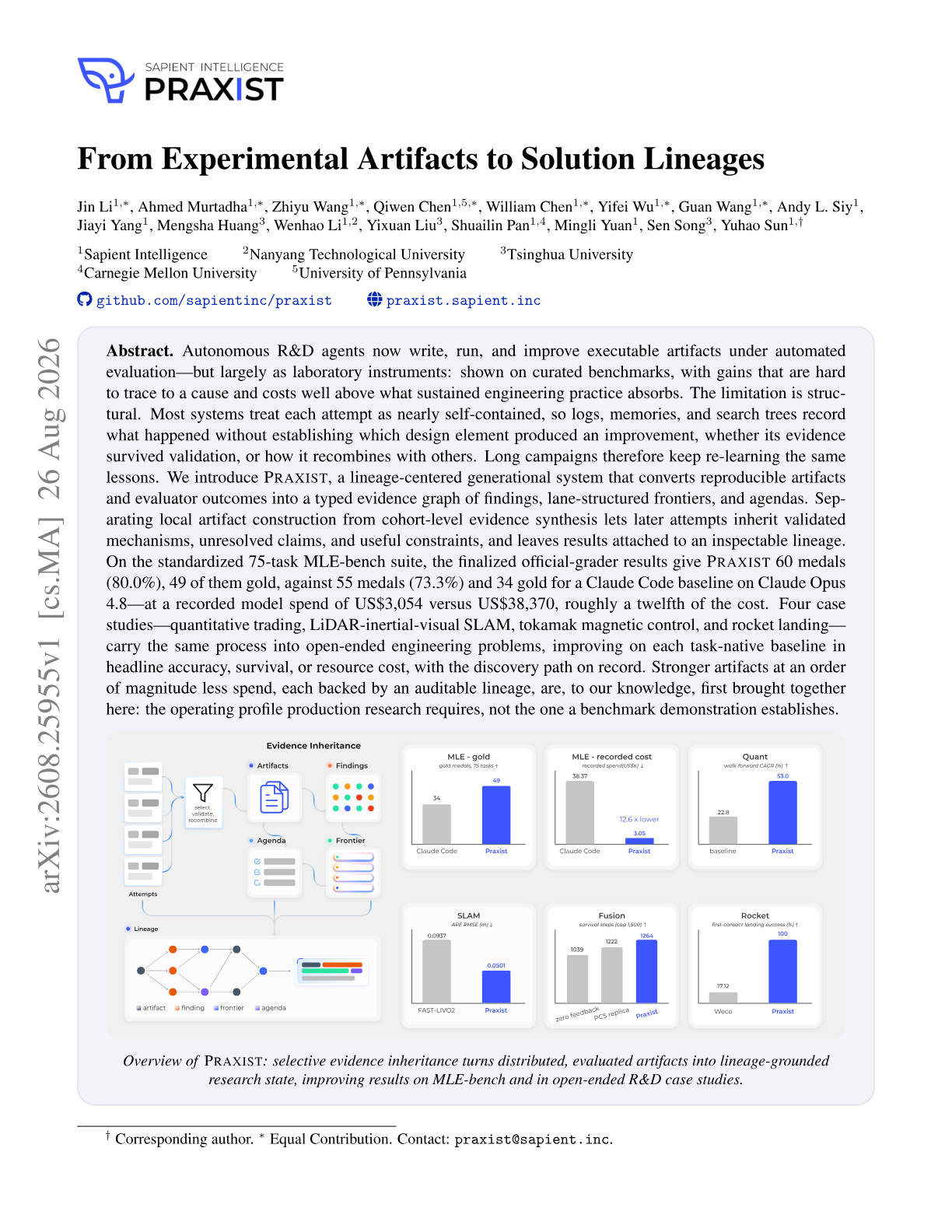
Autonomous R&D agents now write, run, and improve executable artifacts under automated evaluation, but largely as laboratory instruments: shown on curated benchmarks, with gains that are hard to trace to a cause and costs well above what sustained engineering practice absorbs. The limitation is structural. Most systems treat each attempt as nearly self-contained, so logs, memories, and search trees record what happened without establishing which design element produced an improvement, whether its evidence survived validation, or how it recombines with others. Long campaigns therefore keep re-learning the same lessons. We introduce Praxist, a lineage-centered generational system that converts reproducible artifacts and evaluator outcomes into a typed evidence graph of findings, lane-structured frontiers, and agendas. Separating local artifact construction from cohort-level evidence synthesis lets later attempts inherit validated mechanisms, unresolved claims, and useful constraints, and leaves results attached to an inspectable lineage. On the standardized 75-task MLE-bench suite, the finalized official-grader results give Praxist 60 medals (80.0\%), 49 of them gold, against 55 medals (73.3\%) and 34 gold for a Claude Code baseline on Claude Opus 4.8, at a recorded model spend of US\$3,054 versus US\$38,370, roughly a twelfth of the cost. Four case studies, quantitative trading, LiDAR-inertial-visual SLAM, tokamak magnetic control, and rocket landing, carry the same process into open-ended engineering problems, improving on each task-native baseline in headline accuracy, survival, or resource cost, with the discovery path on record. Stronger artifacts at an order of magnitude less spend, each backed by an auditable lineage, are, to our knowledge, first brought together here: the operating profile production research requires, not the one a benchmark demonstration establishes.