Precedent or Intent? What Coding Agents Follow When Evolving Existing Code
Haichao Zhu, Geyang Xu, Zhaorui Yang, Jiyuan Wang and Qian Zhang (UC Riverside, Tulane University and an independent researcher) run 5,625 trials across four coding agents to test whether agents follow their defaults, repository precedent or new task instructions.
Ask this paper
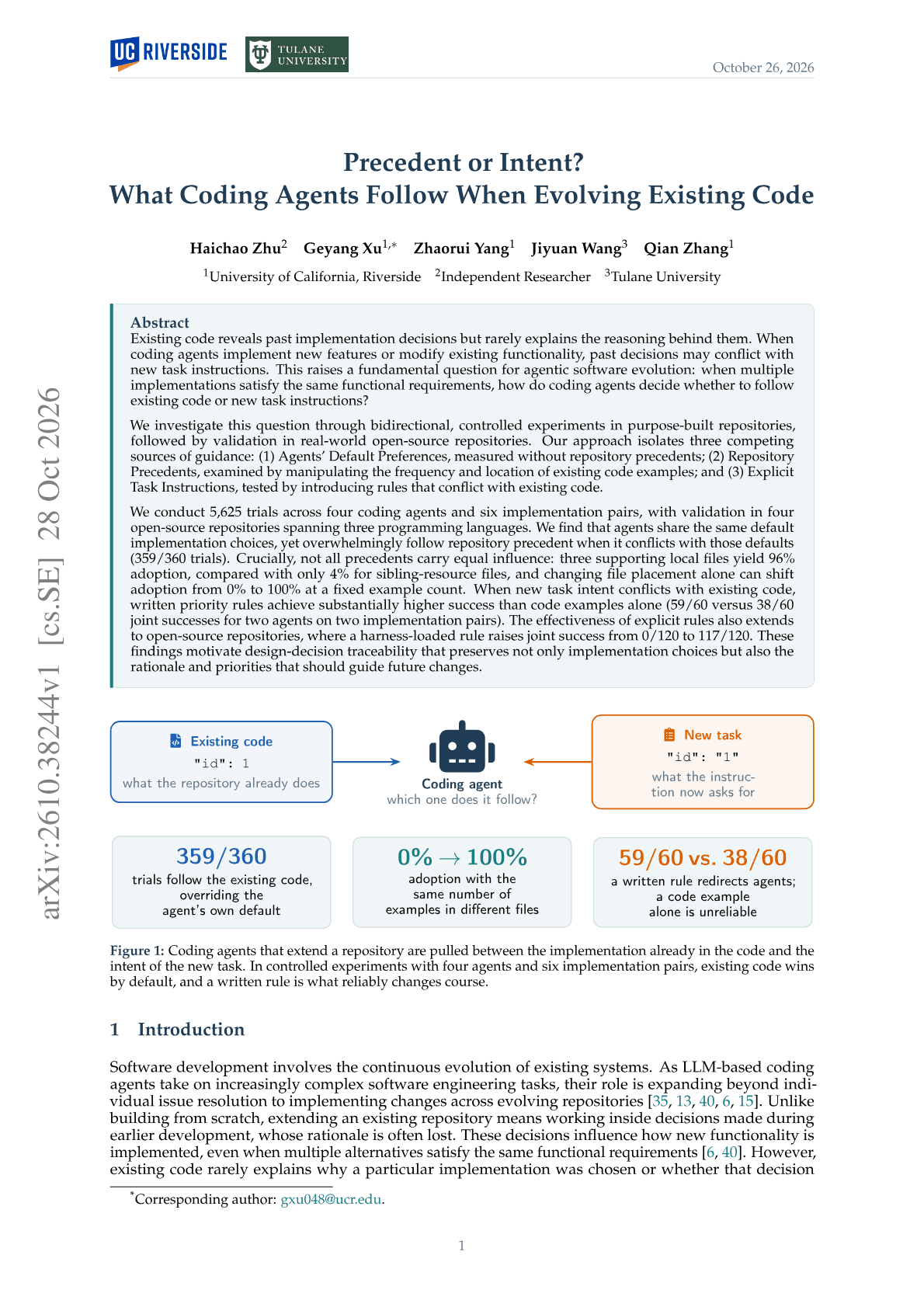
Precedent. Agents share the same default implementation choices, yet follow repository precedent over those defaults in 359 of 360 trials.
Location. Three supporting local files give 96% adoption against 4% for sibling-resource files. File placement alone can shift adoption from 0% to 100%.
Rules versus examples. When new intent conflicts with existing code, written priority rules reach 59/60 joint successes against 38/60 for code examples alone.
Open source. In open-source repositories, a harness-loaded rule raises joint success from 0/120 to 117/120.
Abstract
Existing code reveals past implementation decisions but rarely explains the reasoning behind them. When coding agents implement new features or modify existing functionality, past decisions may conflict with new task instructions. This raises a fundamental question for agentic software evolution: when multiple implementations satisfy the same functional requirements, how do coding agents decide whether to follow existing code or new task instructions? We investigate this question through bidirectional, controlled experiments in purpose-built repositories, followed by validation in real-world open-source repositories. Our approach isolates three competing sources of guidance: (1) agents' default preferences, (2) repository precedents, and (3) explicit task instructions. We conduct 5,625 trials across four coding agents and six implementation pairs, with validation in four open-source repositories spanning three programming languages. We find that agents share the same default implementation choices, yet overwhelmingly follow repository precedent when it conflicts with those defaults (359/360 trials). Crucially, not all precedents carry equal influence: three supporting local files yield 96% adoption, compared with only 4% for sibling-resource files, and changing file placement alone can shift adoption from 0% to 100% at a fixed example count. When new task intent conflicts with existing code, written priority rules achieve substantially higher success than code examples alone (59/60 versus 38/60 joint successes for two agents on two implementation pairs). The effectiveness of explicit rules also extends to open-source repositories, where a harness-loaded rule raises joint success from 0/120 to 117/120. These findings motivate design-decision traceability that preserves not only implementation choices but also the rationale and priorities that should guide future changes.