Precision-RL
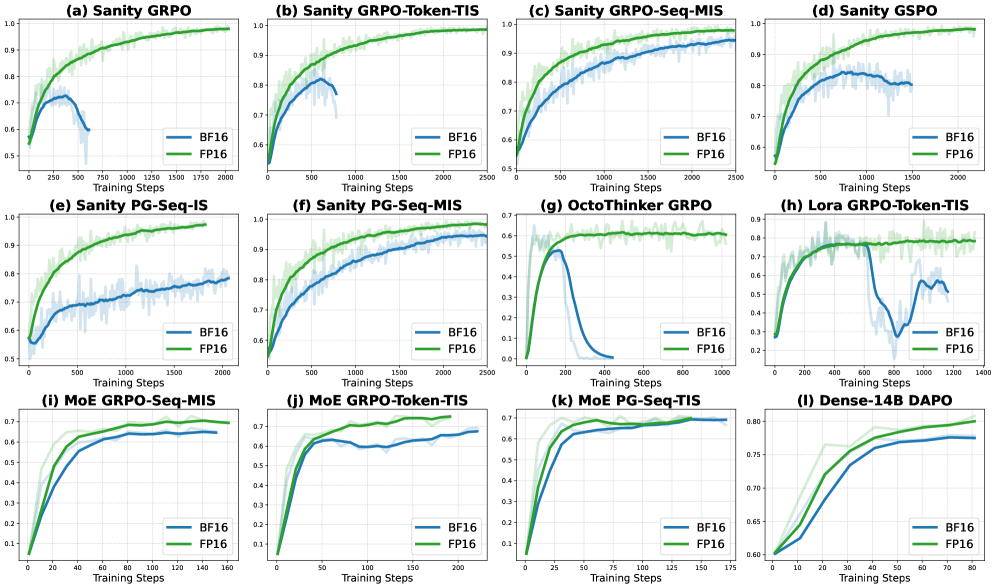
Reinforcement learning fine-tuning of large language models suffers from a critical numerical mismatch between training and inference engines, causing training instability and collapse. This work reveals that simply switching from BF16 to FP16 precision virtually eliminates this mismatch - achieving faster convergence, higher stability, and superior performance across diverse models, frameworks, and algorithms without any algorithmic changes or architectural modifications.
Ask this paper
Abstract
Reinforcement learning (RL) fine-tuning of large language models (LLMs) often suffers from instability due to the numerical mismatch between the training and inference policies. While prior work has attempted to mitigate this issue through algorithmic corrections or engineering alignments, we show that its root cause lies in the floating point precision itself. The widely adopted BF16, despite its large dynamic range, introduces large rounding errors that breaks the consistency between training and inference. In this work, we demonstrate that simply reverting to \textbf{FP16} effectively eliminates this mismatch. The change is simple, fully supported by modern frameworks with only a few lines of code change, and requires no modification to the model architecture or learning algorithm. Our results suggest that using FP16 uniformly yields more stable optimization, faster convergence, and stronger performance across diverse tasks, algorithms and frameworks. We hope these findings motivate a broader reconsideration of precision trade-offs in RL fine-tuning.