PrimeScientist: Strategic Allocation of Research Effort in Autonomous Research
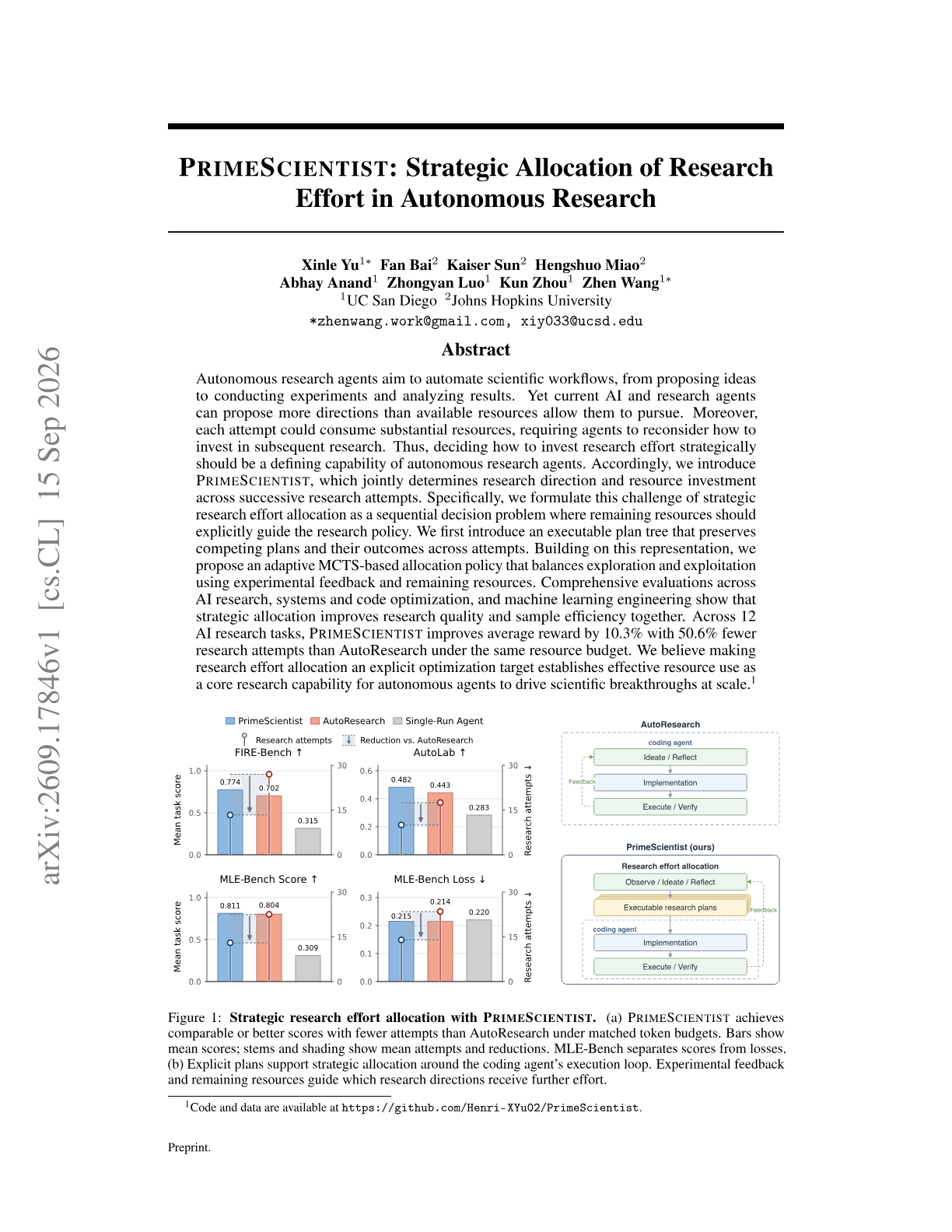
Xinle Yu, Zhen Wang and colleagues at UC San Diego and Johns Hopkins University present PrimeScientist, which treats deciding where to spend a research agent's limited budget as a sequential decision problem.
Ask this paper
Executable plan tree. The tree keeps competing plans and their outcomes across successive research attempts.
MCTS allocation. An adaptive MCTS policy uses experimental feedback and remaining resources to balance exploration and exploitation.
Efficiency. On 12 AI research tasks, PrimeScientist raises average reward by 10.3% with 50.6% fewer research attempts than AutoResearch under the same budget; gains also hold for systems, code optimization and MLE tasks.
Abstract
Autonomous research agents aim to automate scientific workflows, from proposing ideas to conducting experiments and analyzing results. Yet current AI and research agents can propose more directions than available resources allow them to pursue. Moreover, each attempt could consume substantial resources, requiring agents to reconsider how to invest in subsequent research. Thus, deciding how to invest research effort strategically should be a defining capability of autonomous research agents. Accordingly, we introduce PrimeScientist, which jointly determines research direction and resource investment across successive research attempts. Specifically, we formulate this challenge of strategic research effort allocation as a sequential decision problem where remaining resources should explicitly guide the research policy. We first introduce an executable plan tree that preserves competing plans and their outcomes across attempts. Building on this representation, we propose an adaptive MCTS-based allocation policy that balances exploration and exploitation using experimental feedback and remaining resources. Comprehensive evaluations across AI research, systems and code optimization, and machine learning engineering show that strategic allocation improves research quality and sample efficiency together. Across 12 AI research tasks, PrimeScientist improves average reward by 10.3% with 50.6% fewer research attempts than AutoResearch under the same resource budget. We believe making research effort allocation an explicit optimization target establishes effective resource use as a core research capability for autonomous agents to drive scientific breakthroughs at scale.