ProbeAgent: Principled Diagnosis of Agent Failures in Verifiable Environments
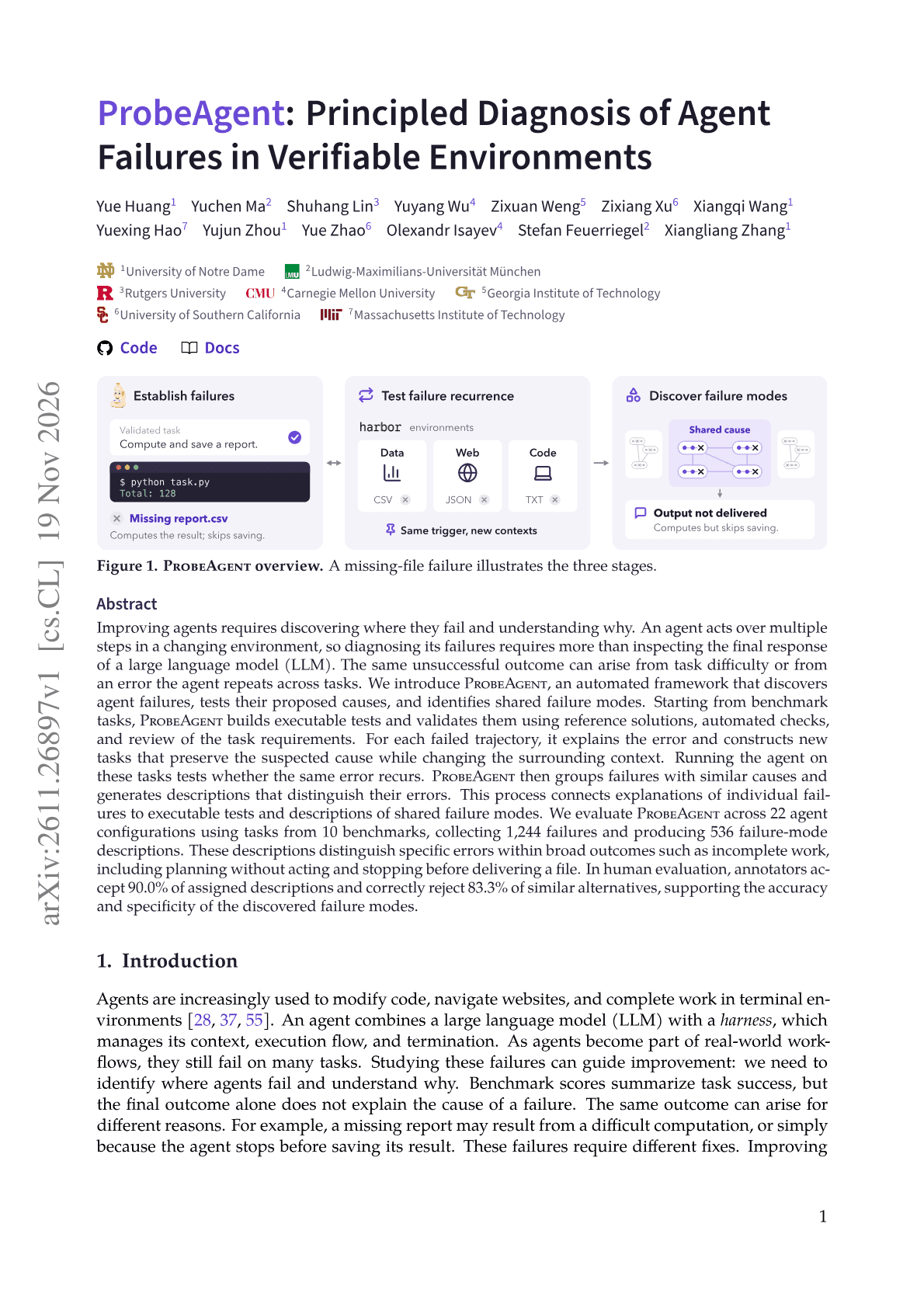
Yue Huang, Xiangliang Zhang and collaborators (University of Notre Dame, LMU Munich, CMU, Georgia Tech and others) present ProbeAgent, which explains each agent failure, builds new tasks that keep the suspected cause while changing the context, and reruns the agent to test whether the error recurs.
Ask this paper
Causes, not outcomes. A failed run can come from task difficulty or from an error the agent repeats. ProbeAgent separates the two by testing the proposed cause on new tasks.
Pipeline. It builds executable tests from benchmark tasks, validates them with reference solutions, automated checks and requirement review, explains each failed trajectory, generates cause-preserving variants, reruns the agent, and clusters confirmed failures into failure modes.
Scale. Across 22 agent configurations and tasks from 10 benchmarks, it collects 1,244 failures and produces 536 failure-mode descriptions.
Specificity. Descriptions split broad outcomes such as incomplete work into specific errors, for example planning without acting or stopping before delivering a file.
Human check. Annotators accept 90.0% of assigned descriptions and correctly reject 83.3% of similar alternatives.
Abstract
Improving agents requires discovering where they fail and understanding why. An agent acts over multiple steps in a changing environment, so diagnosing its failures requires more than inspecting the final response of a large language model (LLM). The same unsuccessful outcome can arise from task difficulty or from an error the agent repeats across tasks. We introduce ProbeAgent, an automated framework that discovers agent failures, tests their proposed causes, and identifies shared failure modes. Starting from benchmark tasks, ProbeAgent builds executable tests and validates them using reference solutions, automated checks, and review of the task requirements. For each failed trajectory, it explains the error and constructs new tasks that preserve the suspected cause while changing the surrounding context. Running the agent on these tasks tests whether the same error recurs. ProbeAgent then groups failures with similar causes and generates descriptions that distinguish their errors. This process connects explanations of individual failures to executable tests and descriptions of shared failure modes. We evaluate ProbeAgent across 22 agent configurations using tasks from 10 benchmarks, collecting 1,244 failures and producing 536 failure-mode descriptions. These descriptions distinguish specific errors within broad outcomes such as incomplete work, including planning without acting and stopping before delivering a file. In human evaluation, annotators accept 90.0% of assigned descriptions and correctly reject 83.3% of similar alternatives, supporting the accuracy and specificity of the discovered failure modes.