Prompt2Model
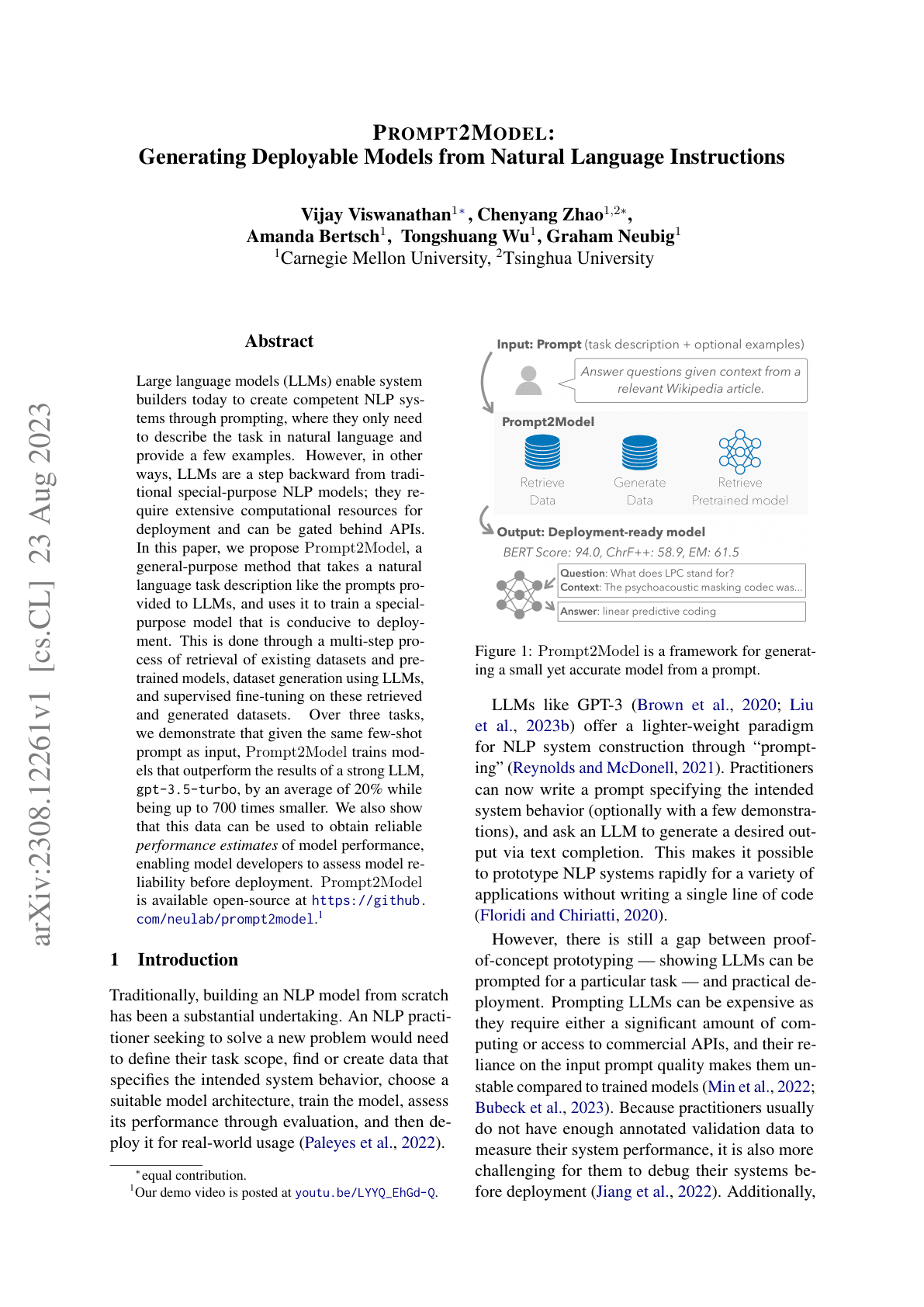
CMU's Prompt2Model automates the path from a natural-language task description to a deployable small special-purpose model.
Ask this paper
Prompt-as-specification: Users describe the target task in natural language; the framework produces a small model that can execute it.
Three-channel pipeline: Automatically assembles training data via dataset retrieval (find relevant existing data), dataset generation (synthesize new data), and model retrieval (find relevant pretrained models).
Small deployable output: Produces small, efficient models suitable for deployment - not just API wrappers around frontier LLMs.
Accessibility gain: Lowers the barrier for non-ML practitioners to build task-specific models, abstracting away much of the data-engineering burden.
Abstract
Large language models (LLMs) enable system builders today to create competent NLP systems through prompting, where they only need to describe the task in natural language and provide a few examples. However, in other ways, LLMs are a step backward from traditional special-purpose NLP models; they require extensive computational resources for deployment and can be gated behind APIs. In this paper, we propose Prompt2Model, a general-purpose method that takes a natural language task description like the prompts provided to LLMs, and uses it to train a special-purpose model that is conducive to deployment. This is done through a multi-step process of retrieval of existing datasets and pretrained models, dataset generation using LLMs, and supervised fine-tuning on these retrieved and generated datasets. Over three tasks, we demonstrate that given the same few-shot prompt as input, Prompt2Model trains models that outperform the results of a strong LLM, gpt-3.5-turbo, by an average of 20% while being up to 700 times smaller. We also show that this data can be used to obtain reliable performance estimates of model performance, enabling model developers to assess model reliability before deployment. Prompt2Model is available open-source at https://github.com/neulab/prompt2model.