ReaGAN
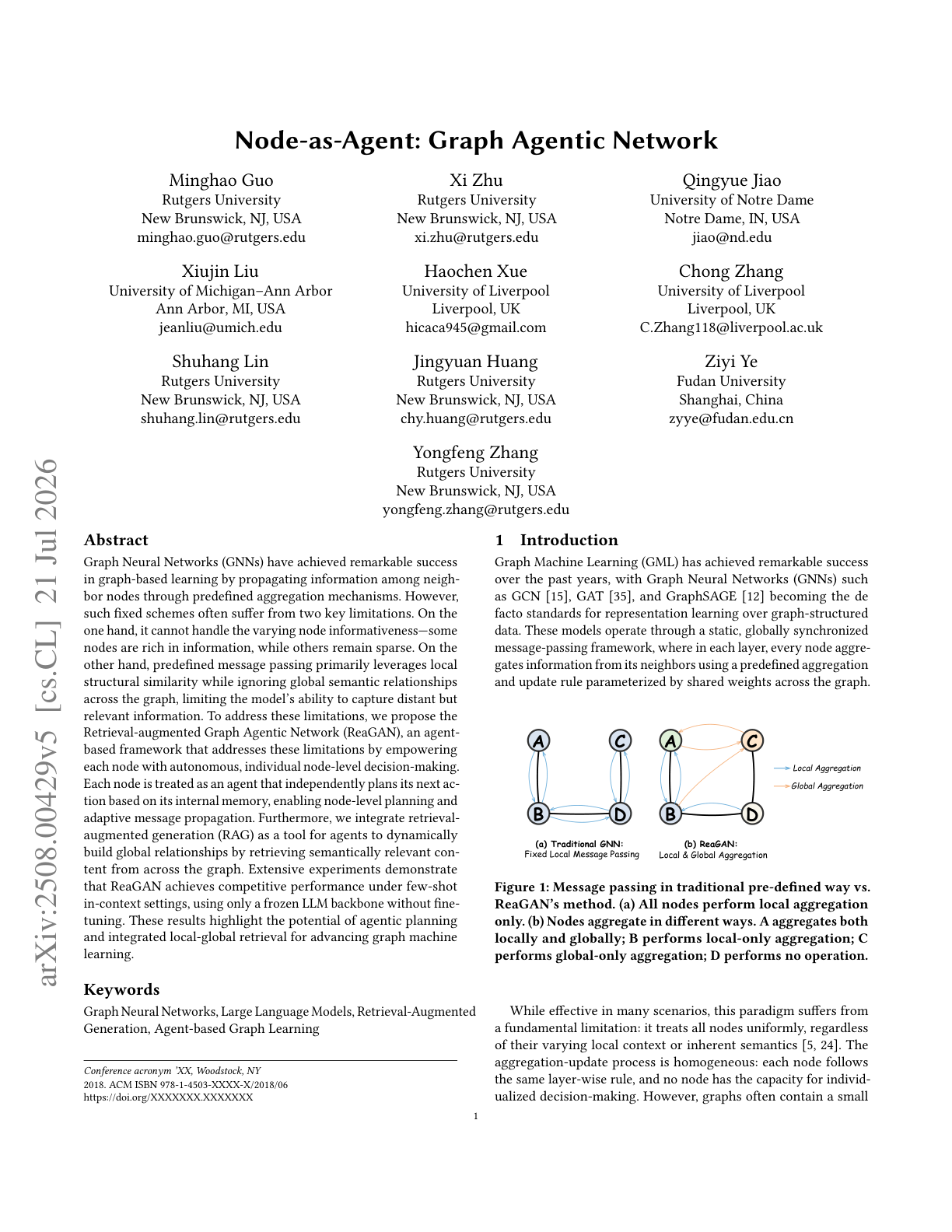
This paper introduces ReaGAN, a graph learning framework that reconceptualizes each node in a graph as an autonomous agent capable of planning, reasoning, and acting via a frozen LLM. Instead of relying on static, layer-wise message passing, ReaGAN enables node-level autonomy, where each node independently decides whether to aggregate information from local neighbors, retrieve semantically similar but distant nodes, or take no action at all. This node-agent abstraction addresses two key challenges in graph learning: (1) handling varying informativeness of nodes and (2) combining local structure with global semantics.
Ask this paper
Each node operates in a multi-step loop with four core modules: Memory, Planning, Action, and Tool Use (RAG). The node constructs a natural language prompt from its memory, queries a frozen LLM (e.g., Qwen2-14B) for the next action(s), executes them, and updates its memory accordingly.
The node’s action space includes Local Aggregation (structured neighbors), Global Aggregation (via retrieval), Prediction, and NoOp. The latter regulates over-aggregation and reflects the agent’s ability to opt out when sufficient context exists.
ReaGAN performs competitively on node classification tasks without any fine-tuning. On datasets like Cora and Chameleon, it matches or outperforms traditional GNNs despite using only a frozen LLM, highlighting the strength of structured prompting and retrieval-based reasoning.
Ablation studies show both the agentic planning mechanism and global semantic retrieval are essential. Removing either (e.g., forcing fixed action plans or disabling RAG) leads to significant accuracy drops, especially in sparse graphs like Citeseer.
Prompt design and memory strategy matter. Using both local and global context improves performance on dense graphs, while selective global use benefits sparse ones. Showing label names in prompts harms accuracy, likely due to LLM overfitting to label text rather than reasoning from examples.