RecreationWorld: Scalable and Verifiable Environments for Hybrid Computer-Use Agents
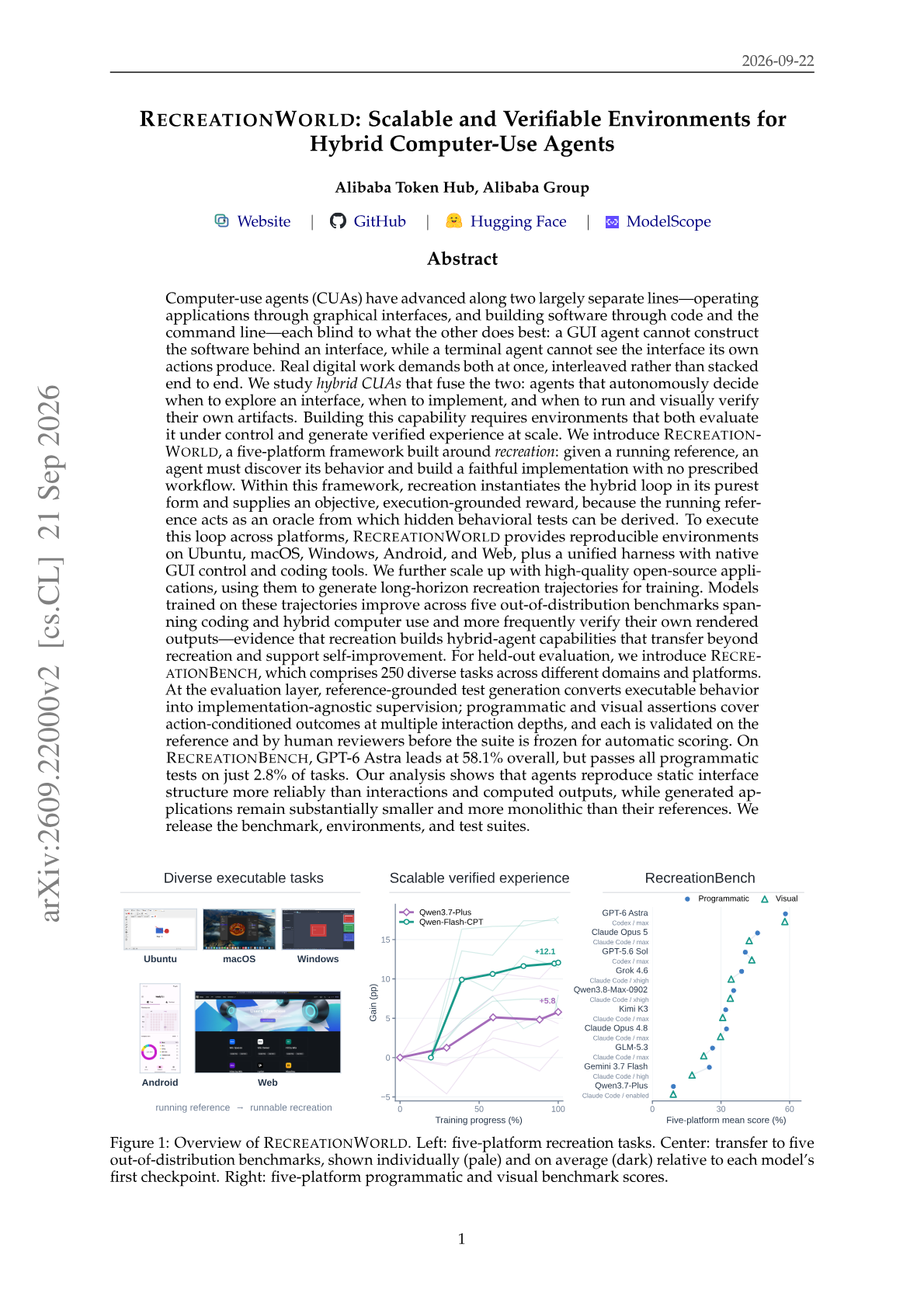
An Alibaba team introduces RecreationWorld, a five-platform environment where a hybrid computer-use agent must inspect a running reference application and build a faithful reimplementation, mixing GUI exploration, coding and visual verification with no fixed workflow.
Ask this paper
Environments. Reproducible setups on Ubuntu, macOS, Windows, Android and Web share one harness with native GUI control and coding tools.
Reference as oracle. The running reference supplies hidden behavioral tests, which gives execution-grounded rewards for trajectory generation.
Transfer. Models trained on generated trajectories improve on five out-of-distribution coding and hybrid computer-use benchmarks and verify their rendered output more often.
RecreationBench. 250 held-out tasks with human-validated programmatic and visual assertions; GPT-6 Astra leads at 58.1% overall but passes all programmatic tests on only 2.8% of tasks.
Abstract
Computer-use agents (CUAs) have advanced along two separate lines: graphical interaction and software development through code and the command line. Real digital work requires both, interleaved rather than stacked end to end. We study hybrid CUAs that autonomously decide when to explore an interface, implement software, and run and visually verify their artifacts. We introduce RecreationWorld, a five-platform framework built around recreation: given a running reference, an agent must discover its behavior and build a faithful implementation with no prescribed workflow. RecreationWorld provides reproducible environments on Ubuntu, macOS, Windows, Android, and Web, plus a unified harness with native GUI control and coding tools. The running reference serves as an oracle for hidden behavioral tests, providing execution-grounded rewards. We scale trajectory generation with high-quality open-source applications. Models trained on these trajectories improve across five out-of-distribution coding and hybrid computer-use benchmarks and more frequently verify their rendered outputs, providing evidence of transfer beyond recreation. For held-out evaluation, we introduce RecreationBench, comprising 250 diverse tasks across domains and platforms. Reference-grounded programmatic and visual assertions cover action-conditioned outcomes at multiple interaction depths; each is validated on the reference and by human reviewers before the suite is frozen for automatic scoring. GPT-6 Astra leads at 58.1% overall, but passes all programmatic tests on just 2.8% of tasks. Agents reproduce static interface structure more reliably than interactions and computed outputs, while generated applications remain smaller and more monolithic than their references. We release the benchmark, environments, and test suites.