Recurrent Looped Transformer
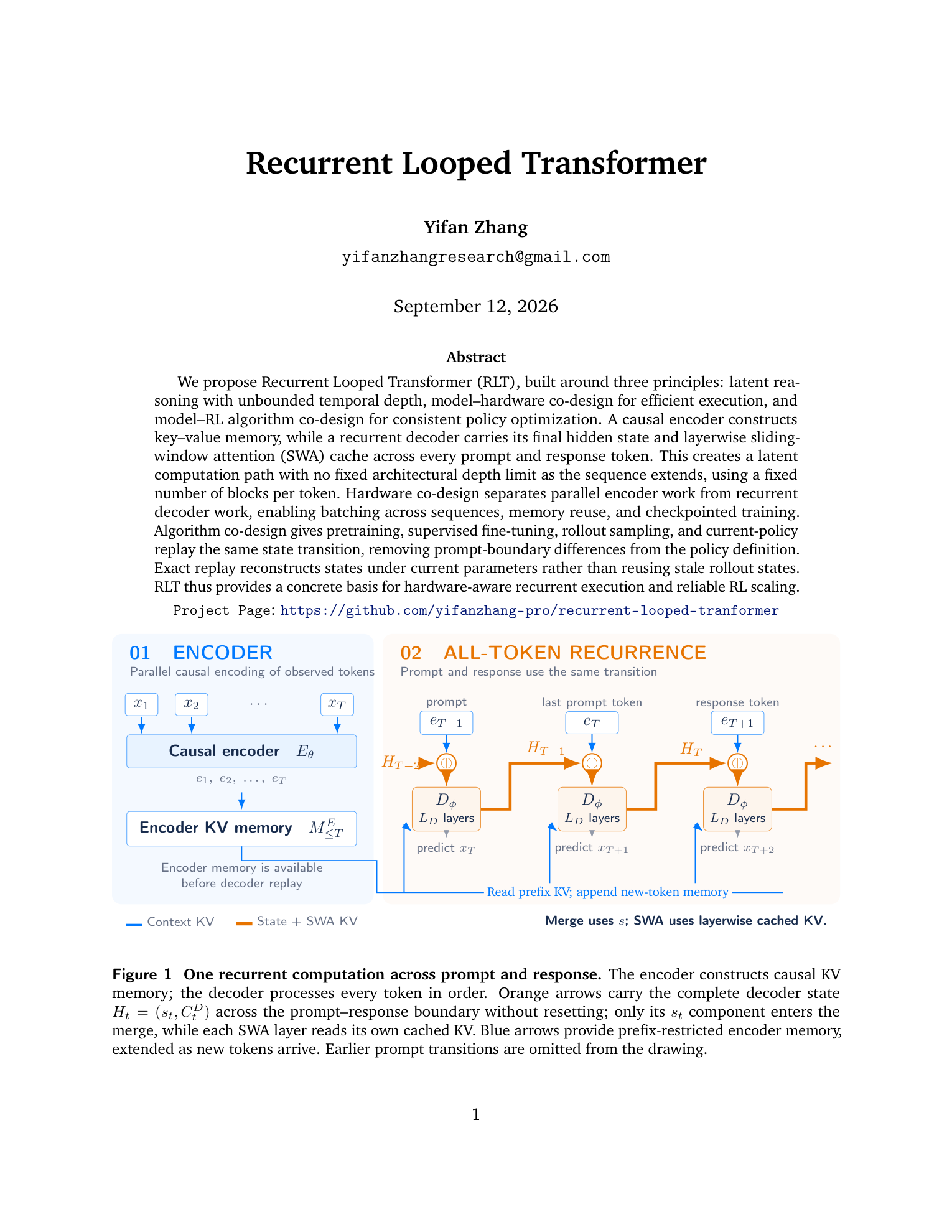
Yifan Zhang proposes the Recurrent Looped Transformer, in which a causal encoder builds global key-value memory and a recurrent decoder carries its final hidden state and sliding-window cache across every prompt and response token, so the depth of the computation path grows with sequence length while the number of blocks per token stays fixed. The report is a design specification and contains no experimental results.
Ask this paper
Architecture: For each token the decoder merges the token's encoder representation with its previous final output, cross-attends to encoder memory restricted to the prefix, and runs causal sliding-window attention over its own cached activations. The concrete configuration is 48 encoder and 48 decoder layers with compatible weights shared, which gives 96 logical block evaluations per token.
Unbounded temporal depth: After t tokens a state path passes through t times the decoder depth, so depth is not capped by the number of stored layers. The author notes that learning useful reasoning along this path is a separate question.
Hardware co-design: Encoder work runs as a parallel causal batch, and decoder transitions can be batched across independent sequences with weight and KV reuse and activation checkpointing. Full prompt recurrence remains sequential work.
RL co-design: Prefill, generation, pretraining, SFT and current-policy RL replay share one complete-state transition with no reset at the prompt-response boundary. Replay reconstructs states under the current weights, and behavior log-probabilities stay tied to the sampler that produced the actions.
Status: The report states that reasoning improvements, hardware speedups and RL scaling are research goals, and it reports no measurements.
Abstract
We propose Recurrent Looped Transformer (RLT), built around three principles: latent reasoning with unbounded temporal depth, model–hardware co-design for efficient execution, and model–RL algorithm co-design for consistent policy optimization. A causal encoder constructs key–value memory, while a recurrent decoder carries its final hidden state and layerwise sliding-window attention (SWA) cache across every prompt and response token. This creates a latent computation path with no fixed architectural depth limit as the sequence extends, using a fixed number of blocks per token. Hardware co-design separates parallel encoder work from recurrent decoder work, enabling batching across sequences, memory reuse, and checkpointed training. Algorithm co-design gives pretraining, supervised fine-tuning, rollout sampling, and current-policy replay the same state transition, removing prompt-boundary differences from the policy definition. Exact replay reconstructs states under current parameters rather than reusing stale rollout states. RLT thus provides a concrete basis for hardware-aware recurrent execution and reliable RL scaling.