Recursive Collective Intelligence: Emergence on an Equal-Budget Ladder in Multi-Agent LLM Systems
Lixuan He and colleagues at Stanford, including Li Fei-Fei, Leonidas Guibas, Gordon Wetzstein and Yejin Choi, propose an equal-budget ladder for judging multi-agent LLM groups and show that groups can train their own next generation without labels.
Ask this paper
Equal-budget ladder. A group is graded against a single agent, a compute-matched majority vote and compute-matched pass@n. A plain vote over independent answers already explains most reported team gains.
When interaction helps. Interaction beats pass@n only when it moves facts that no single agent holds. Forwarding split facts lifts groups above pass@n at three model scales, by about a third at 27B.
Self-organization. Identical 27B agents form hubs and gain 18 points. Writing that organization into a prompt reaches the top level of the ladder at less than half the token budget, in a descriptive comparison.
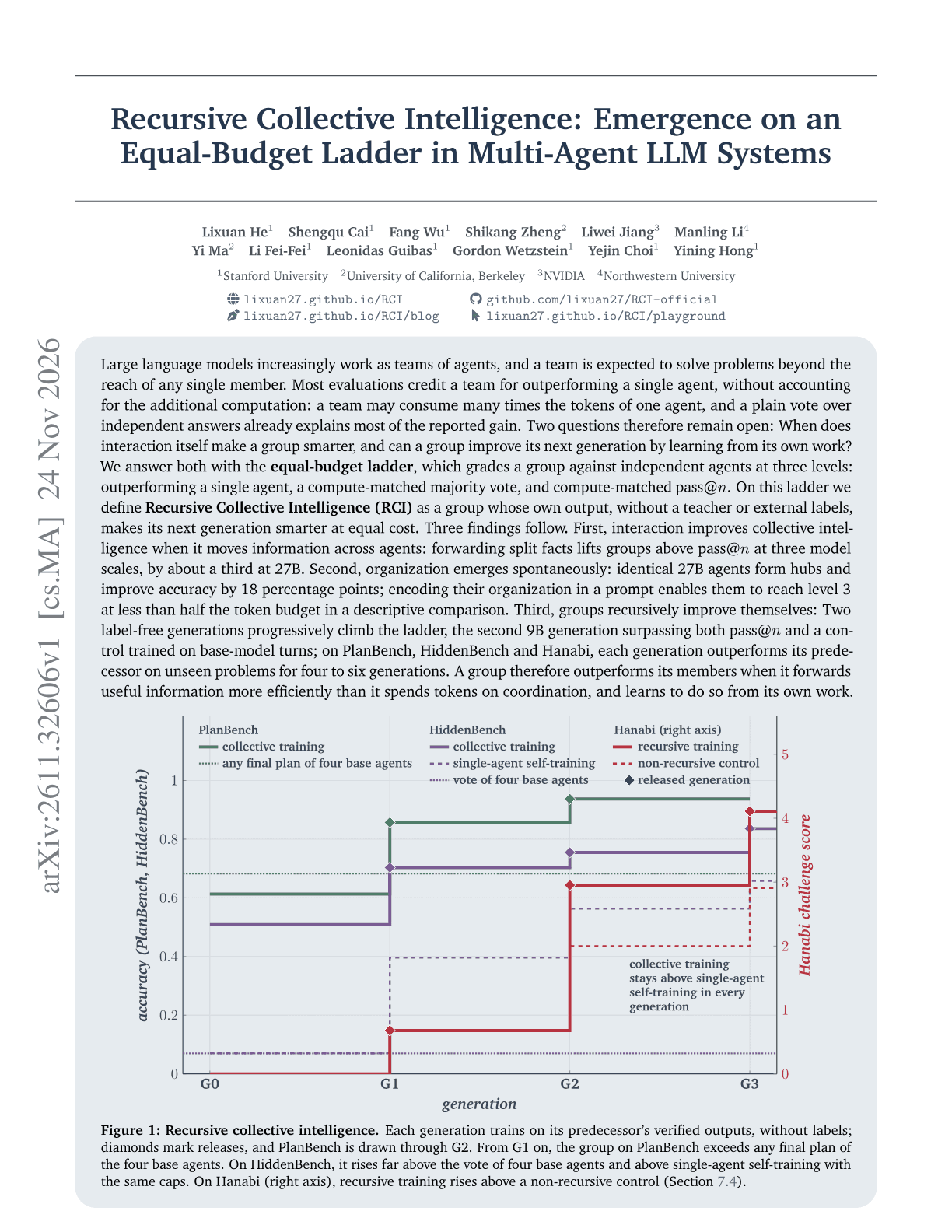
Recursive improvement. Each generation trains on its predecessor's verified outputs. The second 9B generation beats pass@n and a control trained on base-model turns, and on PlanBench, HiddenBench and Hanabi each generation beats its predecessor on unseen problems for four to six generations, with gains narrowing over time.
Abstract
Large language models increasingly work as teams of agents, and a team is expected to solve problems beyond the reach of any single member. Most evaluations credit a team for outperforming a single agent, without accounting for the additional computation: a team may consume many times the tokens of one agent, and a plain vote over independent answers already explains most of the reported gain. Two questions therefore remain open: When does interaction itself make a group smarter, and can a group improve its next generation by learning from its own work? We answer both with the equal-budget ladder, which grades a group against independent agents at three levels: outperforming a single agent, a compute-matched majority vote, and compute-matched pass@n. On this ladder we define Recursive Collective Intelligence (RCI) as a group whose own output, without a teacher or external labels, makes its next generation smarter at equal cost. Three findings follow. First, interaction improves collective intelligence when it moves information across agents: forwarding split facts lifts groups above pass@n at three model scales, by about a third at 27B. Second, organization emerges spontaneously: identical 27B agents form hubs and improve accuracy by 18 percentage points; encoding their organization in a prompt enables them to reach level 3 at less than half the token budget in a descriptive comparison. Third, groups recursively improve themselves: Two label-free generations progressively climb the ladder, the second 9B generation surpassing both pass@$n$ and a control trained on base-model turns; on PlanBench, HiddenBench and Hanabi, each generation outperforms its predecessor on unseen problems for four to six generations. A group therefore outperforms its members when it forwards useful information more efficiently than it spends tokens on coordination, and learns to do so from its own work.