Recursive Reasoning or Statistical Extrapolation? In-Context Learning in Multi-Agent Interdependent Decision-Making
Yu Liu, Wenwen Li, Yifan Dou and Guangnan Ye (Fudan University) test whether LLM agents that improve with interaction history in a public goods game are reasoning about other players or extrapolating statistical patterns from past outcomes.
Ask this paper
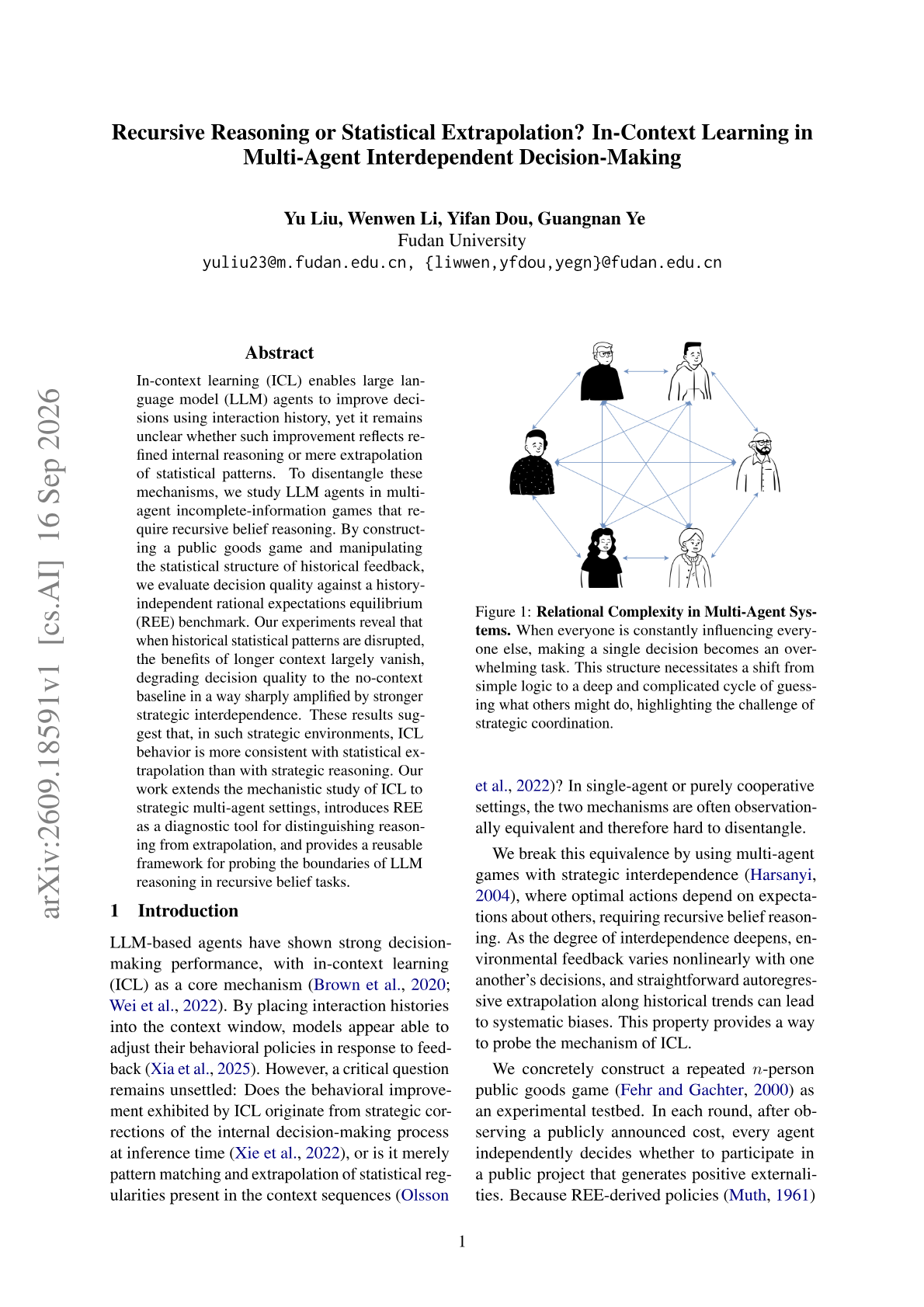
Setup. Agents play a multi-agent incomplete-information public goods game that requires recursive belief reasoning, and the authors manipulate the statistical structure of the feedback history.
Diagnostic. Decisions are scored against a history-independent rational expectations equilibrium, which a reasoning agent could reach without relying on the history's statistics.
Main result. When the historical patterns are disrupted, the benefit of longer context mostly disappears and decision quality falls to the no-context baseline.
Interdependence amplifies it. The drop is sharper when strategic interdependence between players is stronger.
Implication. In these strategic settings, in-context improvement behaves like statistical extrapolation, so gains from longer histories should not be read as evidence of strategic reasoning.
Abstract
In-context learning (ICL) enables large language model (LLM) agents to improve decisions using interaction history, yet it remains unclear whether such improvement reflects refined internal reasoning or mere extrapolation of statistical patterns. To disentangle these mechanisms, we study LLM agents in multi-agent incomplete-information games that require recursive belief reasoning. By constructing a public goods game and manipulating the statistical structure of historical feedback, we evaluate decision quality against a history-independent rational expectations equilibrium (REE) benchmark. Our experiments reveal that when historical statistical patterns are disrupted, the benefits of longer context largely vanish, degrading decision quality to the no-context baseline in a way sharply amplified by stronger strategic interdependence. These results suggest that, in such strategic environments, ICL behavior is more consistent with statistical extrapolation than with strategic reasoning. Our work extends the mechanistic study of ICL to strategic multi-agent settings, introduces REE as a diagnostic tool for distinguishing reasoning from extrapolation, and provides a reusable framework for probing the boundaries of LLM reasoning in recursive belief tasks.