ReFT (Reinforced Fine-Tuning)
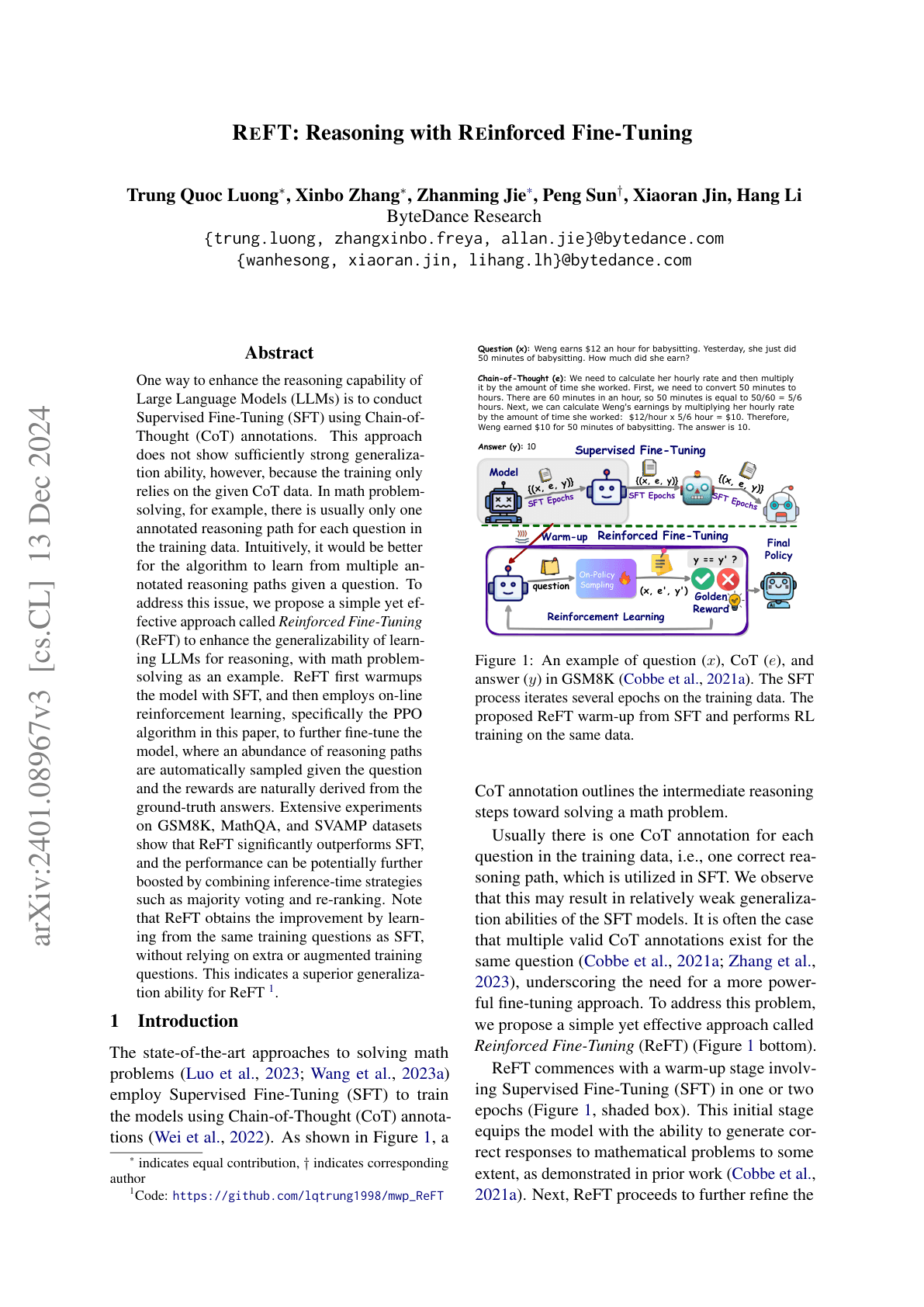
ByteDance's ReFT enhances LLM reasoning by combining supervised fine-tuning with online RL that samples alternative reasoning paths, without a learned reward model.
Ask this paper
Two-stage recipe: Standard SFT gives the model a reasonable starting policy; an online RL phase then refines it by sampling reasoning paths and rewarding those that yield correct final answers.
No reward model needed: Unlike RLHF, ReFT uses the ground-truth answer itself as the reward signal, avoiding the cost and instability of training a separate reward model.
Math problem-solving wins: Strong gains on GSM8K and MATH, with better out-of-distribution generalization than pure SFT at the same compute.
Simple conceptual lesson: The paper is an early demonstration that online RL from verifiable signals can outperform supervised recipes on reasoning - a theme that would dominate the subsequent year's research.
Abstract
One way to enhance the reasoning capability of Large Language Models (LLMs) is to conduct Supervised Fine-Tuning (SFT) using Chain-of-Thought (CoT) annotations. This approach does not show sufficiently strong generalization ability, however, because the training only relies on the given CoT data. In math problem-solving, for example, there is usually only one annotated reasoning path for each question in the training data. Intuitively, it would be better for the algorithm to learn from multiple annotated reasoning paths given a question. To address this issue, we propose a simple yet effective approach called Reinforced Fine-Tuning (ReFT) to enhance the generalizability of learning LLMs for reasoning, with math problem-solving as an example. ReFT first warmups the model with SFT, and then employs on-line reinforcement learning, specifically the PPO algorithm in this paper, to further fine-tune the model, where an abundance of reasoning paths are automatically sampled given the question and the rewards are naturally derived from the ground-truth answers. Extensive experiments on GSM8K, MathQA, and SVAMP datasets show that ReFT significantly outperforms SFT, and the performance can be potentially further boosted by combining inference-time strategies such as majority voting and re-ranking. Note that ReFT obtains the improvement by learning from the same training questions as SFT, without relying on extra or augmented training questions. This indicates a superior generalization ability for ReFT.