Reinforcement-Learned Teachers of Test Time Scaling
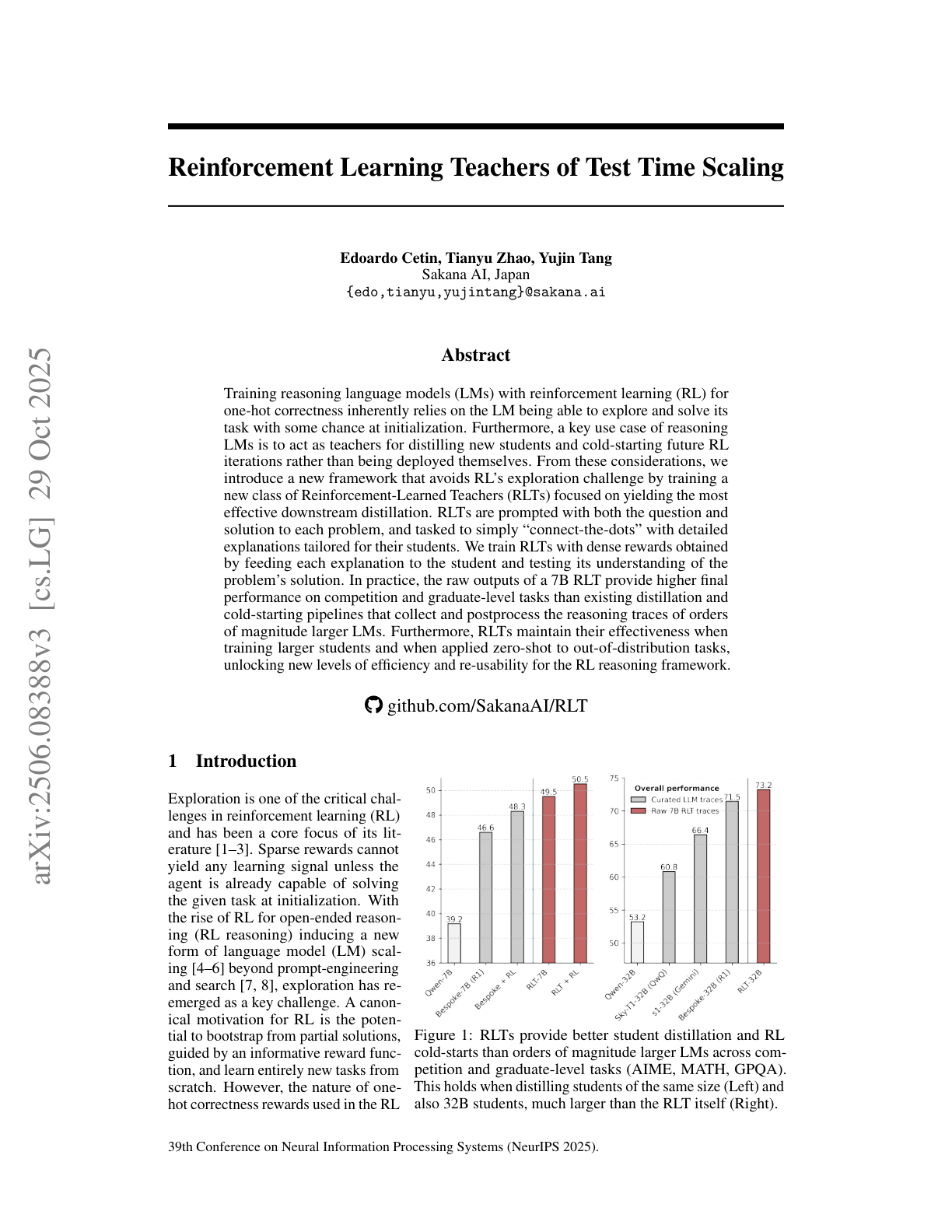
Introduces Reinforcement-Learned Teachers (RLTs), small, efficient LMs trained with RL not to solve problems from scratch, but to generate high-quality explanations that help downstream student models learn better. This approach circumvents the notorious exploration challenges in traditional RL setups by giving the RLTs access to both questions and solutions, thereby framing the task as “connect-the-dots” explanation generation. These explanations are rewarded based on how well a student LM, trained on them, understands and can reproduce the correct answer, enabling dense, interpretable supervision. Key contributions and findings:
Ask this paper
New teacher-training paradigm: RLTs are trained to explain, not solve. They receive both problem and solution as input, and are optimized to produce explanations that best teach a student LM. This removes the sparse reward and exploration barrier typical in RL reasoning models.
Dense RL rewards for teaching: RLTs use two core reward terms: one measuring if the student can reproduce the correct solution given the explanation, and another ensuring the explanation appears logically sound from the student’s perspective. These combined objectives lead to richer, more instructive traces.
Outperforms much larger pipelines: Despite being only 7B in size, RLTs produce raw explanations that outperform distillation pipelines using 32B+ LMs (e.g. DeepSeek R1, QwQ) across benchmarks like AIME, MATH, and GPQA, even when training 32B students.
Generalizes out-of-distribution: RLTs can be transferred zero-shot to new domains (like the countdown arithmetic game), producing distillation datasets that yield better students than direct RL trained with access to task rewards.
Efficient and scalable: Training RLTs is computationally lightweight (125 steps, 1 epoch) and requires no postprocessing or verifiers, making the framework more reproducible and accessible compared to prior RL pipelines.