Remember and Reweight: Enhancing Multi-Agent Debate with Experience Memory and Confidence Estimation
Xuanfa Jin and colleagues at CASIA and UCL attack the shared-misconception failure in multi-agent debate with R2-MAD, giving debating agents an experience memory from past debates plus per-agent confidence weights.
Ask this paper
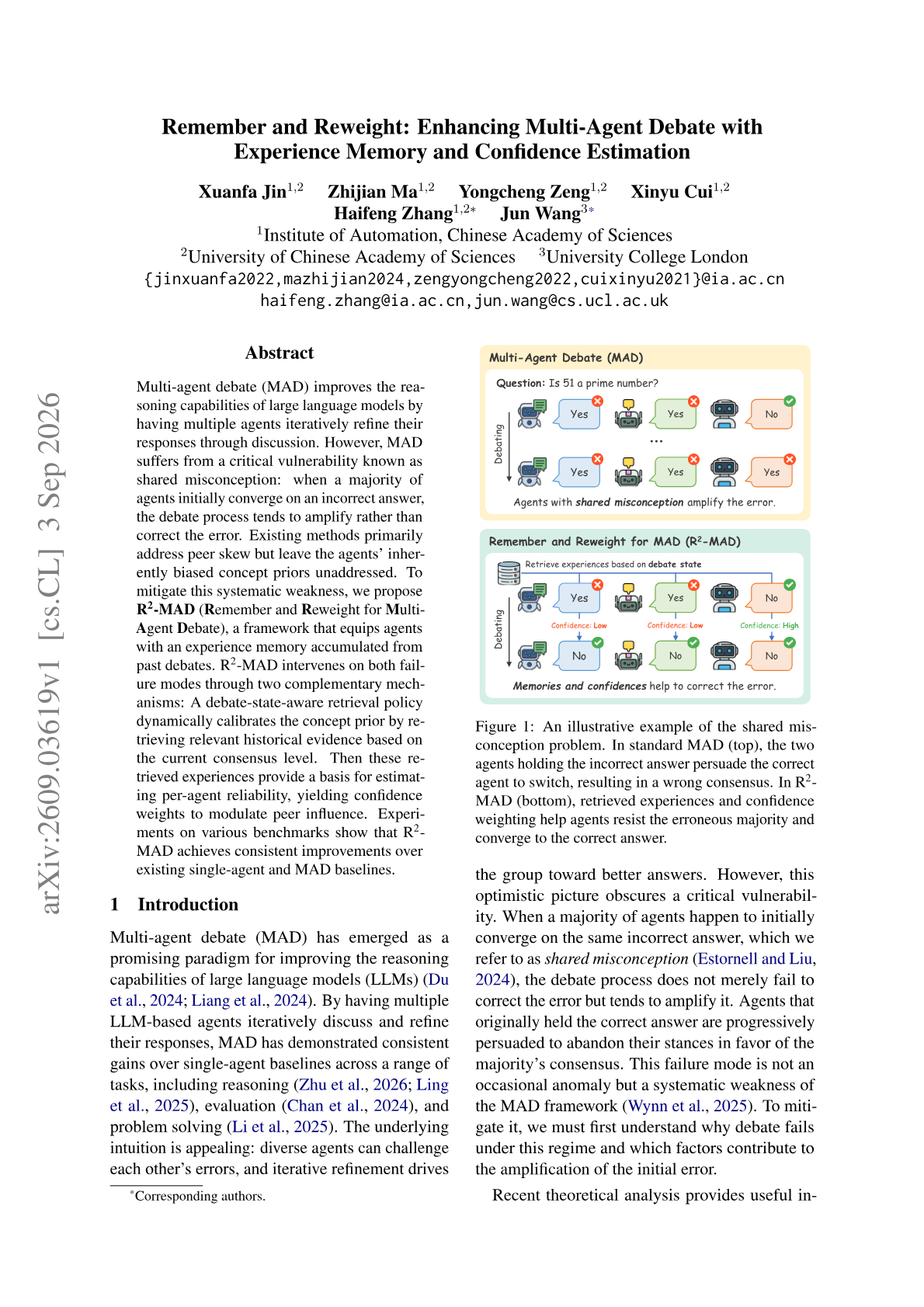
Debate amplifies rather than corrects: when a majority of agents start on the same wrong answer, iterative discussion entrenches it. Prior fixes address peer skew but leave each agent's biased concept prior untouched.
Two coupled interventions: a debate-state-aware retrieval policy that calibrates the concept prior using historical evidence keyed to the current consensus level, and reliability estimates from those experiences that reweight peer influence.
Consensus level as a retrieval signal: retrieval is conditioned on how converged the debate already is, so memory is pulled hardest exactly when groupthink risk peaks.
Consistent gains over single-agent and MAD baselines across the evaluated benchmark set.
Why it matters: multi-agent debate is widely deployed and fails on correlated priors. Memory-of-past-debates is a cheap structural fix rather than another prompt.
Abstract
Multi-agent debate (MAD) improves the reasoning capabilities of large language models by having multiple agents iteratively refine their responses through discussion. However, MAD suffers from a critical vulnerability known as shared misconception: when a majority of agents initially converge on an incorrect answer, the debate process tends to amplify rather than correct the error. Existing methods primarily address peer skew but leave the agents' inherently biased concept priors unaddressed. To mitigate this systematic weakness, we propose R$^2$-MAD (Remember and Reweight for Multi-Agent Debate), a framework that equips agents with an experience memory accumulated from past debates. R$^2$-MAD intervenes on both failure modes through two complementary mechanisms: A debate-state-aware retrieval policy dynamically calibrates the concept prior by retrieving relevant historical evidence based on the current consensus level. Then these retrieved experiences provide a basis for estimating per-agent reliability, yielding confidence weights to modulate peer influence. Experiments on various benchmarks show that R$^2$-MAD achieves consistent improvements over existing single-agent and MAD baselines.