ReOPD
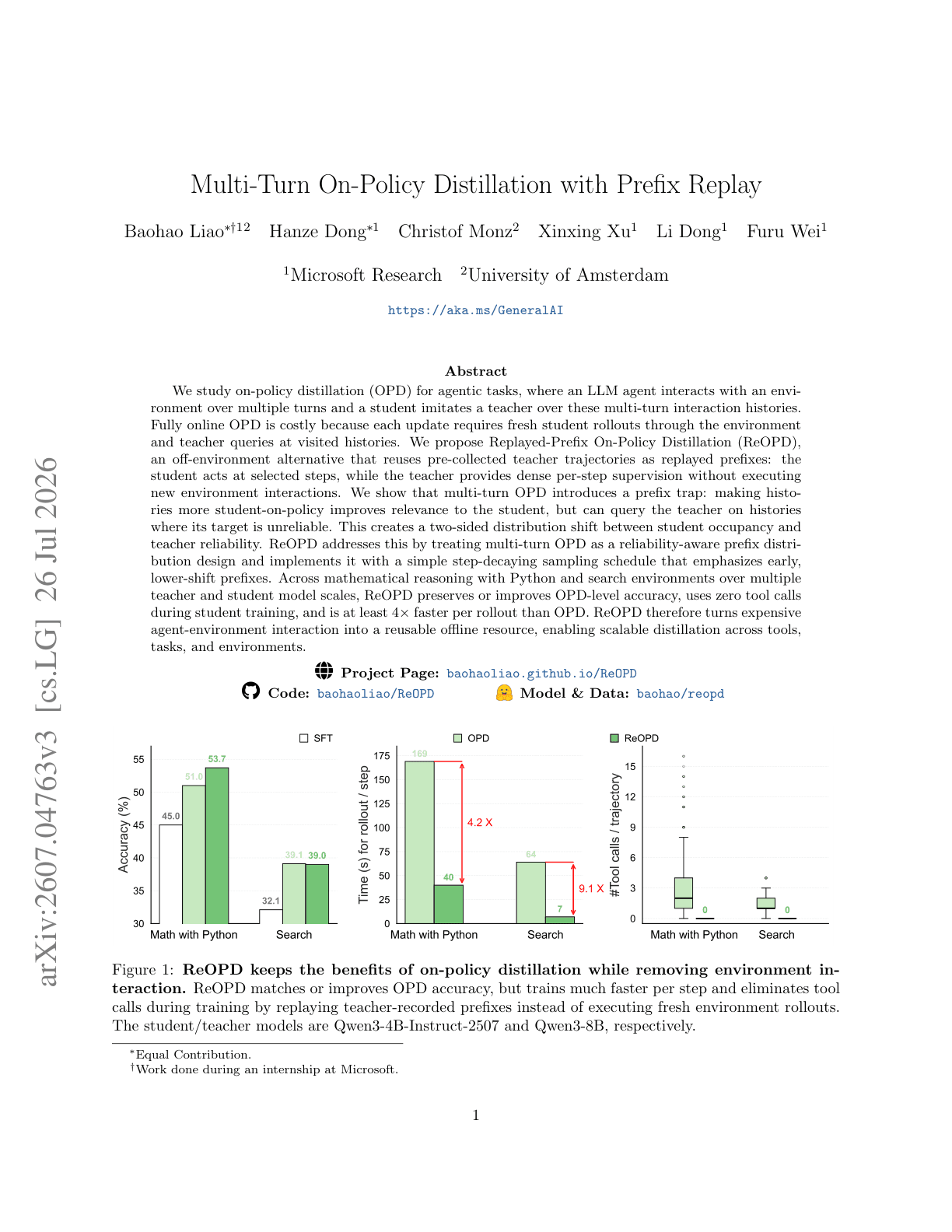
On-policy distillation for agentic tasks is expensive because every update needs fresh student rollouts through the environment plus teacher queries at each visited history. Microsoft Research and the University of Amsterdam propose reusing pre-collected teacher trajectories instead.
Ask this paper
Replayed prefixes: ReOPD samples a teacher trajectory, replays it as a prefix, has the student act at selected steps, and lets the teacher supply dense per-step supervision, with no new environment interaction during student training.
The prefix trap: The paper names a real pathology in multi-turn distillation. Pushing histories toward the student's own distribution makes them more relevant to the student and simultaneously drags the teacher onto states where its targets are unreliable, a two-sided shift between student occupancy and teacher reliability.
A simple control: Treating this as reliability-aware prefix distribution design, ReOPD uses a step-decaying sampling schedule that emphasizes early, lower-shift prefixes rather than trying to match the student everywhere.
Why it matters: Across math reasoning with Python and search environments, over multiple teacher and student scales, it preserves or improves accuracy, uses zero tool calls during student training, and runs at least 4 times faster per rollout, turning agent-environment interaction into a reusable offline asset.
Abstract
We study on-policy distillation (OPD) for agentic tasks, where an LLM agent interacts with an environment over multiple turns and a student imitates a teacher over these multi-turn interaction histories. Fully online OPD is costly because each update requires fresh student rollouts through the environment and teacher queries at visited histories. We propose Replayed-Prefix On-Policy Distillation (ReOPD), an off-environment alternative that reuses pre-collected teacher trajectories as replayed prefixes: the student acts at selected steps, while the teacher provides dense per-step supervision without executing new environment interactions. We show that multi-turn OPD introduces a prefix trap: making histories more student-on-policy improves relevance to the student, but can query the teacher on histories where its target is unreliable. This creates a two-sided distribution shift between student occupancy and teacher reliability. ReOPD addresses this by treating multi-turn OPD as a reliability-aware prefix distribution design and implements it with a simple step-decaying sampling schedule that emphasizes early, lower-shift prefixes. Across mathematical reasoning with Python and search environments over multiple teacher and student model scales, ReOPD preserves or improves OPD-level accuracy, uses zero tool calls during student training, and is at least 4$\times$ faster per rollout than OPD. ReOPD therefore turns expensive agent-environment interaction into a reusable offline resource, enabling scalable distillation across tools, tasks, and environments.