Repairs for Whom? Evaluator-Executor Mismatch in Selecting Repairs for Failed LLM Agents
Yijun Liao (independent researcher) and Fanwei Liang (South China University of Technology) measure how much deployment value agent repair methods lose when candidate repairs are scored by an evaluator other than the deployed agent.
Ask this paper
Greedy replay. On failures not screened for repair value, greedy replay loses 0.08-0.13 in expected net success gain on ALFWorld and 0.06-0.13 in net reward on WebShop.
Stronger model. Selecting repairs for Qwen2.5-7B with Qwen2.5-14B rollouts loses 0.25 on ALFWorld and 0.07 on WebShop at an equal rollout budget.
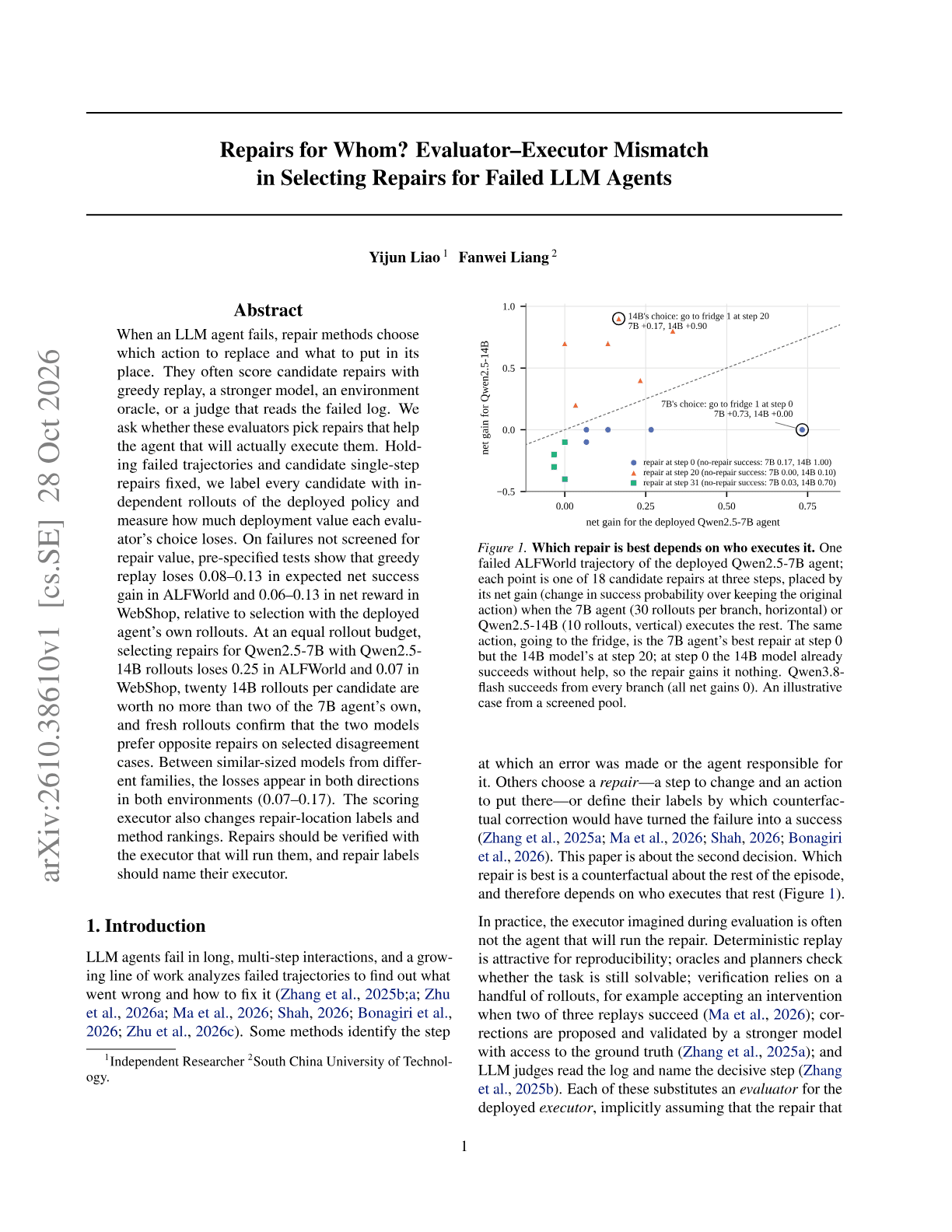
Rollout value. Twenty 14B rollouts per candidate are worth no more than two of the 7B agent's own, and on selected disagreement cases the two models prefer opposite repairs.
Cross-family. Between similar-sized models from different families, losses of 0.07-0.17 appear in both directions in both environments.
Scope. The study covers two open 7-8B deployed agents, three text environments and single-step repairs within fixed candidate sets.
Abstract
When an LLM agent fails, repair methods choose which action to replace and what to put in its place. They often score candidate repairs with greedy replay, a stronger model, an environment oracle, or a judge that reads the failed log. We ask whether these evaluators pick repairs that help the agent that will actually execute them. Holding failed trajectories and candidate single-step repairs fixed, we label every candidate with independent rollouts of the deployed policy and measure how much deployment value each evaluator's choice loses. On failures not screened for repair value, pre-specified tests show that greedy replay loses 0.08-0.13 in expected net success gain in ALFWorld and 0.06-0.13 in net reward in WebShop, relative to selection with the deployed agent's own rollouts. At an equal rollout budget, selecting repairs for Qwen2.5-7B with Qwen2.5-14B rollouts loses 0.25 in ALFWorld and 0.07 in WebShop, twenty 14B rollouts per candidate are worth no more than two of the 7B agent's own, and fresh rollouts confirm that the two models prefer opposite repairs on selected disagreement cases. Between similar-sized models from different families, the losses appear in both directions in both environments (0.07-0.17). The scoring executor also changes repair-location labels and method rankings. Repairs should be verified with the executor that will run them, and repair labels should name their executor.