Rethinking On-Policy Distillation of Large Language Models II: One Training Example
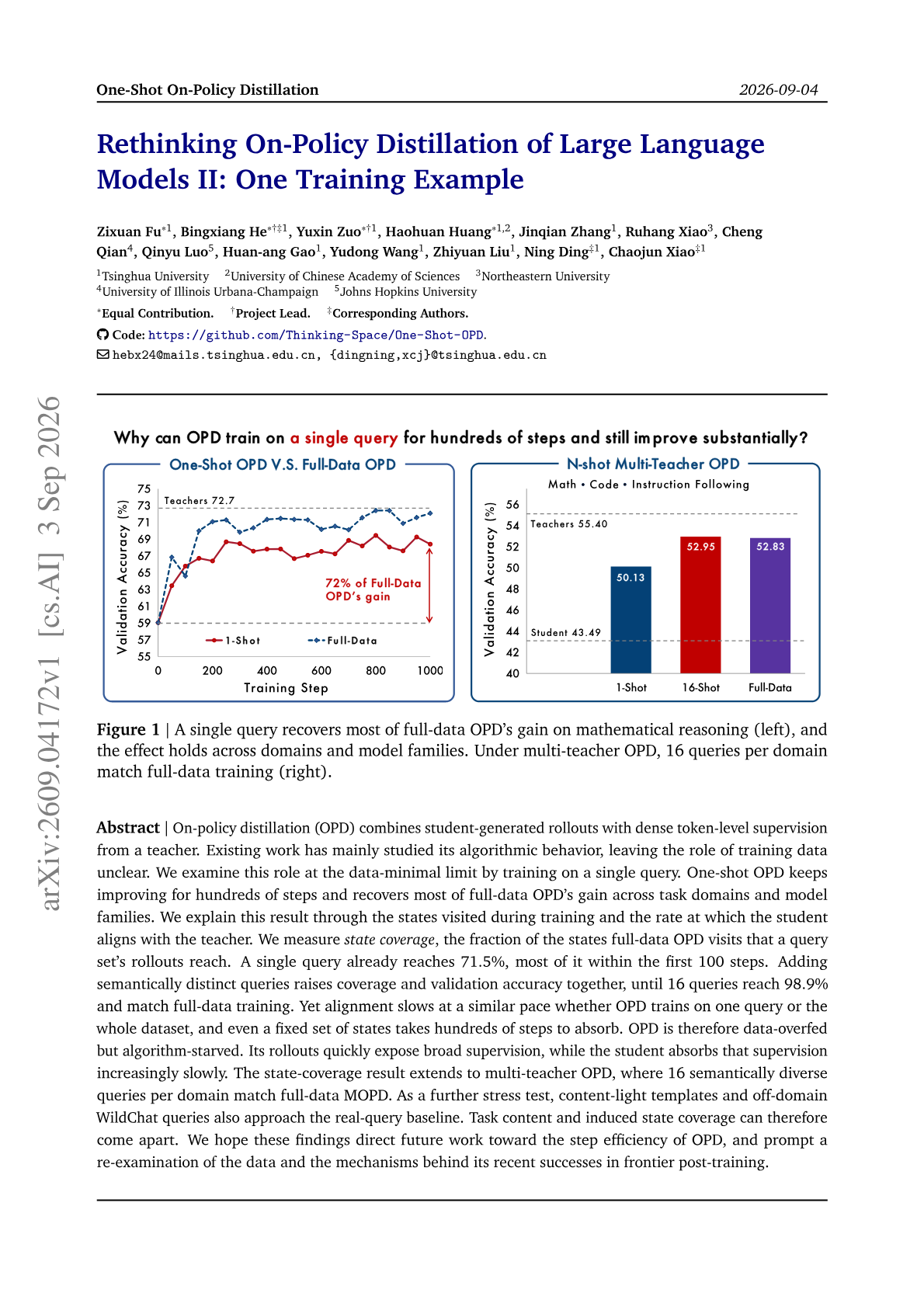
Zixuan Fu and colleagues at Tsinghua push on-policy distillation to the data-minimal limit by training on a single query, and find it recovers most of full-data OPD's gain, which reframes what OPD is actually short of.
Ask this paper
One query gets 71.5% state coverage: the fraction of states full-data OPD visits that a single query's rollouts also reach, most of it within the first 100 steps.
16 semantically distinct queries match full data: coverage rises to 98.9% and validation accuracy tracks it, giving a concrete number for how much data OPD actually needs.
Data-overfed but algorithm-starved: alignment slows at a similar rate whether training on one query or the whole dataset, and even a fixed set of states takes hundreds of steps to absorb.
The result generalizes past real data: it extends to multi-teacher OPD at 16 queries per domain, and content-light templates plus off-domain WildChat queries also approach the real-query baseline, so task content and induced state coverage come apart.
Why it matters: it redirects effort from curating distillation data to improving OPD's step efficiency, and invites a re-examination of what recent frontier post-training successes are actually attributable to.
Abstract
On-policy distillation (OPD) combines student-generated rollouts with dense token-level supervision from a teacher. Existing work has mainly studied its algorithmic behavior, leaving the role of training data unclear. We examine this role at the data-minimal limit by training on a single query. One-shot OPD keeps improving for hundreds of steps and recovers most of full-data OPD's gain across task domains and model families. We explain this result through the states visited during training and the rate at which the student aligns with the teacher. We measure \emph{state coverage}, the fraction of the states full-data OPD visits that a query set's rollouts reach. A single query already reaches \(71.5\%\), most of it within the first 100 steps. Adding semantically distinct queries raises coverage and validation accuracy together, until 16 queries reach \(98.9\%\) and match full-data training. Yet alignment slows at a similar pace whether OPD trains on one query or the whole dataset, and even a fixed set of states takes hundreds of steps to absorb. OPD is therefore data-overfed but algorithm-starved. Its rollouts quickly expose broad supervision, while the student absorbs that supervision increasingly slowly. The state-coverage result extends to multi-teacher OPD, where 16 semantically diverse queries per domain match full-data MOPD. As a further stress test, content-light templates and off-domain WildChat queries also approach the real-query baseline. Task content and induced state coverage can therefore come apart. We hope these findings direct future work toward the step efficiency of OPD, and prompt a re-examination of the data and the mechanisms behind its recent successes in frontier post-training.