Retrieval-Augmented Reasoning Model
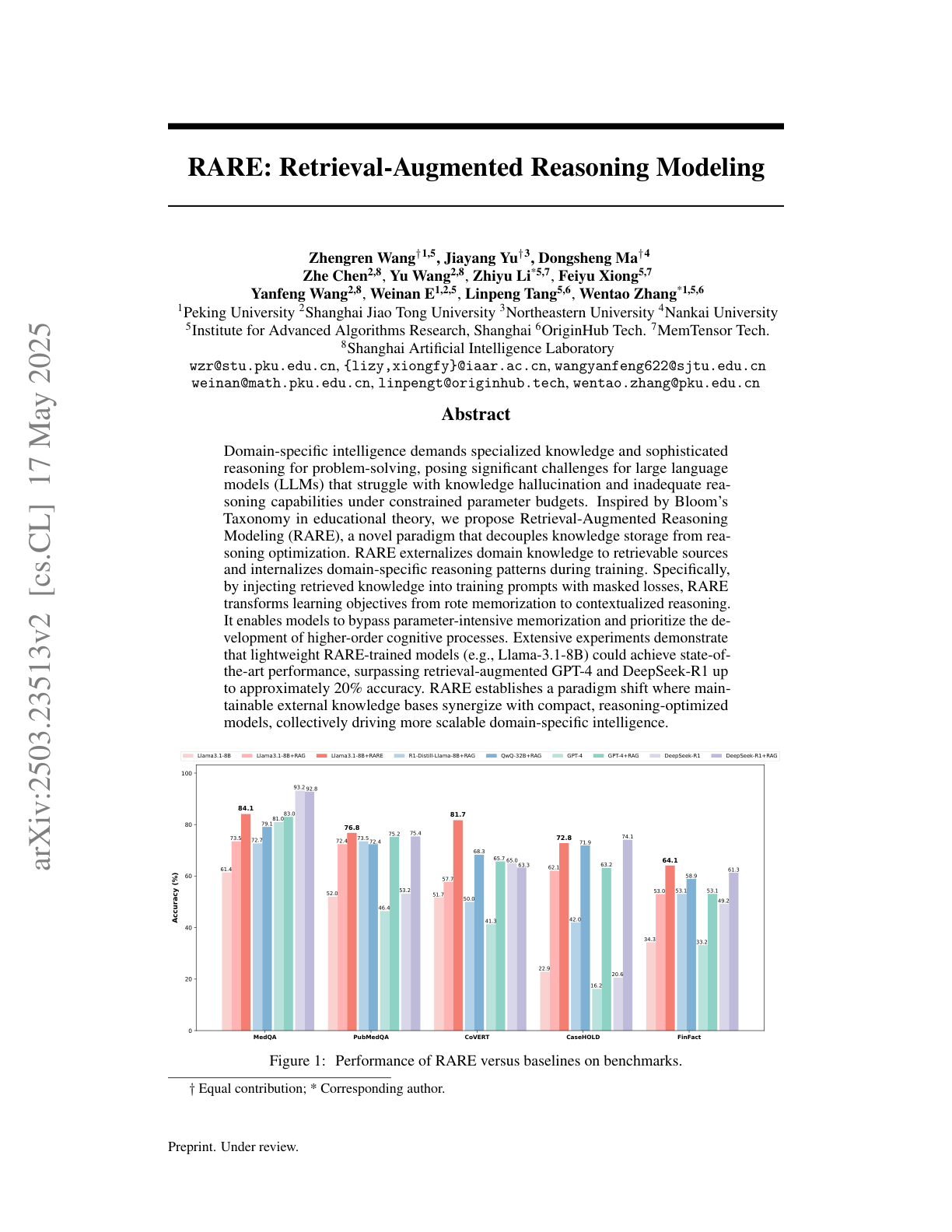
Introduces RARE, a new paradigm for training domain-specific LLMs that focuses on reasoning, not memorization. Key ideas: ● Inspired by Bloom’s Taxonomy – RARE shifts LLM training from memorizing knowledge (“Remember”) to applying and evaluating it (“Analyze”, “Create”). It separates domain knowledge (retrieved externally) from domain thinking (learned during training), enabling better performance under tight parameter budgets. ● Open-book prepared training – RARE injects retrieved knowledge into training prompts, letting models learn reasoning patterns instead of rote facts. This open-book, reasoning-first setup beats both standard SFT and RAG approaches, especially in medicine. ● Massive accuracy gains with small models – On five medical QA benchmarks, RARE-trained Llama-3.1-8B and Qwen-2.5-7B outperformed GPT-4 + RAG, with up to +20% accuracy boosts (e.g., PubMedQA: 78.63% vs. GPT-4’s 75.2%, CoVERT: 74.14% vs. GPT-4’s 65.67%). ● Training via distillation + adaptive retries – RARE distills answers (and reasoning paths) from a strong teacher (e.g., QwQ-32B), refining outputs until a correct answer is found. This creates a high-quality dataset that teaches contextualized, case-based thinking. ● New role for retrieval – Unlike standard RAG (used only at inference), RARE uses retrieval during training to shape reasoning. It models knowledge integration (p(kx, R(x))) and reasoning (p(rx, R(x), k)) as separate steps, replacing memorization with application. Overall, this work reframes LLM training for domain-specific intelligence: externalize facts, internalize reasoning. It unlocks strong performance from small models without overfitting or hallucination.